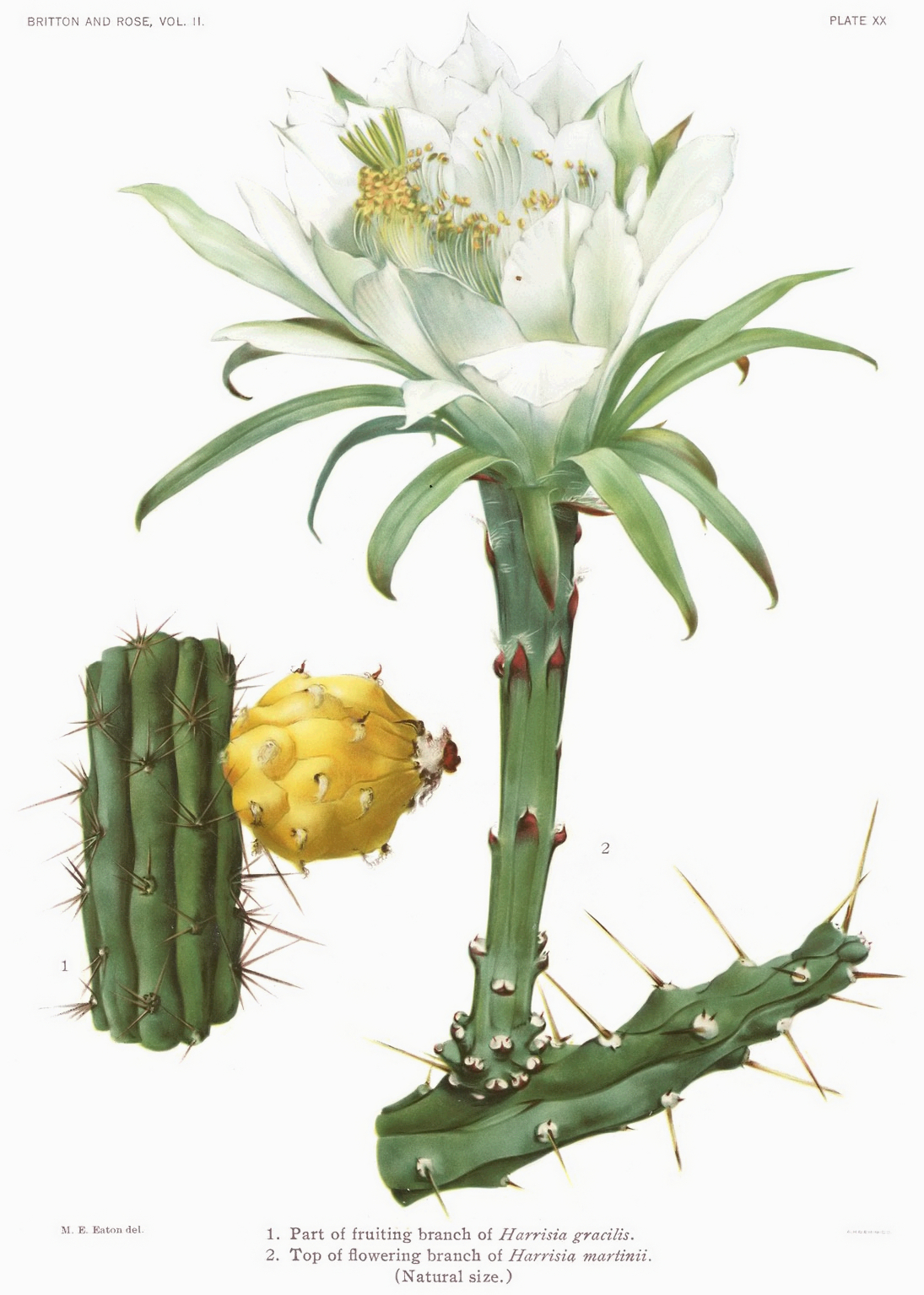
Harrisia is a genus of approximately 20 species of cacti in the family Cactaceae (order Caryophyllales), commonly known as applecactus and moonlight cactus. The genus was established by the American botanist Nathaniel Lord Britton in 1909, and is named in honour of William Harris, a prominent botanist associated with Jamaica.
Plants in this genus are tree-shaped, occasionally climbing or shrub-like, and grow on cylindrical shoots that bear four to twelve longitudinal ribs. They do not produce aerial roots, and can reach heights of up to 7 metres. Harrisia species are celebrated for their large, night-blooming white flowers, which may reach 12 cm in diameter and open after dark. Following pollination, the plants produce rounded fruits that ripen to red or orange; the fruits bear scales with areoles in the axils, and contain black seeds measuring 2–3 × 1.5 mm.
The genus is native to South America (Argentina, Paraguay, Brazil, Bolivia, and Uruguay), the Caribbean (Greater Antilles and Bahamas), and the U.S. state of Florida. Several species have become invasive outside their native range, particularly in Queensland and New South Wales in Australia, parts of Africa, and Hawaii.
Etymology
The genus name Harrisia honours William Harris, a botanist of Jamaica who made significant contributions to the study of Caribbean flora. The genus was formally described by Nathaniel Lord Britton in 1909.
Distribution
Harrisia is native to South America (Argentina, Paraguay, Brazil, Bolivia, Uruguay), the Greater Antilles, the Bahamas, and Florida. Several species have naturalised beyond their native range and are considered invasive in parts of Australia (Queensland and New South Wales), Africa, and Hawaii.
Taxonomy Notes
Harrisia was established by Nathaniel Lord Britton in 1909 and belongs to the family Cactaceae within the order Caryophyllales. Plants of the World Online recognises approximately 20 species, divided into two subgenera. GBIF lists the genus as accepted with family Cactaceae and order Caryophyllales.

