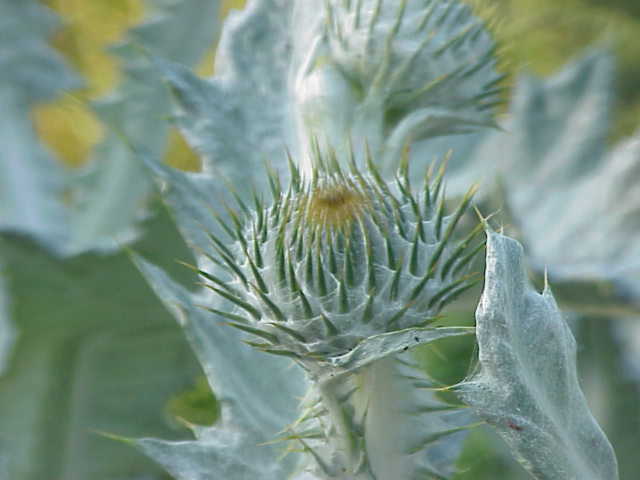
Onopordum, commonly known as cottonthistle, is a genus of flowering plants in the tribe Cardueae, within the family Asteraceae (order Asterales). The genus comprises around 60 species distributed across southern Europe, northern Africa, the Canary Islands, the Caucasus, and southwest and central Asia, where they typically colonise disturbed land, roadsides, arable fields, and pastures.
Most species are biennials, occasionally short-lived perennials. In their first season they produce a basal rosette of gray-green, felted leaves and rarely any flower heads; in the second season they grow rapidly on branched, spinose winged stems reaching 0.5–3 m in height, flower extensively, then die after setting seed. The leaves are dentate or shallowly lobed to compound, with deeply cut or pinnatifid leaflets that are strongly spiny. The distinctive flower heads are semi-spherical to ovoid capitula bearing purple disc florets — occasionally white or pink — and no ray florets, giving them the characteristic look of true thistles. The involucre bracts are leathery linear-lanceolate spines arranged in overlapping rows.
Reproduction is by seed alone. Seeds ripen in mid-summer and are wind-dispersed on a pappus of many rows of fine hairs united at a circular base. The fruit is a glabrous achene, 4–6 mm long, with 4–50 ribs.
Notable members include Onopordum acanthium (Scotch thistle or Cotton thistle), which is widely distributed across Europe and temperate Asia and has long served as a heraldic symbol of Scotland, and Onopordum illyricum (Illyrian cottonthistle) of the Mediterranean region. Onopordum species serve as larval food plants for certain Lepidoptera, most notably Coleophora onopordiella, which feeds exclusively on O. acanthium.
Etymology
The genus name Onopordum derives from Greek: onos (donkey) and porde (flatulence), alluding to the supposed effect of eating the plant on donkeys — a folk-etymology recorded in ancient sources. The common name "cottonthistle" refers to the dense whitish woolly tomentum covering the stems and leaves.
Distribution
Onopordum species are native to southern Europe, northern Africa (including Morocco, Algeria, Tunisia, Libya, and Egypt), the Canary Islands, the Caucasus, and southwest and central Asia as far as Afghanistan and Central Asia. They colonise open, disturbed habitats — roadsides, arable land, and pastures — and several species, most prominently O. acanthium, have become naturalised weeds in North America, Australia, and other temperate regions outside their native range.
Ecology
Onopordum species grow in open, disturbed habitats including roadsides, arable land, and grazed pastures, typically on well-drained soils in sunny positions. They are important food plants for larvae of certain Lepidoptera; Coleophora onopordiella feeds exclusively on Onopordum acanthium. The large, nectar-rich capitula attract a wide range of pollinators. On the Greek island of Crete, a native species has its flower heads and tender young leaves consumed raw as a wild vegetable.
Cultural Uses
The most culturally significant species is Onopordum acanthium, known as the Scotch thistle or heraldic thistle, which has been the national emblem of Scotland since at least the 15th century and features on Scottish royal arms and the Order of the Thistle. In parts of Crete, the native cottonthistle is used as a wild edible, with flower heads and tender leaves eaten raw. Several species have been used in traditional medicine across their native range.

