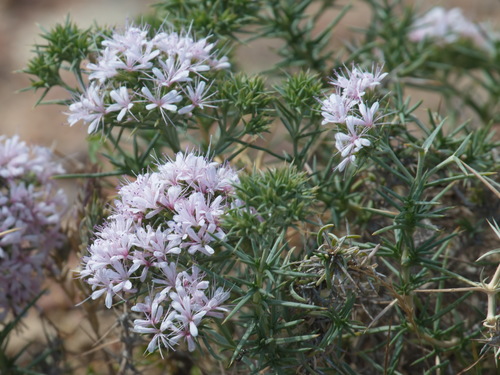
Acanthophyllum is a genus of approximately 75 species of small shrubby perennial flowering plants belonging to the family Caryophyllaceae (the pink family), within the order Caryophyllales. The genus is distributed across the Irano-Turanian floristic region, encompassing Iran, Central Asia, and adjacent arid and semi-arid areas.
Plants in this genus are characterised by a compact, cushion-forming or shrubby habit with stiff, spiny leaves and spiny bracts that give the genus its name. Flowers are white or pink, sessile, and borne either singly or in dense globose heads. The calyx is cylindrical with five teeth; there are five petals, which may be entire or retuse, and twenty stamens. The fruit is an ovoid capsule that opens irregularly from the base, containing reniform (kidney-shaped) seeds.
The genus was formally described by the botanist Carl Anton von Meyer and published in Verzeichness der Pflanzen des Caspischen Meeres in 1831. The type species is Acanthophyllum mucronatum C.A.Mey. As of 2023, Plants of the World Online recognises approximately 75 accepted species within this genus.
Etymology
The name Acanthophyllum derives from the Greek akantha (thorn or spine) and phyllon (leaf), referring to the genus's distinctively stiff, spine-tipped leaves that characterise all members of the group.
Distribution
Acanthophyllum is distributed across the Irano-Turanian floristic region, a vast arid and semi-arid zone stretching from Iran and Turkey eastward through Central Asia. Species are adapted to dry, rocky, and steppe habitats characteristic of this phytogeographic region.
Taxonomy Notes
The genus was described by Carl Anton von Meyer and published in Verzeichness der Pflanzen des Caspischen Meeres (210, 1831). The type species is Acanthophyllum mucronatum C.A.Mey. The genus belongs to family Caryophyllaceae, order Caryophyllales. As of March 2023, Plants of the World Online accepts approximately 75 species.










