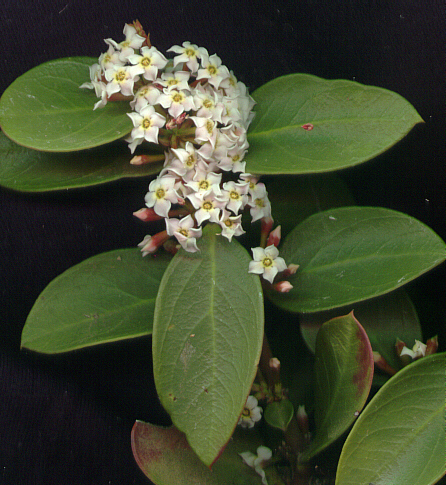
Acokanthera is a small genus of flowering plants in the family Apocynaceae, order Gentianales, comprising approximately five species of shrubs and small trees. The genus is native almost entirely to sub-Saharan Africa, with one species, A. schimperi, extending into the Arabian Peninsula (Yemen) and the Horn of Africa.
All members of the genus produce a milky sap that is rich in ouabain (also called g-strophanthin), a highly toxic cardiac glycoside. Ouabain inhibits the sodium-potassium pump in heart muscle cells, causing cardiac arrest at sufficient doses. Because of this, extracts of Acokanthera have been used for centuries by hunters across eastern and southern Africa as an arrow poison — pressed into arrow tips and hunting spears for big-game hunting, and historically documented in the poaching of elephants.
The most widely cultivated species, A. oblongifolia (poison arrow plant or dune poison bush), is native to coastal South Africa and Mozambique and is occasionally grown as an ornamental hedge plant in warm temperate regions despite its extreme toxicity. A. oppositifolia (common poison bush) has the widest natural range, spreading from the Cape Province northward to the Democratic Republic of the Congo and Tanzania.
Distribution
Acokanthera is largely restricted to sub-Saharan Africa, ranging from South Africa north through eastern Africa to the Horn of Africa and the Great Lakes region. The sole exception is A. schimperi, which also occurs in Yemen, Eritrea, Djibouti, Ethiopia, Somalia, and the island of Socotra.
Cultural Uses
The sap of Acokanthera species has been among the most widely used arrow poisons in African hunting traditions. Hunters concentrated the toxic sap by boiling bark and root extracts, then applied the residue to arrowheads and spear tips. The active poison, ouabain, causes rapid cardiac arrest; the same compound has been investigated in Western medicine as a potential cardiac drug. Historical accounts document its use in elephant poaching across eastern Africa.
Taxonomy Notes
Acokanthera belongs to the tribe Plumerieae within the subfamily Rauvolfioideae of Apocynaceae. GBIF lists the genus as accepted within order Gentianales. The genus was described with authorship not fully recorded in GBIF's current dataset. Wikipedia lists five species; GBIF recognises two accepted descendants in its current checklist.










