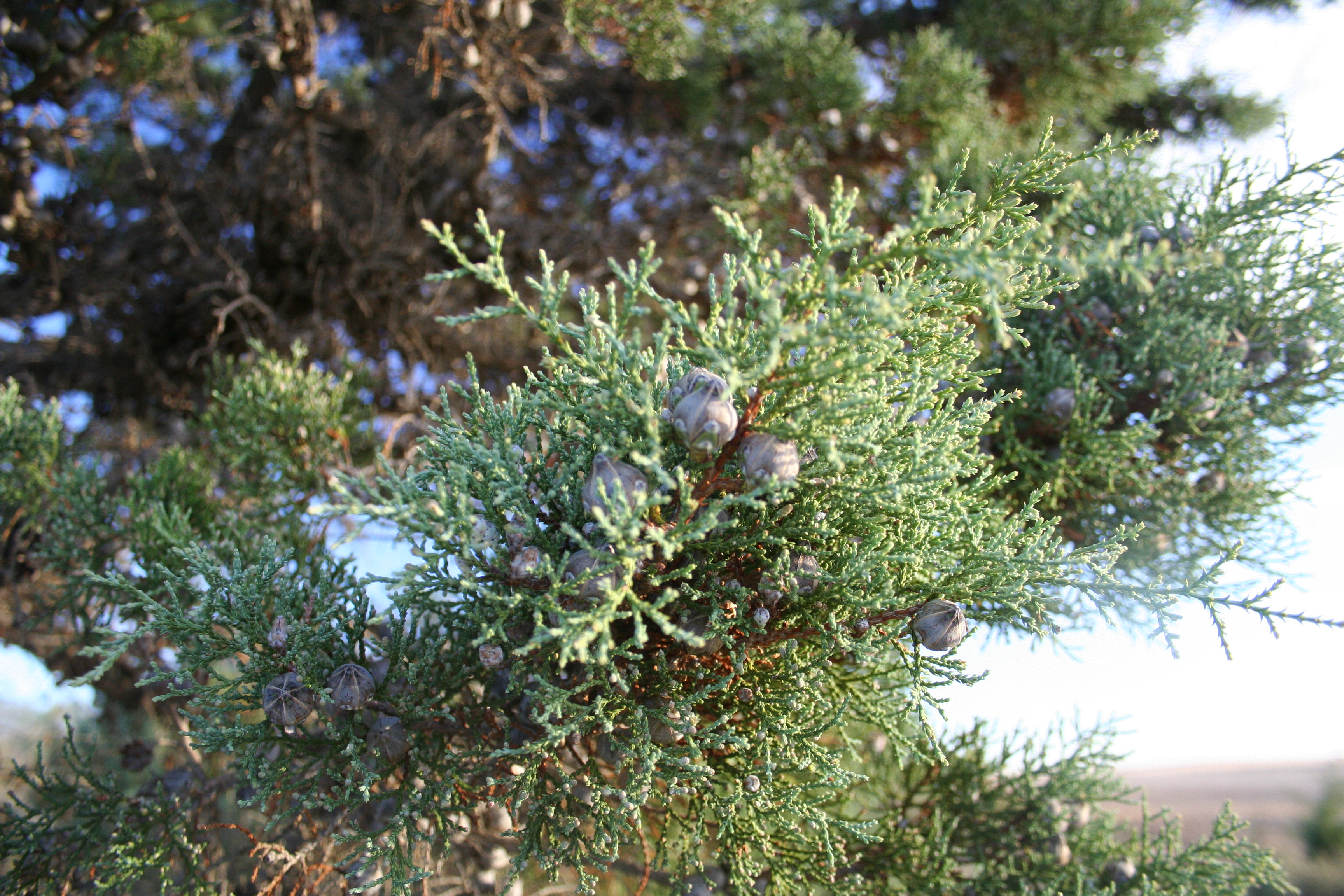
Actinostrobus is a small genus of three species of coniferous shrubs and small trees belonging to the family Cupressaceae (the cypress family), within the order Cupressales. The genus was described by the Dutch botanist Friedrich Miquel in 1845. All three species are endemic to the sandplains of southwestern Western Australia, where they are commonly known as cypress, sandplain-cypress, or cypress-pine — a common name shared with the closely related genus Callitris.
Plants grow 3–8 metres tall and bear evergreen leaves in two distinct forms: needle-like juvenile leaves 10–20 mm long on young seedlings (occasionally persisting into adulthood in Actinostrobus acuminatus), and tightly appressed, scale-like adult leaves 2–8 mm long with only the apex free. Both leaf types are arranged in six rows along the twigs, in alternating whorls of three. Male cones are small (3–6 mm), terminal on branchlets. Female cones mature over 18–20 months to 10–20 mm across, becoming globular to acute-ovoid and woody, with six thick scales in two whorls of three, plus 9–15 thin sterile basal scales — a feature that distinguishes the genus from Callitris. The cones are serotinous, remaining closed on the tree for many years and releasing their seeds only after being scorched by bushfire, an adaptation to the fire-prone Australian landscape.
The wood is light, soft, and aromatic, but because the plants remain small, timber use is negligible. They are cultivated occasionally as ornamental shrubs, though their very high flammability in bushfire conditions restricts broader horticultural use.
Actinostrobus is most closely related to Callitris, the cypress-pines of mainland Australia. A 2010 morphological and anatomical study of 42 characters proposed subsuming all three Actinostrobus species into an expanded Callitris, though Actinostrobus continues to be recognized as a distinct genus in many treatments. The three species are A. acuminatus, A. arenarius, and A. pyramidalis.
Distribution
All three species of Actinostrobus are endemic to the sandplains of southwestern Western Australia. The genus is not found naturally outside this region. Its closest relative, Callitris, is far more widespread across most of the Australian continent.
Ecology
Actinostrobus species are adapted to fire-prone sandplain habitats. Their cones are serotinous — remaining sealed on the tree for years and opening to release seeds only after the heat of a bushfire, enabling seedling establishment on freshly cleared, ash-enriched ground. The plants themselves are highly flammable, a trait that limits their use in landscaping.
Taxonomy Notes
Actinostrobus was described by Friedrich Miquel in 1845. A 2010 study based on 42 morphological and anatomical characters concluded that all three species of Actinostrobus nest within the genus Callitris, and proposed merging them into an expanded Callitris. The key morphological difference maintained by those who keep the genera separate is the presence of 9–15 thin sterile basal scales at the base of the female cone in Actinostrobus, which are absent in Callitris. GBIF currently treats Actinostrobus as an accepted genus in the family Cupressaceae, order Cupressales.










