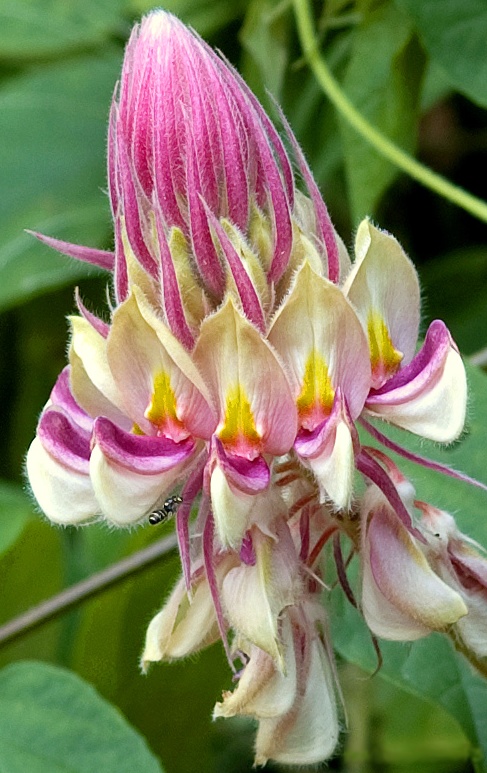
Afgekia is a small genus of two species of large, perennial climbing shrubs in the legume family Fabaceae (order Fabales), native to Thailand in Southeast Asia. The genus is closely related to Wisteria and belongs to the tribe Wisterieae.
Both species are vigorous scrambling climbers that reach 10–20 metres in height. Their mature stems are brown, and the leaves are evergreen with 8–16 pairs of leaflets plus a terminal leaflet; individual leaflets measure 3–14 cm long. The erect, leafy raceme inflorescences are 30–70 cm long and bear flowers with the characteristic pea-flower (Faboideae) form: a cream standard petal with pale pink to purple markings and a yellow or greenish nectar guide, deep pink or purple wing petals roughly equal in length to the white keel petals, and nine fused stamens with one free. Inflated seed pods are 6–15 cm long and split when ripe to release two or three seeds.
The genus was established by William Grant Craib in 1927 with the single species Afgekia sericea, whose type specimen was collected by Anuwat, a Thai associate of Arthur Francis George Kerr — the Irish physician and pioneering botanist for whom the genus is named (from his initials A.F.G.K.). A 2019 molecular phylogenetic study refined the genus's circumscription, transferring A. filipes to Padbruggea and confirming the remaining two species — A. sericea and A. mahidoliae — as a well-supported clade sister to Kanburia.
Etymology
The genus name Afgekia was coined by William Grant Craib in 1927 to commemorate Arthur Francis George Kerr, an Irish physician who was a pioneering botanist in Thailand in the early twentieth century. The name is formed from Kerr's initials: A.F.G.K.
Distribution
Afgekia is endemic to Thailand in mainland Southeast Asia. Both accepted species are native to the country, where they grow as forest climbers.
Taxonomy
The genus was placed in tribe Wisterieae (family Fabaceae). A 2019 molecular phylogenetic study demonstrated that Afgekia filipes did not belong in the genus and transferred it to Padbruggea. The two remaining species form a well-supported clade sister to Kanburia, which in turn falls within a larger clade including Callerya, Serawaia, and Whitfordiodendron. Morphological features distinguishing Afgekia from related genera include two pairs of callosities on the standard petal (rather than one) and the longest stipules and floral bracts in the tribe.










