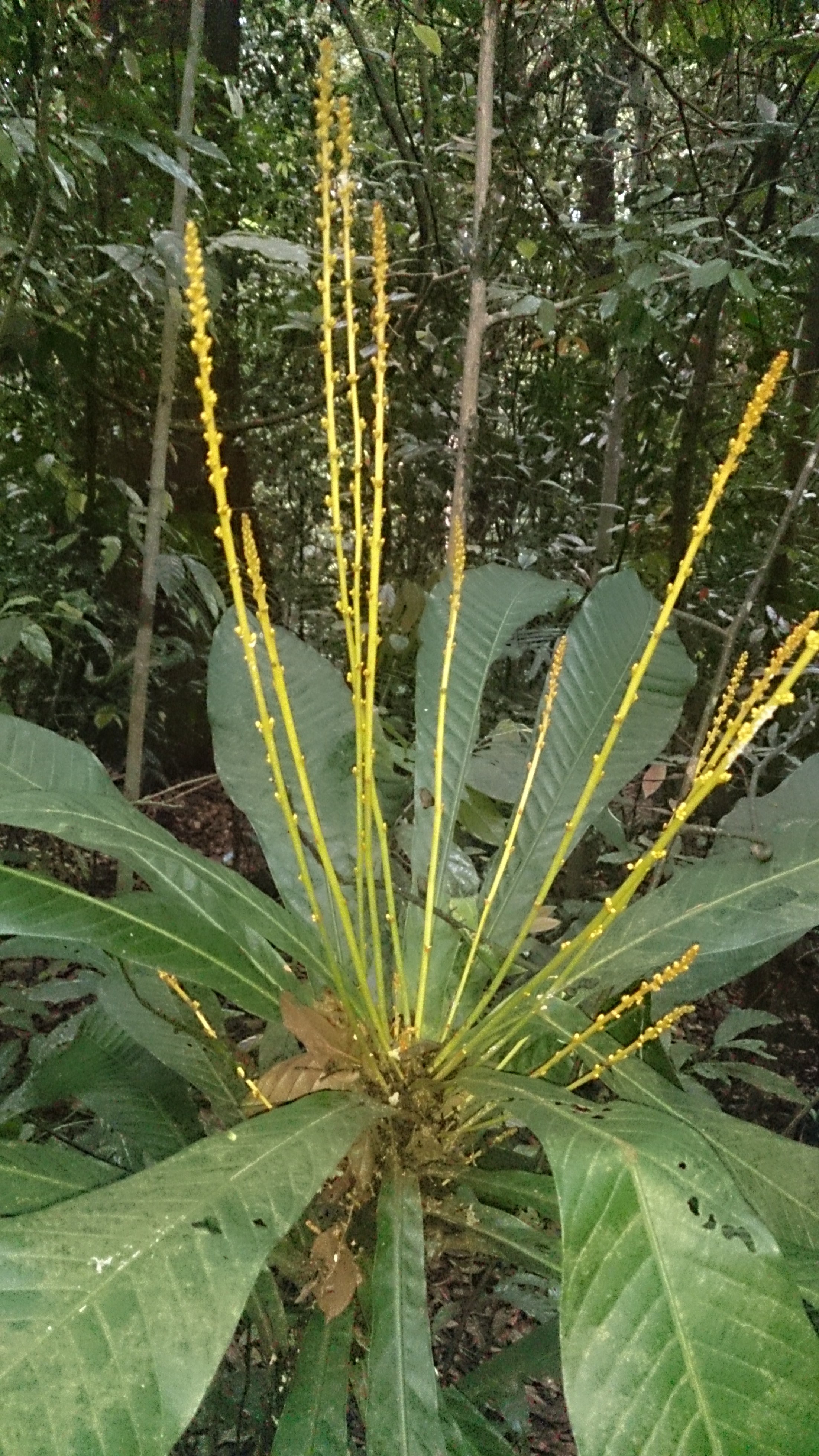
Agrostistachys is a small genus of flowering plants in the family Euphorbiaceae, placed within the order Malpighiales. The genus was first formally described in 1850 and comprises around five to six accepted species of tropical trees and shrubs. Its members are distributed across South and Southeast Asia, ranging from India and Sri Lanka through Myanmar, Thailand, Vietnam, Laos, Cambodia, Malaysia, Borneo, Sumatra, the Philippines, and extending east to New Guinea.
The genus belongs to the large and economically diverse spurge family (Euphorbiaceae), which includes such well-known members as rubber trees, cassava, and poinsettias. Within this family, Agrostistachys represents a group of understory forest plants adapted to humid tropical conditions across the Indo-Pacific region. Three genera formerly included under Agrostistachys — Pseudagrostistachys, Tannodia, and Wetria — have since been moved to separate genera.
The most widely distributed species is Agrostistachys indica, found from the Indian subcontinent across mainland and island Southeast Asia to New Guinea. Other notable species include Agrostistachys borneensis, which occurs across a similarly broad range encompassing India, Sri Lanka, and much of island Southeast Asia, and Agrostistachys hookeri, endemic to Sri Lanka.
Distribution
Agrostistachys is native to South Asia and Southeast Asia, with species recorded in India, Sri Lanka, Myanmar, Thailand, Vietnam, Laos, Cambodia, Malaysia (Peninsular and Borneo), Sumatra, the Philippines, and New Guinea. The genus is absent from continental East Asia and Australasia proper.
Taxonomy Notes
The genus was first described in 1850 and is placed in Euphorbiaceae, order Malpighiales. Three genera formerly treated within or near Agrostistachys — Pseudagrostistachys, Tannodia, and Wetria — have been segregated into separate genera.










