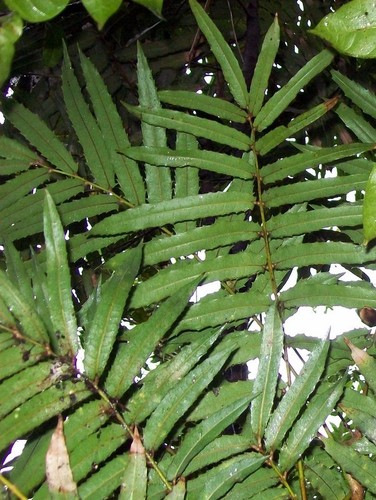
Akania is a monotypic genus of flowering trees in the family Akaniaceae, placed in the order Brassicales alongside mustards and capers. The genus comprises a single widely recognised species, Akania bidwillii, known by the common name turnipwood — a reference to the pungent, turnip-like odour released when the timber is felled or cut.
Turnipwood is a medium-sized rainforest tree endemic to the subtropical and warm-temperate coastal rainforests of eastern Australia, occurring naturally in New South Wales and Queensland. It belongs to a small, ancient family (Akaniaceae) with only two genera — Akania in Australia and Bretschneidera in southern China and Southeast Asia — making it a significant lineage for understanding the biogeography of the order Brassicales.
Morphologically, the tree produces fragrant white or pink flowers arranged in panicles typically 8–15 cm long, with pedicels 5–20 mm long, calyx 3–4 mm long, and corolla 8–12 mm long. The fruit is a dull-red, rounded capsule that dries and splits to release one or two seeds. Flowering occurs in spring.
A second species, Akania americana, has been recognised in some classifications for populations in Central and South America, though its placement and distinctness from A. bidwillii remain subject to taxonomic debate.
Distribution
Akania bidwillii is restricted to subtropical and warm-temperate coastal rainforests of eastern Australia, with its natural range spanning New South Wales and Queensland. The genus has no native representatives outside Australia under most taxonomic treatments.
Taxonomy Notes
Akania is the sole Australian genus in the family Akaniaceae (order Brassicales). The family contains only two genera globally — Akania and the Asian Bretschneidera — underscoring its botanical rarity. GBIF recognises one accepted species within the genus; a second species, A. americana, appears in some treatments.










