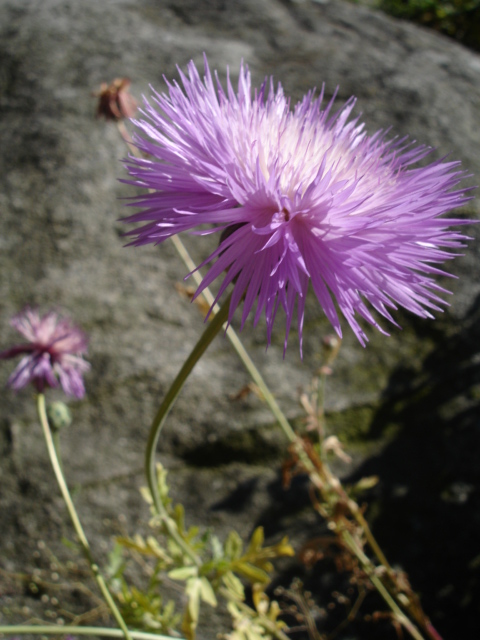
Amberboa is a genus of flowering plants in the tribe Cardueae within the family Asteraceae (order Asterales), described as a genus in 1832 by Christian Friedrich Lessing. The type species is Amberboa moschata. The genus comprises about seven species of annual or biennial herbs native to central and southwestern Asia.
Plants have erect, branched or unbranched stems with leaves that are undivided, lyrate, or pinnatipartite, with entire or toothed margins. The flower heads (capitula) are heterogamous and solitary at the ends of stems and branches, sometimes with one or a few subbasal heads. The involucre is glabrous or sparsely arachnoid, with imbricate phyllaries that are rigid to subrigid; the middle phyllaries are broadly rounded and the inner ones bear a scarious apical appendage. Outer florets form a single sterile row with 5–20-cleft corollas, while the inner florets are numerous, bisexual, and arranged in many rows. Corolla color is yellow or purple. The achenes are sericeous-villous with a denticulate rim at the apex and a conspicuously thickened rim around the attachment scar. Pappus elements are scalelike, wider toward the apex, scabridulous, or rarely absent.
The best-known species is Amberboa moschata (sweet sultan), cultivated as an ornamental for its showy, sweet-scented purple flower heads, and naturalized in parts of China and North America.
Distribution
Amberboa species are native to central and southwestern Asia, ranging from Turkey and the Caucasus through Iran, Iraq, and Central Asia (Turkmenistan, Kazakhstan, Uzbekistan, Tajikistan, Kyrgyzstan) to Afghanistan, Pakistan, and northwestern India, with one species (A. turanica) extending into Xinjiang, China. Amberboa moschata has been widely introduced as an ornamental and is naturalized in parts of China and North America.
Ecology
Species occur in open, often arid or semi-arid habitats across their native range. Amberboa moschata is widely cultivated and has escaped cultivation to become naturalized in parts of China and North America.
Cultivation
Amberboa moschata (sweet sultan) is widely cultivated as an ornamental for its showy, sweet-scented purple flower heads. It is an annual or biennial branching herb growing to about 50 cm tall.
Taxonomy Notes
The genus was described in 1832 by Christian Friedrich Lessing in Synopsis generum compositarum. Earlier, Vaillant had used the name in 1754 (Königl. Akad. Wiss. Paris. 5: 182). Synonyms include Amberboia Kuntze, Centaurea subg. Amberboa Pers., and Chryseis Cass. The type species is Amberboa moschata (Linnaeus) DC. The genus belongs to subtribe Centaureinae within tribe Cardueae of the Asteraceae.










