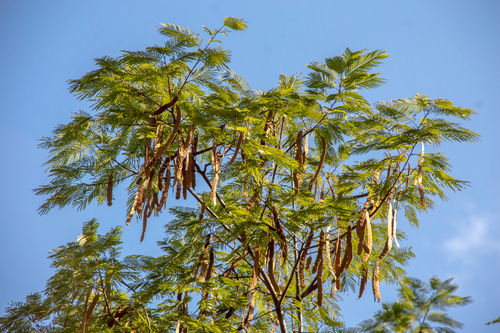
Anadenanthera is a small genus of large deciduous trees in the legume family Fabaceae, order Fabales, native to South America and the Caribbean. The genus is traditionally treated as comprising two species — Anadenanthera colubrina (vilca, cebil) and Anadenanthera peregrina (yopo, cohoba) — though a 2024 molecular marker study supports a four-species hypothesis also recognizing A. macrocarpa and A. falcata.
Both species are fast-growing trees reaching 5–20 metres in height, characterised by distinctly thorny trunks and bark, and bipinnate, mimosa-like leaves that fold at night. Their flowers are borne in small, pale yellow to white spherical clusters closely resembling those of Acacia. The wood is exceptionally hard and dense (approximately 0.86 g/cm³), making it valuable for timber, furniture, construction, and fencing. Bark and gum have traditional economic and medicinal uses, including as a source of tannins for the leather industry and as an expectorant remedy for respiratory ailments.
The genus is best known internationally for its seeds (beans), which contain significant concentrations of bufotenin — the primary active alkaloid — along with trace amounts of DMT and 5-MeO-DMT. These seeds have been central to Indigenous ceremonial life across northern South America, the Andean highlands, and the Caribbean for over four thousand years, with archaeological evidence dating use to at least 2130 BC. Today, Anadenanthera trees are important components of South American dry forests and savanna-dry rainforest ecotones, and A. colubrina holds high-priority conservation status in Brazil.
Etymology
The genus name Anadenanthera derives from the Greek ana- (upward), aden (gland), and anthera (anther), referring to the glandular anthers of the flowers. The two species carry common names from Indigenous languages of South America: yopo and cohoba (A. peregrina) from Arawakan languages, and vilca or willka (A. colubrina) from Quechua, meaning "grandchild" or "sacred."
Distribution
Anadenanthera is native to South America and the Caribbean. A. peregrina is distributed across the Caribbean islands (including Hispaniola and Puerto Rico) and northern/central South America including Venezuela, Colombia, Brazil, and Trinidad. A. colubrina has a broader distribution ranging from Argentina, Bolivia, Brazil, Ecuador, Paraguay, and Peru to Cuba, and also occurs on Mauritius. The genus occupies habitats from savanna to dry rainforest, typically at altitudes of 315–2,200 metres.
Ecology
Both species grow in dry to seasonally dry tropical environments — savanna, dry rainforest, and cerrado — often on rocky hillsides in well-drained soils, frequently near rivers. A. colubrina tolerates a wide altitudinal range (315–2,200 m) with modest annual precipitation (25–60 cm) and a mean temperature around 21 °C. Growth is fast, reaching 1–1.5 m per year in favourable conditions, with flowering possible as early as two years after germination. Seeds and falling leaves are toxic to cattle.
Cultural Uses
Anadenanthera has one of the longest documented records of entheogenic use of any plant genus. The seeds (beans) of both species are ground, sometimes mixed with calcium hydroxide (lime), and inhaled as a hallucinogenic snuff — called yopo or cohoba from A. peregrina and vilca or cebil from A. colubrina. Archaeological evidence from Inca Cueva, Argentina (puma-bone pipes containing DMT) places use at approximately 2130 BC, making it over 4,000 years old.
Among the Piaroa of the Venezuelan Orinoco, yopo is reserved for shamanic specialists who use it in visionary rituals to diagnose illness, mediate with spiritual beings, and access ancestral cosmological knowledge. The Wichi of Argentina use vilca under the name hatáj. The Wari of southern Peru combined vilca seeds with chicha, as confirmed by excavations at the Quilcapampa site (2013–2017). The first Western account was recorded in 1496 by Friar Ramon Pane among the Taino of Hispaniola.
Beyond entheogenic use, the wood provides dense, durable timber used for furniture, construction, fencing, and railway sleepers. Bark gum has been used medicinally as an expectorant, and tannins extracted from both bark and beans are used industrially for processing animal hides.
Conservation
Anadenanthera colubrina has been assigned "high priority" conservation status in Brazil. No IUCN Red List status was found in the sources consulted for either species.










