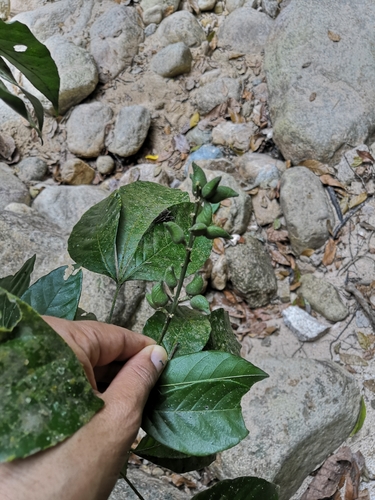
Angostura Rich. is a genus of approximately 12 species of tropical trees and shrubs in the family Rutaceae, order Sapindales. The genus was described by the French botanist Louis Claude Richard and published in 1812. All members are native to the tropical Americas, with the range spanning from northern South America into Central America and the Caribbean.
The most well-known member is Angostura trifoliata, an evergreen tree reaching 18 to 24 metres in height. It bears compound leaves with three ovoid to lanceolate leaflets and produces purplish-white flowers. The aromatic bark of this species — commonly called angostura bark — has a long history of medicinal and culinary use. It has traditionally been employed in the treatment of fevers, where it was considered comparable in efficacy to quinine.
Angostura bark also has a notable cultural footprint: it is used in a number of aromatic bitters products, including Abbott's Bitters and Fever-Tree aromatic tonic water, and has been used to flavor foods such as candy and ice cream. Despite the common association, the famous Angostura brand cocktail bitters does not actually contain angostura bark; those bitters are instead named after the Venezuelan town of Angostura (now Ciudad Bolívar). The bark has also been used in some traditional practices to stun fish.
Etymology
The genus name Angostura derives from Angostura, the former name of the Venezuelan city now known as Ciudad Bolívar, situated on the Orinoco River. The type species A. trifoliata and its aromatic bark were historically associated with this region, and the genus was named accordingly by Louis Claude Richard in 1812.
Distribution
Angostura is native to the tropical Americas, with the best-documented species (A. trifoliata) occurring in northern South America. The genus as a whole spans tropical South America, with species recorded from Venezuela, Colombia, Brazil, and neighboring countries.
Taxonomy Notes
Angostura Rich. (1812) belongs to the family Rutaceae (the citrus family), order Sapindales. GBIF recognizes 12 accepted species. The name Angostura Roem. & Schult. is listed as a synonym in the GBIF backbone. The genus was published by Louis Claude Richard in Mémoires de Mathématiques et de Physique de l'Institut de France (1812).
Cultural Uses
Angostura trifoliata bark (angostura bark) has been used medicinally to treat fevers, considered comparable in efficacy to quinine. The bark is also used as a flavoring in some aromatic bitters products (Abbott's Bitters, Fever-Tree aromatic tonic water) and to flavor candy and ice cream. In some traditional practices, bruised bark is used to intoxicate fish. Notably, the widely known Angostura brand cocktail bitters does not contain angostura bark; the brand name derives from the Venezuelan city of Angostura (now Ciudad Bolívar).










