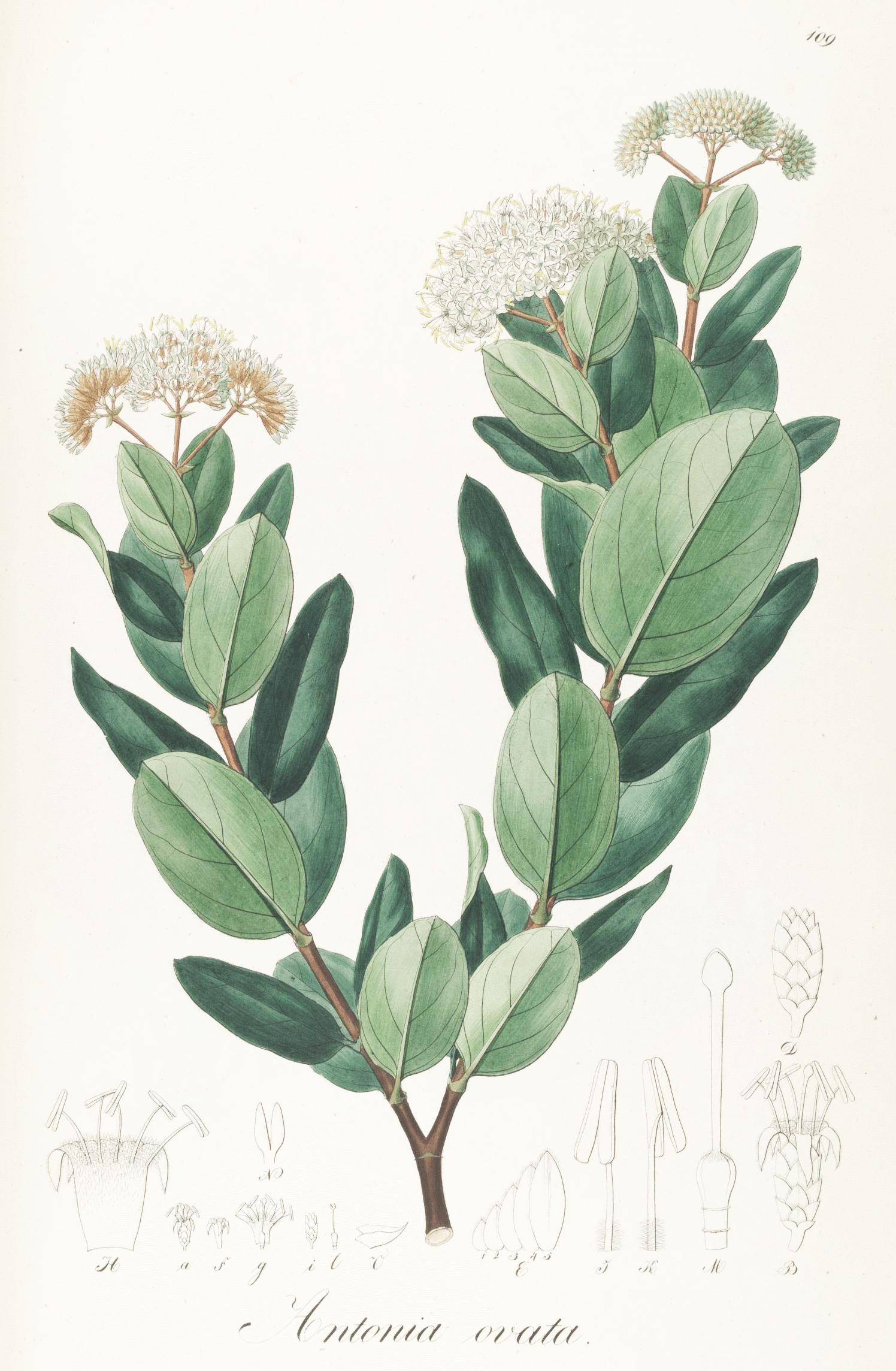
Antonia is a small flowering plant genus in the family Loganiaceae, placed in the order Gentianales. It was described by the Czech botanist Johann Baptist Emanuel Pohl in 1831, in his landmark work Plantarum Brasiliae Icones et Descriptiones (vol. 2, t. 109). The genus is monotypic, containing a single accepted species, Antonia ovata Pohl.
Loganiaceae, the family to which Antonia belongs, is a group of tropical and subtropical flowering plants whose members are often noted for the presence of powerful alkaloids and glycosides. Some classification systems — most notably that of Takhtajan — have treated Antonia as the sole genus of its own segregate family, Antoniaceae, though modern treatments maintain it within a more narrowly circumscribed Loganiaceae.
Antonia ovata is a woody plant native to tropical South America, occurring across a broad range that includes Brazil (northern, northeastern, southeastern, and west-central regions), Bolivia, Colombia, Venezuela, Peru, Guyana, Suriname, and French Guiana.
Etymology
The genus Antonia was named by Czech botanist Johann Baptist Emanuel Pohl, who described it in 1831 in Plantarum Brasiliae Icones et Descriptiones. The specific epithet ovata refers to the oval shape of the leaves.
Distribution
Antonia (represented solely by Antonia ovata) is native to tropical South America, with a distribution spanning Brazil (northern, northeastern, southeastern, and west-central regions), Bolivia, Colombia, Venezuela, Peru, Guyana, Suriname, and French Guiana, according to the World Checklist of Vascular Plants.
Taxonomy Notes
Some classification schemes, including Takhtajan's, segregate Antonia into its own monogeneric family Antoniaceae, rather than placing it within Loganiaceae. Modern consensus (including GBIF, WCVP, and the current circumscription of Loganiaceae) retains Antonia within Loganiaceae, order Gentianales.










