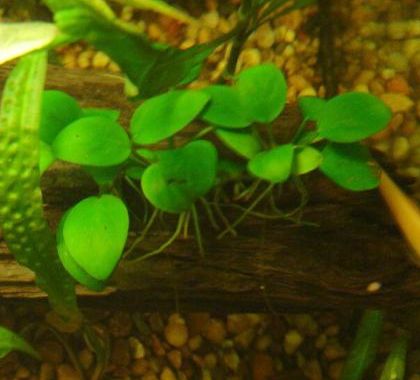
Anubias is a genus of aquatic and semi-aquatic flowering plants belonging to the family Araceae, within the order Alismatales. The genus comprises plants native to tropical central and western Africa, where they grow primarily in rivers and streams, and are also found in marshes and other wetland habitats.
The genus is characterized by broad, thick, dark leaves that vary considerably in form across species — from narrow, lance-shaped blades in Anubias afzelii and some varieties of A. barteri, to large heart- or arrow-shaped leaves in species such as A. heterophylla, A. gigantea, and A. hastifolia. Plants typically grow on submerged or emergent substrates including rocks and wood, anchoring with a creeping rhizome rather than burying their roots in soft sediment.
Anubias was first formally described in 1857 by the Austrian botanist Heinrich Wilhelm Schott, with A. afzelii designated as the type species. The genus underwent a comprehensive taxonomic revision in 1979, after which its nomenclature has remained largely stable. Species identification relies principally on characteristics of the inflorescence rather than vegetative features.
The genus is well known in the aquarium hobby worldwide. Anubias barteri and its numerous varieties — including the miniature var. nana — are among the most widely cultivated aquatic plants, valued for their tolerance of low light, slow but steady growth, and hardiness in a broad range of water conditions.
Etymology
The genus name Anubias alludes to Anubis, the ancient Egyptian god of the afterlife, a reference to the characteristically shaded, dim habitats — the dark understories of tropical rivers and stream banks — where these plants naturally grow.
Distribution
Anubias is native to tropical central and western Africa, occurring across river and stream systems as well as marshy habitats. Species are adapted to submerged and emergent conditions in shaded, humid lowland environments.
Ecology
Plants in this genus grow attached to hard substrates such as rocks, roots, and submerged wood in flowing or still freshwater, anchoring via a creeping rhizome. They tolerate low light levels and a wide range of water temperatures and pH, reflecting the variable conditions of their shaded tropical riverine habitats.
Cultivation
Anubias species are widely cultivated as aquarium plants. They thrive under low to moderate light and tolerate a broad range of water chemistry (pH roughly 5.5–9.0 depending on species). They should not be planted with the rhizome buried in substrate; instead, they are typically attached to rocks or driftwood. Growth is slow — individual species produce roughly one new leaf per one to three months under typical aquarium conditions.
Taxonomy Notes
The genus was revised in 1979, resulting in a nomenclature that has been stable since. Species are distinguished primarily by inflorescence characteristics rather than leaf morphology alone. Several species carry extensive synonym lists reflecting earlier, separate generic treatments (e.g., Amauriella for some A. hastifolia relatives). GBIF recognises 5 accepted species in the genus.










