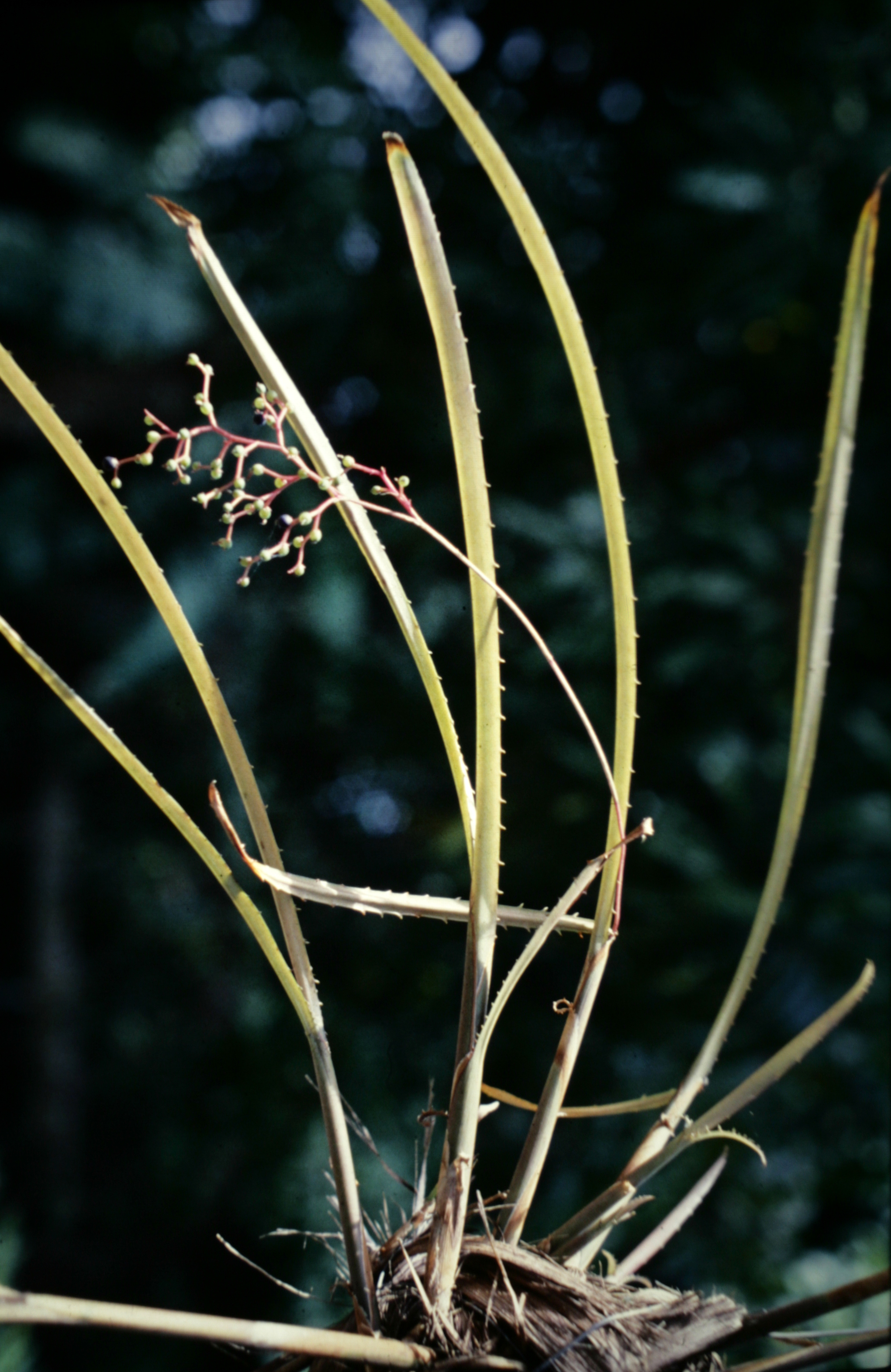
Araeococcus is a small genus of epiphytic bromeliads in the family Bromeliaceae (subfamily Bromelioideae), order Poales. The genus is native to northern South America, Central America, and Trinidad, with species distributed across Colombia, Venezuela, the Guianas, northern Brazil, Costa Rica, and Panama.
The genus name is derived from the Greek araios, meaning thin, weak, or slight, and the Latin coccus, meaning berry — a reference to the slender habit and small berry-like fruits characteristic of the group.
Araeococcus comprises four currently accepted species: A. flagellifolius, A. goeldianus, A. micranthus, and A. pectinatus. The genus was formerly broader, encompassing a second subgenus (Pseudaraeococcus) that was raised to the separate genus Pseudaraeococcus in 2020, with five former Araeococcus species endemic to Bahia, Brazil transferred to it.
Etymology
The genus name Araeococcus combines the Greek araios (thin, weak, slight) with the Latin coccus (berry), alluding to the plant's slender form and small berries.
Distribution
Araeococcus is native to northern South America (Colombia, Venezuela, the Guianas, northern and eastern Brazil), Central America (Costa Rica, Panama), and Trinidad. Individual species have ranges spanning from Trinidad & Tobago in the east to Costa Rica in the northwest.
Taxonomy Notes
Araeococcus was originally divided into two subgenera: the type subgenus and subgenus Pseudaraeococcus. In 2020, Pseudaraeococcus was elevated to a separate genus, with five Bahia-endemic species transferred out, leaving four accepted species in Araeococcus sensu stricto.










