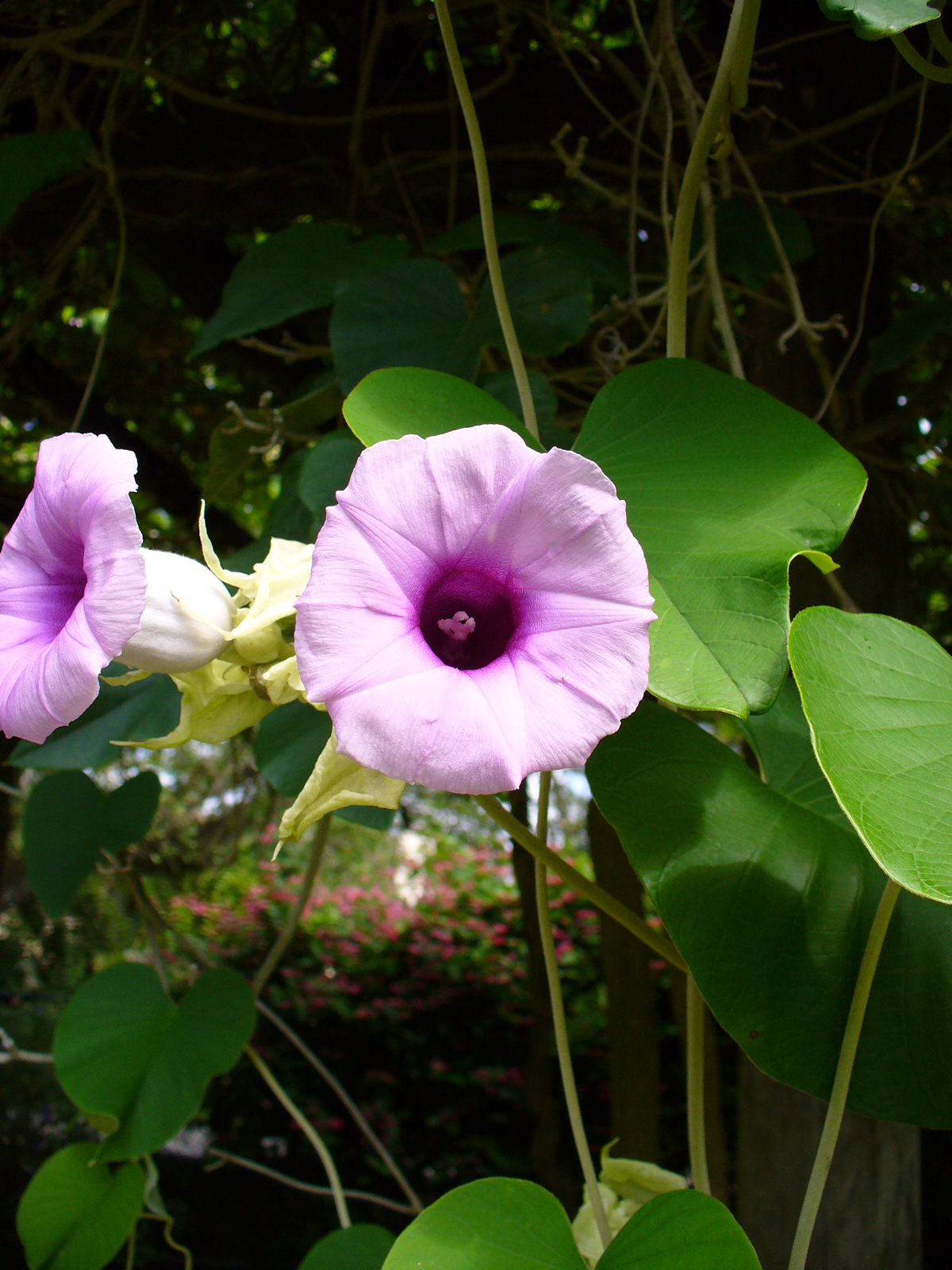
Argyreia is a genus of flowering vines and shrubs in the family Convolvulaceae, the morning glory family, placed within the order Solanales. The genus was first described by the Portuguese botanist João de Loureiro in his 1790 work Flora Cochinchinensis, and it encompasses roughly 90–100 species distributed across tropical Asia, with its centre of diversity in the Indian subcontinent, Southeast Asia, and China.
Members of the genus are typically twining climbers or woody scramblers bearing large, often heart-shaped or ovate leaves with a characteristic silvery-silky underside — a trait reflected directly in the genus name, from the Greek argyros (silver). Flowers are funnel-shaped or bell-shaped, in shades of pink, purple, or white, closely resembling those of related morning glory genera such as Ipomoea and Convolvulus.
The best-known member, Argyreia nervosa (elephant creeper or woolly morning glory), is a vigorous perennial vine native to the Indian subcontinent and widely cultivated or naturalised in tropical and subtropical regions worldwide, including Hawaii, East Africa, and the Caribbean. Its large, velvety leaves and showy pink-purple blooms make it a valued ornamental, while its root has a long history of use in Ayurvedic medicine as a nerve tonic and adaptogen. The seeds of A. nervosa contain ergoline alkaloids including ergine (d-lysergic acid amide, LSA), giving them potent entheogenic properties.
Argyreia belongs to the tribe Argyreieae within Convolvulaceae and is closely allied to Stictocardia and Rivea. The genus contains both specialist tropical forest climbers and more drought-tolerant scrubland species.
Etymology
The name Argyreia derives from the Greek word argyros (ἄργυρος), meaning "silver," referring to the silvery-silky indumentum that covers the undersides of leaves and stems in many species of the genus. The genus was established by João de Loureiro in Flora Cochinchinensis (1790).
Distribution
Argyreia is distributed across tropical and subtropical Asia, with the centre of diversity in the Indian subcontinent (India, Sri Lanka), mainland Southeast Asia, southern China, and the Malay Archipelago. Argyreia nervosa, the most widely recognised species, has been introduced and naturalised in Hawaii, parts of Africa, and the Caribbean.
Cultural Uses
The root of Argyreia nervosa has been used in Ayurvedic medicine as a nerve tonic, rejuvenation tonic, and aphrodisiac, and in traditional treatments for conditions including diabetes, anemia, gonorrhea, and cerebral disorders. The seeds of A. nervosa contain ergoline alkaloids (notably ergine/LSA) and have been used as an entheogen, though documented pre-20th-century ceremonial use in the plant's native range has not been firmly established.
Cultivation
Argyreia nervosa and related ornamental species are grown on arbours, pergolas, walls, or large trees in tropical and subtropical gardens. They require full sun, moderately fertile and moist but well-drained soil, and regular watering from spring through autumn. Where temperatures fall below 13 °C (55 °F), plants are best grown in a warm greenhouse in loam-based compost; water is reduced over winter and pruning is carried out in late winter.










