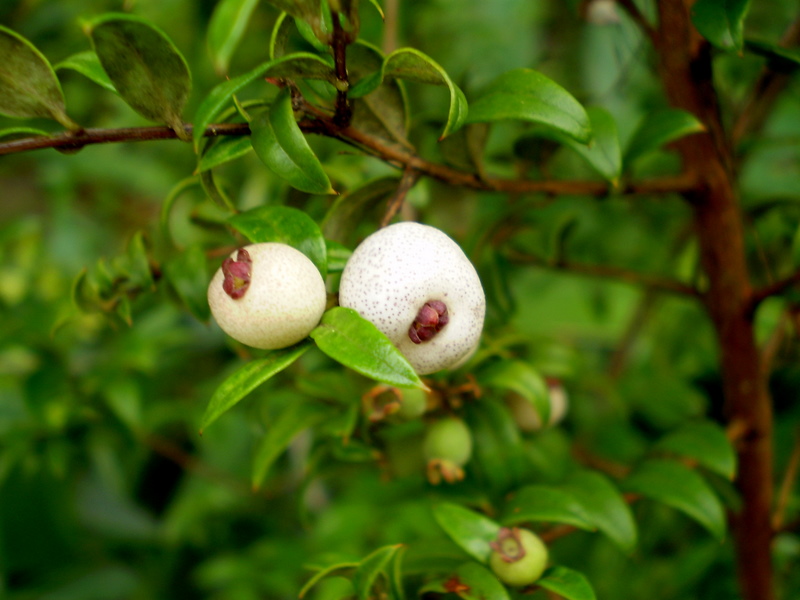
Austromyrtus is a small genus of shrubs belonging to the myrtle family Myrtaceae, within the order Myrtales. The genus was first described in 1893 by Franz Josef Niedenzu as a section of the broader genus Myrtus, then elevated to full genus rank in 1941 by Max Burret.
Plants in this genus are woody shrubs native to coastal eastern Australia — principally Queensland and New South Wales — with one species, Austromyrtus mendute, endemic to New Caledonia. The genus has undergone significant taxonomic revision: many species formerly placed here have been transferred to the related genera Gossia and Lenwebbia. As a result, only four species are currently accepted under the name Austromyrtus. The New Caledonian species in particular are subject to ongoing revision and are expected to be transferred to another genus.
The best-known member is Austromyrtus dulcis, commonly called the midgenberry or sweet midyim, which produces small white to pinkish berries with a distinctive cinnamon-like flavour. It is native to coastal heath and scrub of Queensland and northern New South Wales.
Distribution
The accepted species of Austromyrtus are distributed along the east coast of Australia — primarily Queensland and New South Wales — with A. mendute endemic to New Caledonia. The broader historical range of the genus is now attributed to the segregate genera Gossia and Lenwebbia.
Taxonomy Notes
Austromyrtus was first described in 1893 by Franz Josef Niedenzu as a section of Myrtus, then raised to genus rank by Max Burret in 1941. The genus has contracted substantially through revisionary work: former members are now placed in Gossia, Lenwebbia, and Eugenia, and the New Caledonian species remain under active revision. Only four species are currently accepted.
Cultural Uses
The fruit of Austromyrtus dulcis (midgenberry) is edible and noted for a hint of cinnamon flavouring. The species has attracted interest as a bush food native to subtropical coastal Queensland and New South Wales.










