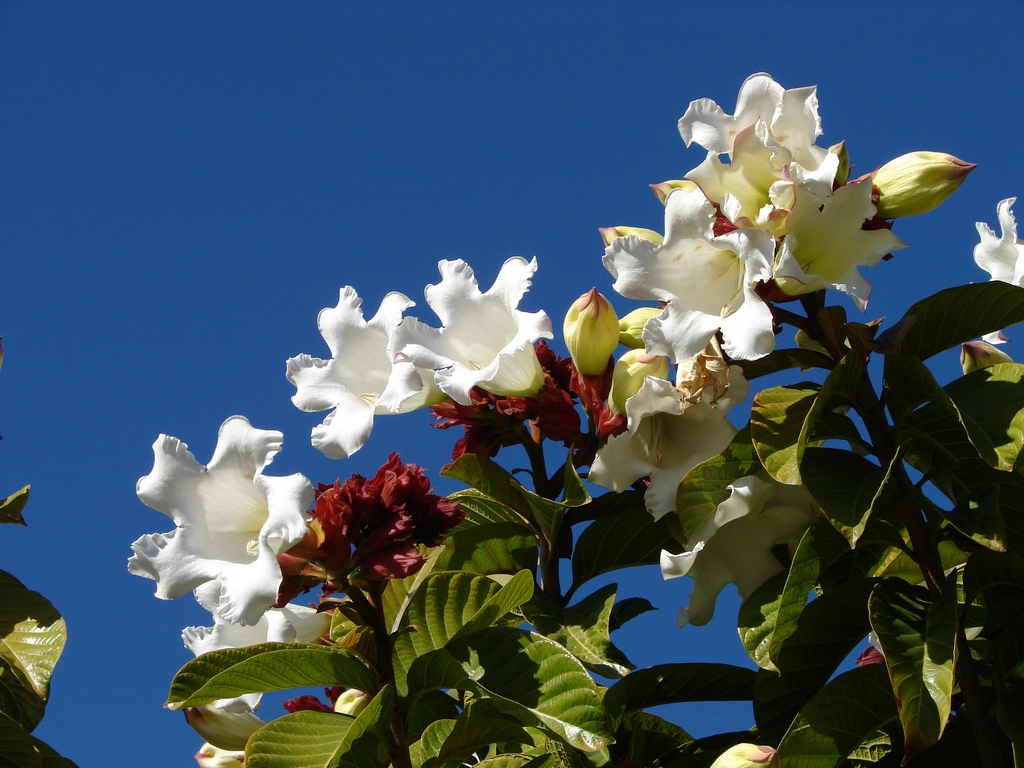
Beaumontia is a small genus of evergreen woody vines in the family Apocynaceae (the dogbane or milkweed family), order Gentianales. Native to China, the Indian subcontinent, and Southeast Asia, the genus comprises around nine accepted species of rampant climbing shrubs celebrated for their spectacular floral displays.
Plants are typically vigorous, scrambling climbers that can reach considerable heights when given support. The leaves are large, smooth, and arranged oppositely on the stem; petiolar glands produce a sticky white latex sap characteristic of the Apocynaceae. In subtropical gardens Beaumontia grandiflora may become briefly semi-deciduous during cooler winters, but most species remain evergreen under suitable conditions.
The flowers are the genus's defining ornamental feature: large, white, and intensely fragrant, borne in terminal and axillary corymbs. Each flower has a five-lobed calyx and a dark funnel- or bell-shaped corolla with five spreading lobes. Stamens are inserted near the base of the corolla tube with slender filaments and distinctive arrow-shaped anthers. The blooms are considered among the most outstanding of any climbing plant in the world. Fruits are paired thick woody follicles; seeds are compressed and taper to an apex bearing a silky tuft of hairs (coma), an adaptation for wind dispersal common in Apocynaceae.
The genus was established by Scottish botanist Nathaniel Wallich in 1824 and named in honour of Diana Wentworth Beaumont (1765–1831), an English horticultural enthusiast who maintained a famous dome-shaped glasshouse for exotic plants at Bretton Hall, Wakefield, Yorkshire. The most widely cultivated species, Beaumontia grandiflora, is commonly known as Easter lily vine or Nepal trumpet flower and is a staple of subtropical and warm-temperate gardens worldwide.
Etymology
The genus name Beaumontia honours Diana Wentworth Beaumont (1765–1831), an English gardener and wife of Colonel Thomas Richard Beaumont of Bretton Hall, Wakefield, Yorkshire. She was renowned for her estate's massive dome-shaped glasshouse housing exotic plants. The genus was formally described by Nathaniel Wallich in Tentamen Florae Napalensis Illustratae (1824).
Distribution
Beaumontia is native to a broad arc of tropical and subtropical Asia, encompassing southern China (Guangxi, Yunnan, Hainan), the Indian subcontinent (Nepal, Bhutan, Sikkim, Assam, Bangladesh, southern India, and the Andaman Islands), and Southeast Asia (Vietnam, Thailand, Laos, Myanmar, Cambodia, peninsular Malaysia, Java, Bali, and Sumatra). Beaumontia grandiflora has become naturalized in parts of Central America, and B. multiflora in Hawaii.
Cultivation
Beaumontia species are grown as ornamental vines in subtropical and warm-temperate gardens, with B. grandiflora the most widely available in the nursery trade. They thrive in full sun with fertile, well-drained soil, consistent moisture, and hot, humid conditions — Southern California and similar Mediterranean-subtropical climates suit them well. Plants are propagated from seed or from half-hardened heel cuttings rooted in sandy propagation mix under intermittent mist.
Taxonomy Notes
The genus was circumscribed by Nathaniel Wallich in Tentamen Florae Napalensis Illustratae, p. 14 (1824) and placed in the family Apocynaceae, order Gentianales. Kew's Plants of the World Online currently recognises nine species. GBIF lists the genus as accepted with 5–10 descendant taxa depending on the backbone checklist consulted.










