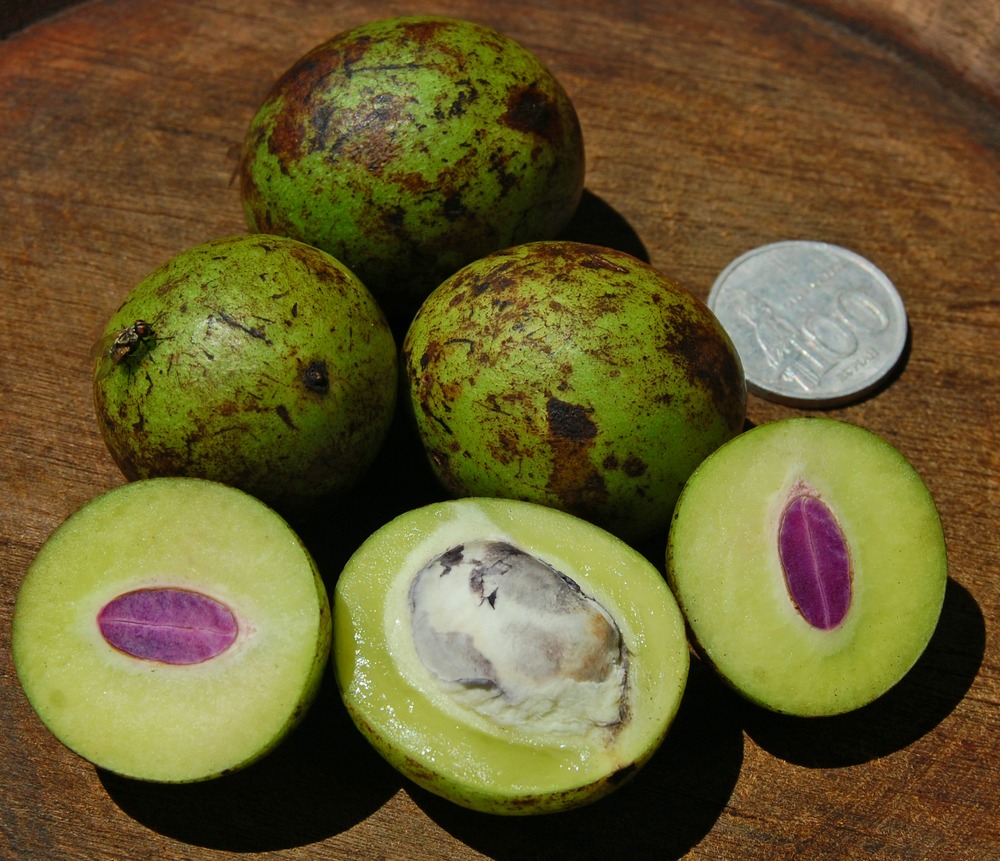
Bouea is an Asian genus of fruiting trees in the family Anacardiaceae (order Sapindales), which also includes mango, cashew, and pistachio. Species are native to southern China, Indo-China, and Malesia, where they occur as understorey trees in primary lowland forests below about 300 metres elevation.
Members of the genus are large, evergreen trees with very dense foliage, reaching up to 27 metres tall with a bole up to 55 cm in diameter. Young leaves emerge deep violet — sometimes strikingly white — before maturing to green. The fruit is a yellow to orange, subglobose drupe 25–50 mm in diameter, with juicy flesh that varies from sour to sweet and carries a faint, characteristic smell of turpentine. The heartwood is dark brown with black streaks, sharply demarcated from the lighter sapwood; it is moderately hard and used for medium construction, veneer, plywood, and furniture.
The most notable species is Bouea macrophylla (commonly called gandaria or maprang), widely cultivated across Thailand, Sumatra, Java, and Borneo for its edible fruit. Both ripe and young fruits are used — the latter as an ingredient in sambal and pickles, where the bright purple cotyledons add visual appeal. The young leaves are also consumed fresh with rice. Bouea oppositifolia is the type species, occurring throughout the genus's range.
Distribution
Bouea species are found from southern China through Indo-China and Malesia, including Thailand, Peninsular Malaysia, Sumatra, Java, and Borneo. Bouea macrophylla has the widest cultivation, grown as a fruit and ornamental tree in Thailand, Sumatra, Java, and Borneo. Bouea oppositifolia, the type species, occurs throughout the genus's range, while Bouea poilanei is restricted to Vietnam.
Ecology
Bouea species naturally occur as understorey trees in primary lowland tropical forests, typically below 300 metres elevation. They have been successfully cultivated at elevations up to about 850 metres. The genus is adapted to the humid, monsoonal tropics and can withstand occasional very light frosts.
Cultivation
Bouea species, particularly B. macrophylla, are widely cultivated for their fruit and as ornamental shade trees. They thrive in light, fertile soils and dislike calcareous conditions. Trees grown from seed begin fruiting in 8–10 years, while grafted plants produce in 2–3 years. Yields of up to 200 kg of fruit per tree have been recorded. Young trees require shade from the strongest sun. Several named cultivars exist, with fruit quality ranging from sweet (eaten raw) to sour (used in cooking).
Cultural Uses
The fruit of Bouea macrophylla is eaten both ripe and unripe. Ripe fruits are consumed raw or cooked; the best forms are sweetish-sour. Sour varieties substitute for tamarind or sour lime in cooking. Young fruits are an important ingredient in sambal, the chilli-based condiment, and in pickles — the bright purple cotyledons inside the large seed add visual appeal. Young leaves, which emerge deep violet to white, are occasionally eaten fresh with rice.
Taxonomy Notes
Bouea belongs to the family Anacardiaceae (order Sapindales), alongside mango, cashew, and pistachio. Bouea oppositifolia is the type species. Bouea macrophylla has the synonyms Bouea gandaria and Tropidopetalum javanicum. GBIF records three accepted descendants.
Propagation
Propagation is by seed; young trees require shade from the strongest sun. Grafting is also commonly practiced and significantly reduces the time to first fruiting (2–3 years versus 8–10 years for seedlings).










