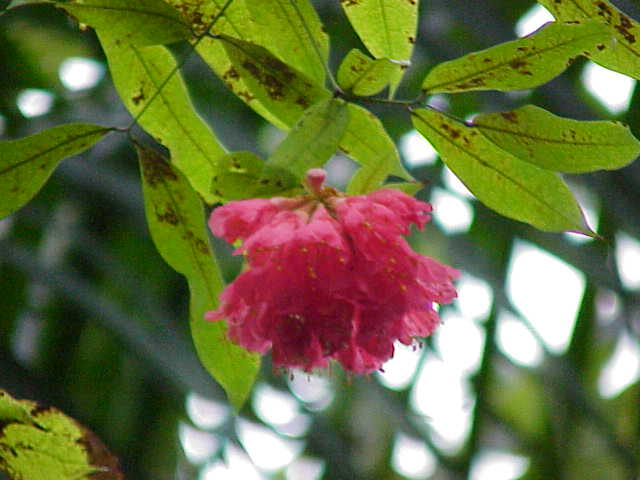
Brownea is a genus of tropical flowering trees and shrubs in the legume family (Fabaceae), placed within the subfamily Detarioideae of the order Fabales. The genus comprises approximately 22 accepted species, all native to the Neotropics — ranging from Honduras southward through Central America and into northern and western South America, reaching Peru and northern Brazil, and extending to the Caribbean islands of Trinidad and Tobago and the Windward Islands.
In habit, Brownea species are typically small to medium-sized understorey trees or shrubs in lowland tropical rainforest, capable of reaching up to 20 metres in height. They are renowned in horticulture and among botanical enthusiasts for their striking, dense, globe-shaped flower heads borne in shades of red, orange, and pink, produced directly on older stems or pendulous from branches. The young flush of leaves is a distinctive feature: new foliage emerges limp and copper-pink or bronze, hanging loosely before hardening and turning green — a phenomenon sometimes called "juvenile leaf display."
Notable members of the genus include Brownea ariza, Brownea grandiceps (the rose of Venezuela), and Brownea coccinea, all cultivated as ornamental trees in tropical gardens worldwide. The genus was described by Nikolaus Joseph von Jacquin and is named in honour of Patrick Browne, an eighteenth-century Irish botanist and physician.
Distribution
Brownea species are native to tropical regions of the Americas, ranging from Honduras through southern Central America and northern South America to Peru and northern Brazil. The genus also reaches Trinidad and Tobago and the Windward Islands in the Caribbean.
Ecology
Species of Brownea are characteristically understorey trees or shrubs in lowland tropical rainforest. Their range of habitats spans humid lowland forests from Central America into the Amazon basin and the Caribbean islands.
Cultivation
Several Brownea species, including B. ariza and B. grandiceps, are cultivated as ornamental trees in tropical and subtropical gardens for their spectacular, large, globe-like inflorescences in warm red and orange tones. They perform best in humid tropical climates and are typically grown in sheltered positions that replicate lowland forest conditions.










