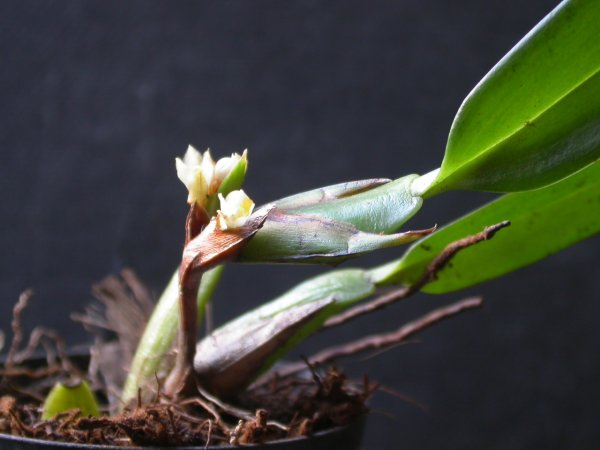
Camaridium is a genus of orchids (family Orchidaceae, order Asparagales) first described by John Lindley in 1824 (published in the Botanical Register, vol. 10, t. 844). Its taxonomic status is unsettled: GBIF's backbone taxonomy still treats Camaridium as a synonym folded into the large genus Maxillaria, but a 2007 molecular phylogenetic study of subtribe Maxillariinae found that broadly-circumscribed Maxillaria was polyphyletic and proposed splitting it into 17 segregate genera — Camaridium among them, alongside Brasilorchis, Christensonella, Heterotaxis, Maxillariella, Ornithidium and others. Authorities remain divided on whether to adopt the split: some checklists, such as the Leipzig Catalogue of Vascular Plants and a recent checklist of the Orchidaceae of Honduras, accept Camaridium as a distinct genus of around 100 species, while others (including, per Wikipedia, Plants of the World Online) continue to list it as one of over 40 synonyms absorbed into an enlarged Maxillaria.
Whichever classification is followed, plants assigned to Camaridium share the general morphology of the Maxillaria alliance: sympodial orchids — mostly large epiphytes, with some terrestrial or lithophytic species — bearing round or oblong pseudobulbs that carry one or two lanceolate leaves along a rhizome sheathed in silvery-gray velamen. Flowers are produced singly on short scapes arising from the base of the pseudobulb; the sepals and petals are free, and the lip is curved and adnate with three inconspicuous lobes, its surface bearing papillae and trichomes that vary considerably between species. Species of the alliance range through the Neotropics, from central Mexico and Florida through Central America and the West Indies to Bolivia, in rainforest habitats from sea level up to about 3,500 m elevation — a spread that spans both warm-growing and cold-growing conditions.
The genus's only species tracked in this database, Camaridium vestitum (the "purple tiger orchid," published by Lindley in 1858), exemplifies the ongoing nomenclatural tension: it is treated by GBIF's backbone and by Wikipedia's current article title as a synonym of Maxillaria parviflora, yet is retained as Camaridium vestitum under the segregate-genus classification. As with the wider Maxillaria group, such orchids are not among the most sought-after genera with hobby growers overall, but individual species are collected chiefly for the fragrance of their flowers rather than for large, showy blooms.
Distribution
Species treated under Camaridium occur through the Neotropics — from central Mexico and Florida through Central America, the West Indies, and south to Bolivia — in rainforest from sea level to roughly 3,500 m elevation. The genus's sole tracked species, Camaridium vestitum, is specifically recorded from Florida, the West Indies, and Latin America from Mexico to Bolivia.
Ecology
Members of the alliance are mostly large epiphytes, though some species grow as terrestrials or lithophytes. The wide elevational range across the group (sea level to ~3,500 m) corresponds to a mix of warm-growing and cold-growing temperature requirements.
Cultivation
Orchids of this alliance are not among the most widely grown genera in cultivation — relatively few species produce large, showy flowers — but some, prized chiefly for the fragrance of their blossoms, are sought after by specialist collectors.
Taxonomy Notes
Camaridium was originally described by John Lindley in 1824. It was later absorbed as a synonym into the broadly-circumscribed genus Maxillaria, which remains its treatment in GBIF's backbone taxonomy and (per Wikipedia) in Plants of the World Online. A 2007 molecular phylogenetic study of subtribe Maxillariinae found that circumscription of Maxillaria to be polyphyletic and proposed resurrecting Camaridium as one of 17 segregate genera. Some specialist checklists (the Leipzig Catalogue of Vascular Plants; a recent Orchidaceae checklist for Honduras) have adopted this and list Camaridium as an accepted genus of about 100 species, while other major references continue to lump it into Maxillaria — so the correct name for any given species (e.g. Camaridium vestitum vs. Maxillaria parviflora) currently depends on which classification is followed.










