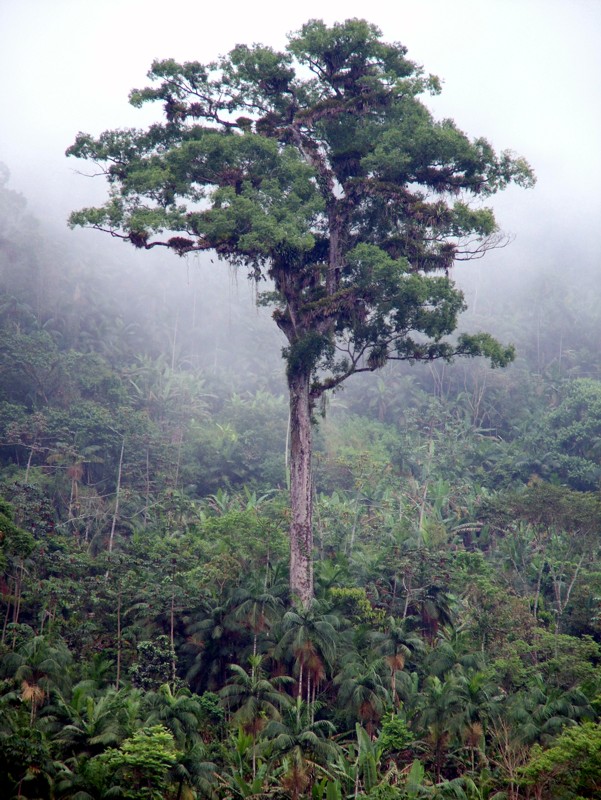
Cariniana is a genus of large neotropical trees in the family Lecythidaceae (order Ericales), first formally described by Casaretto in 1842 in Novorum Stirpium Brasiliensium. The genus is endemic to South America, where its roughly 11 species are distributed across tropical and subtropical forests, particularly in Brazil, Colombia, Venezuela, and neighbouring countries.
Members of the genus are canopy and emergent trees, often reaching considerable heights in humid lowland and montane forests. They are closely related to other Lecythidaceae genera such as Bertholletia (the Brazil nut) and Couroupita, and the genus formerly included species now placed in Allantoma and Couratari. The wood is prized for its high chatoyance — a shimmering, ribbon-like optical effect in the grain — and is commercially traded under the common name jequitibá in Brazil.
Several species, notably Cariniana legalis and Cariniana estrellensis, are among the largest trees in South America outside the Amazon basin and are considered ecologically and commercially important. Cariniana legalis is the state tree of São Paulo and is classified as endangered in parts of its range due to extensive logging and deforestation of the Atlantic Forest.
Distribution
All species of Cariniana are native to South America, with the centre of diversity in Brazil. Species occur across the Amazon basin, the Atlantic Forest, and inter-Andean valleys of Colombia and Venezuela, favouring humid tropical and subtropical forests.
Etymology
The genus name Cariniana was coined by the Italian botanist Giovanni Casaretto in 1842; it is generally considered to derive from the Latin carina (keel), possibly referring to a keeled morphological feature of the fruit or flower parts, though the precise motivation is not documented in the protologue.
Ecology
Cariniana species are canopy emergents of humid neotropical forests. They play a structural role as some of the tallest trees in the Atlantic Forest and Amazonian transitional zones. Their large, wind-dispersed winged seeds are characteristic of Lecythidaceae. Old-growth individuals provide important habitat for epiphytes and cavity-nesting wildlife.
Conservation
Several species, particularly Cariniana legalis — the jequitibá-rosa — and Cariniana estrellensis, have been heavily logged for their valuable timber and are considered threatened in parts of their range. Deforestation of the Atlantic Forest has significantly reduced wild populations. Cariniana legalis is protected by Brazilian law and is the state tree of São Paulo.










