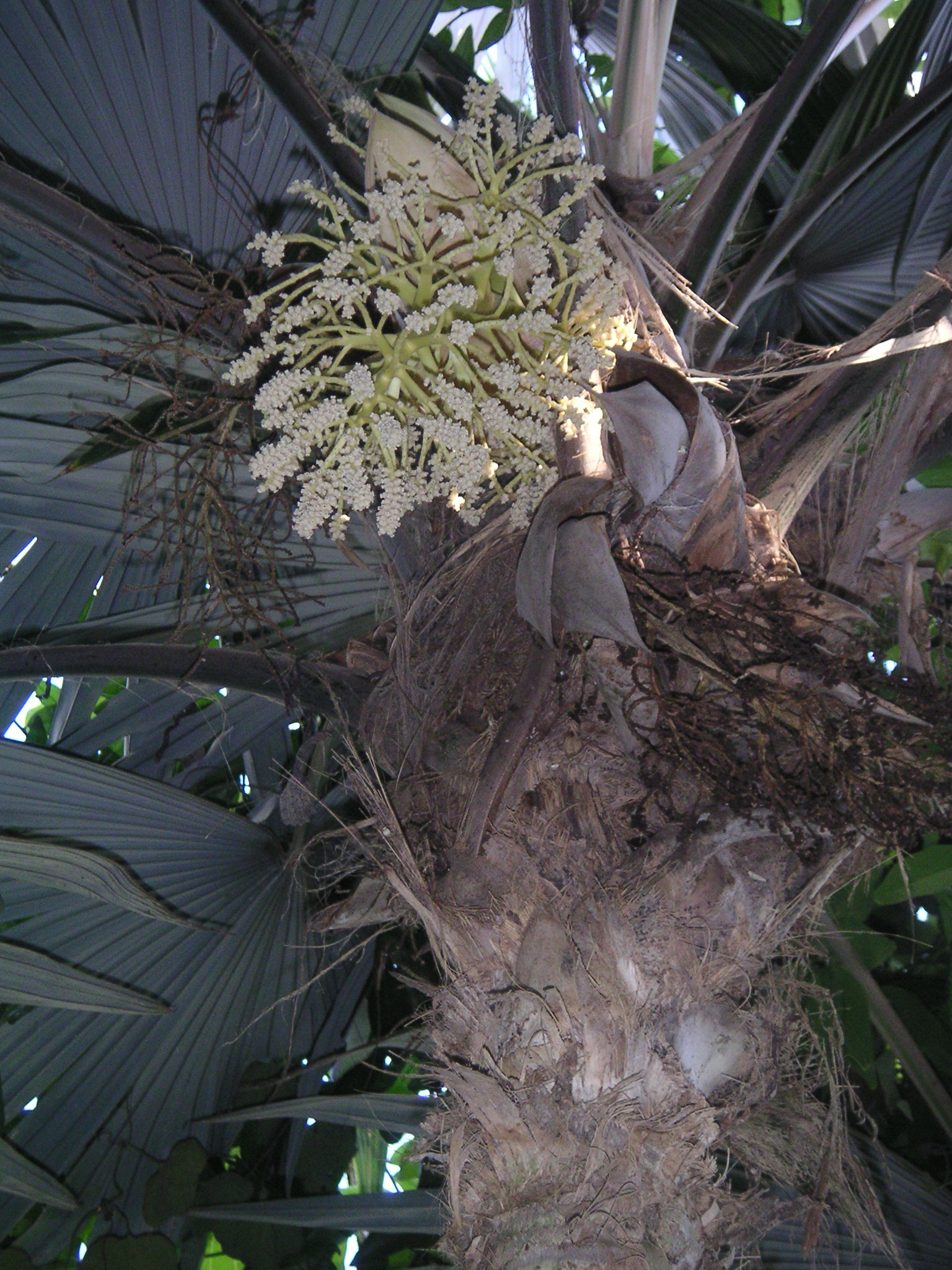
Cryosophila is a genus of about ten species of medium-sized fan palms in the family Arecaceae (order Arecales), native to a continuous range from central Mexico south to northern Colombia. They are commonly called root spine palms, a name that reflects their most distinctive feature: the trunk is armoured with long, branched, downward-pointing spines that are not true spines at all but modified adventitious roots. This adaptation is unique among palms in both morphology and function, making Cryosophila instantly recognisable.
Plants are typically single-stemmed and upright, with stems ranging from less than one metre to about fifteen metres in height and four to twenty centimetres in diameter. The leaves are palmate (fan-shaped), borne on elongated petioles, and are frequently pale or whitish-grey on their undersides — a character that contributes to the genus name (from Greek kryos, cold or icy, and sophia, wisdom or appearance). Plants carry between five and thirty-five leaves at a time. The small, bisexual flowers are whitish, with six stamens and three carpels. Fruits are white, smooth, and single-seeded.
Almost all species of Cryosophila inhabit the understorey of lowland humid or wet tropical forests, where they are shade-tolerant components of the forest floor. The exception is C. nana, which is adapted to the seasonally dry conditions of tropical dry forests in western Mexico. The genus contains 10 known species, several of which are of conservation concern due to deforestation and habitat fragmentation across Central America. Cryosophila williamsii, endemic to Honduras, is listed on the IUCN Red List as extinct in the wild. Within the palm family, Cryosophila is placed in tribe Cryosophileae (subfamily Coryphoideae) and is considered most closely related to the monotypic genus Schippia.
Etymology
The name Cryosophila is derived from the Greek words kryos (icy or cold) and sophia (wisdom or aspect), likely alluding to the pale, whitish-grey colouring of the leaf undersides. The genus was coined by Carl Ludwig Blume between 1838 and 1839 for the type species C. nana, but the name was not formally validated until Carl E. Salomon published the combination in 1887.
Distribution
Cryosophila occurs from central Mexico (states including Sinaloa, Jalisco, Chiapas, and Oaxaca) south through Guatemala, Belize, Honduras, Nicaragua, Costa Rica, and Panama to northern Colombia. Nine of the ten species grow in lowland humid or wet forests; C. nana is the sole species adapted to tropical dry forests along Mexico's Pacific slope.
Ecology
All species of Cryosophila are understorey palms, thriving in the shade of closed-canopy tropical forests. They grow in lowland humid and wet forest habitats across Central America and northern South America, with C. nana occupying drier, seasonally deciduous forest in western Mexico.
Conservation
Several species in the genus are threatened by deforestation and habitat fragmentation. Cryosophila williamsii, known only from Honduras, is listed on the IUCN Red List as extinct in the wild. The fragmentation of remaining forest populations may have complicated species delimitation within the genus, potentially inflating species counts by making isolated populations appear more distinct than they would otherwise be.
Taxonomy Notes
Cryosophila was originally placed in subfamily Coryphoideae, tribe Corypheae, subtribe Thrinacinae (Uhl & Dransfield, Genera Palmarum, 1987). Subsequent molecular phylogenetic analyses demonstrated that the Old World and New World members of Thrinacinae are not closely related, leading to the establishment of the separate tribe Cryosophileae for Cryosophila and related genera. Within Cryosophileae, Cryosophila is considered most closely related to Schippia. A synonym genus, Acanthorrhiza (Wendland, 1869), is now subsumed within Cryosophila.










