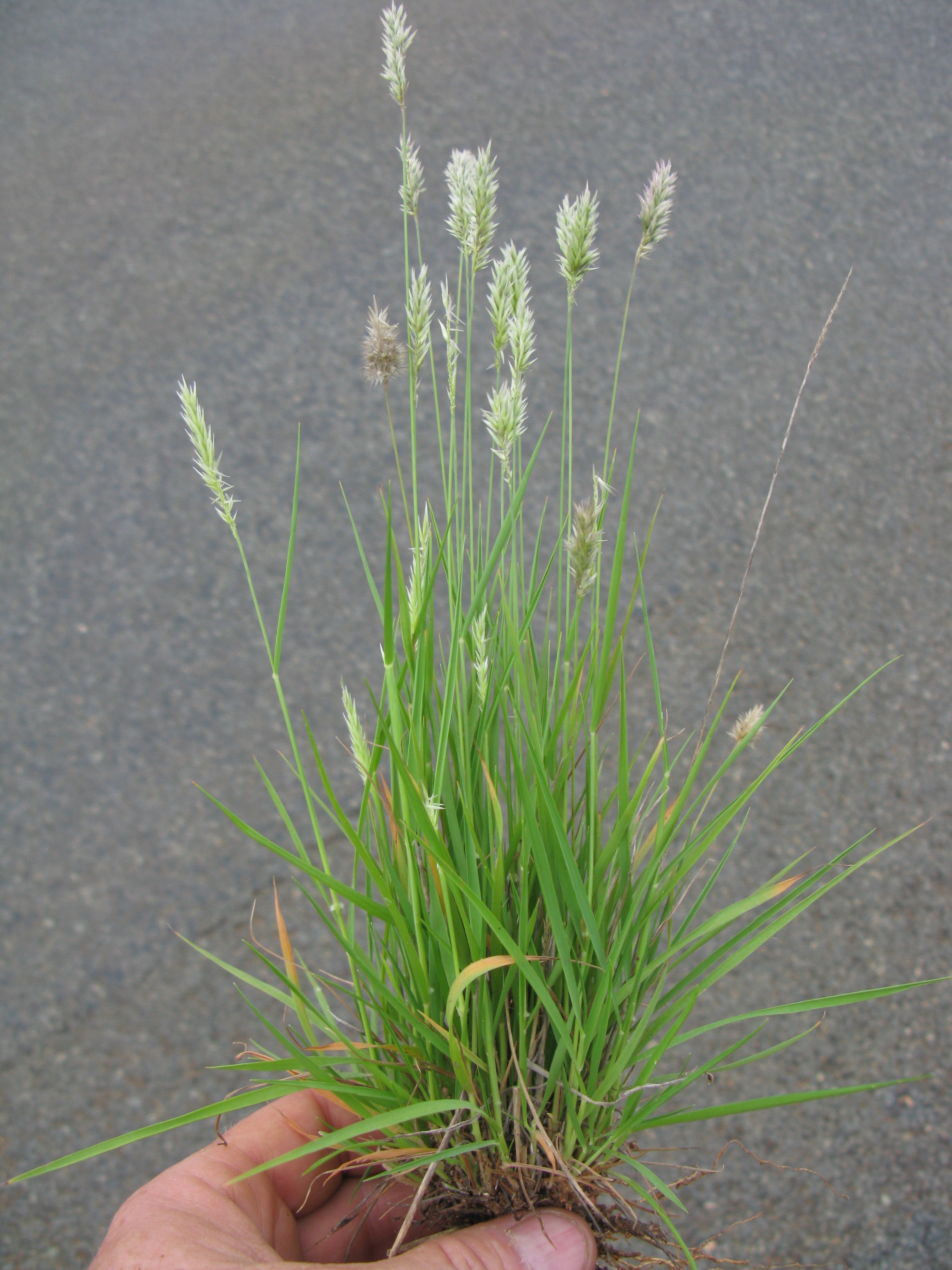
Enneapogon is a cosmopolitan genus of annual and perennial grasses in the family Poaceae (order Poales), commonly known as bottle washers or pappus grass. The name "nineawn" refers to the nine feathery awns that tip each lemma in the spikelet — a diagnostic feature of the genus. Plants typically form tufted clumps with narrow, often hairy leaves and produce small, cylindrical to spike-like inflorescences that, in many species, resemble a miniature bottle brush when dried.
The genus is widely distributed across tropical and warm temperate regions, with its centre of diversity in Australia, where numerous endemic species occur. Other species extend through Africa, Madagascar, the Arabian Peninsula, the Indian subcontinent, Central Asia, the Middle East, southwestern North America, and into South America as far south as Argentina and Chile.
Well-known members include Enneapogon desvauxii (nineawn pappusgrass), which ranges from Africa and temperate Asia through the southwestern United States and Mexico to the southern cone of South America; Enneapogon avenaceus (bottle-washers) and Enneapogon nigricans (blackheads), both Australian natives; and Enneapogon cenchroides, widespread across Africa, Madagascar, and the Indian subcontinent. The genus comprises approximately 25 accepted species.
Etymology
The name Enneapogon derives from the Greek ennea ("nine") and pōgōn ("beard"), referring to the nine feathery awns that characterise the lemma of each spikelet — the most visually distinctive feature of the genus. This same characteristic underlies the English common name "nineawn."
Distribution
Enneapogon is a cosmopolitan genus centred on Australia, where many species are endemic. The range extends through tropical and warm-temperate Africa (including Madagascar), the Arabian Peninsula, the Indian subcontinent, Central Asia, the Middle East, and into southwestern North America and South America (Bolivia, Peru, Chile, Argentina). Individual species have highly variable ranges: E. desvauxii spans multiple continents, while others such as E. foxii are known from a single country (Israel).
Ecology
Members of Enneapogon are characteristic of tropical and warm temperate grasslands, arid scrublands, and disturbed ground. Their feathery awns aid wind dispersal of seeds, and several Australian species are important components of dry inland pastures. The small, tufted growth form and drought tolerance suit them to seasonally dry or semi-arid conditions.










