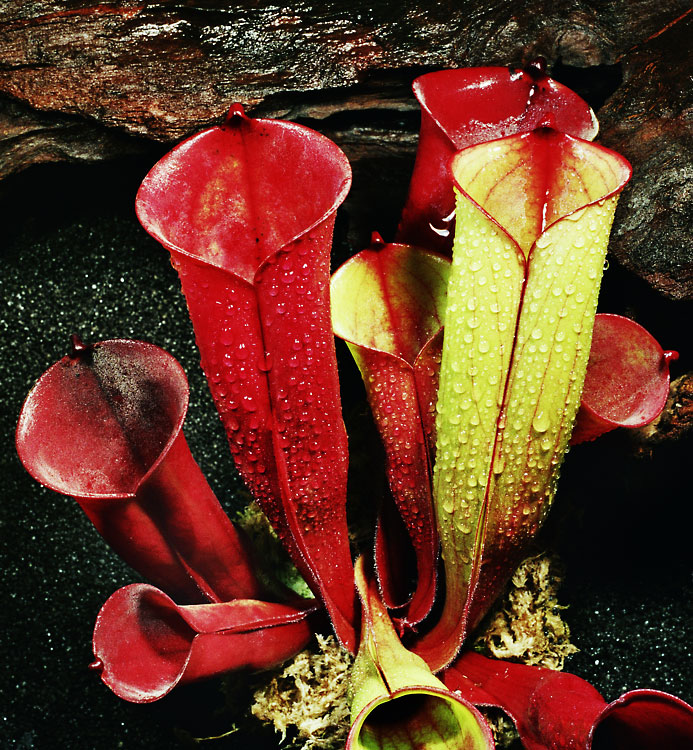
Heliamphora Benth. is a genus of 20–24 carnivorous pitcher plants in the family Sarraceniaceae, endemic to the ancient tepui tablelands of the Guiana Highlands in South America. Known as marsh pitcher plants — from the Greek helos (marsh) and amphoreus (amphora) — they are the most species-rich genus in their family and the oldest lineage of New World pitcher plants.
All species grow as stemless rosettes of tubular pitchers, produced by leaves that have rolled and fused along their margins. The traps range from just a few centimetres tall in dwarf species such as H. minor and H. pulchella, to more than 50 cm in the giants H. ionasi and H. tatei. Unlike most other carnivorous pitcher genera, Heliamphora lacks a lid (operculum) over the pitcher opening. Instead, each pitcher bears a small spoon-shaped appendage that secretes nectar-like compounds and scent volatiles to attract insect prey. Downward-pointing hairs line the interior, and a drainage hole or slit prevents the pitfall trap from overflowing in the high-rainfall tepui environment.
Digestion is unusual: most species depend on symbiotic bacteria living within the pitcher fluid to break down captured prey, rather than secreting their own proteolytic enzymes. Heliamphora tatei is the notable exception, producing both digestive enzymes and waxy scales that assist prey capture.
The genus was first described by George Bentham in 1840, based on a specimen of H. nutans collected by Robert Schomburgk in what is now Venezuela. Major revisions in the 20th century by Steyermark, Maguire, and others expanded the species count; extensive fieldwork by German horticulturists from the 1990s onward added many more. The tepuis' complex and often inaccessible geography means new species continue to be found. Phylogenetic analysis places the main lineages as products of Miocene geographic isolation, with finer diversification during Pleistocene climate oscillations.
Etymology
The genus name Heliamphora was coined by George Bentham in 1840 and combines two Greek words: helos, meaning "marsh" or "swamp," and amphoreus, meaning "amphora" (a two-handled jar). The intended meaning is therefore "marsh pitcher" or "swamp amphora," reflecting the plants' waterlogged highland habitat and the vessel-like shape of their leaves.
The genus is frequently called "sun pitchers" in popular literature, a name that conflates helos with helios (Greek for "sun"). This is a misreading: helios and helos are distinct Greek roots, and the authoritative botanical interpretation is "marsh pitcher," not "sun pitcher."
Distribution
All species of Heliamphora are endemic to the Guiana Highlands of northern South America, a region of ancient sandstone plateaus and isolated table mountains called tepuis. The primary centre of diversity is Venezuela, where the vast majority of species occur; a smaller number extend into adjacent Guyana and extreme northern Brazil.
The plants are found predominantly at elevations ranging from below 2,000 m to above 3,000 m above sea level, occupying bogs, seeps, and rocky outcrops on tepui summits and slopes where soils are nutrient-poor and rainfall is exceptionally high. The extreme isolation of individual tepuis has driven strong species-level endemism: many species are restricted to a single massif or a small cluster of summits. The highly dissected topography of the region suggests that additional undescribed species likely remain to be discovered in areas that have received little botanical exploration.
Ecology
Heliamphora species inhabit the nutrient-poor, waterlogged bogs and rocky seeps of the Guiana Highlands tepuis, environments where carnivory provides supplemental nitrogen and phosphorus unavailable from the substrate. Their pitfall traps accumulate rainwater, and a drainage hole or slit in each pitcher prevents dilution overflow during the region's heavy rainfall.
Most species do not secrete their own digestive enzymes. Instead, they rely on communities of symbiotic bacteria colonising the pitcher fluid to decompose and mineralise captured prey — primarily invertebrates attracted by nectar secretions from the "nectar spoon" appendage. The nectar spoon has been shown to express specialised genes for sugar transport and scent volatile production, actively luring prey rather than relying on passive entrapment alone. Downward-pointing hairs on the inner pitcher surface impede the escape of captured insects.
Heliamphora tatei stands apart from this pattern: it produces proteolytic digestive enzymes of its own, and additionally traps prey using waxy scales on the pitcher interior. The genus forms at least eleven documented natural hybrids where the ranges of two species overlap on shared tepui summits, indicating that reproductive barriers remain incomplete across much of the genus.
Taxonomy
Heliamphora belongs to Sarraceniaceae, one of three families of New World pitcher plants (alongside Sarracenia of North America and Darlingtonia of California). Within Sarraceniaceae the genus is the most species-rich, currently comprising 20 accepted species in the GBIF backbone and approximately 24 in the most comprehensive treatments, with two further incompletely diagnosed taxa and several undescribed variants documented. A number of additional species are anticipated as botanists access previously unvisited tepuis.
Phylogenetic work places the major clades as products of Miocene vicariance — geographic isolation as the tepuis rose and drainage systems shifted — with secondary diversification during Pleistocene glacial-interglacial cycles. One notable evolutionary trend is the modification of the pitcher's overflow mechanism: ancestral species have simple holes, while the derived E1 clade has evolved specialised slits, interpreted as an adaptation to maximise prey retention while still preventing waterlogging. At least eleven natural interspecific hybrids have been confirmed where species co-occur on shared summits, indicating that speciation remains relatively recent and reproductive isolation incomplete.
History
The genus was established in 1840 when George Bentham described Heliamphora nutans from a herbarium specimen collected by the explorer Robert Schomburgk during his survey of the Guiana region for the Royal Geographical Society. Bentham's description appeared in the Proceedings of the Linnean Society.
The genus then received little attention for nearly a century. Henry Gleason described H. tatei and H. tyleri in 1931 and H. minor in 1939. Julian Steyermark added H. heterodoxa in 1951, and a major revision by Steyermark and Bassett Maguire between 1978 and 1984 described H. ionasi and H. neblinae while clarifying species boundaries across the genus.
The most dramatic expansion of species knowledge began in the 1990s and continued into the 2000s and 2010s, driven largely by German carnivorous-plant specialists — Thomas Carow, Joachim Harbarth, Joachim Nerz, and Andreas Wistuba — who undertook dedicated expeditions to remote tepuis and described numerous new species. This fieldwork roughly doubled the species count within a generation, and ongoing exploration continues to yield new taxa.
Cultivation
Heliamphora is considered one of the more challenging carnivorous genera to cultivate successfully, primarily because of the specific microclimatic conditions of its tepui habitats. Most growers use a mix of shredded live or long-fibred sphagnum moss combined with inorganic amendments such as lava rock, perlite, or pumice to maintain both moisture and aeration. Mineral-free or purified water is essential; tap water is unsuitable.
Temperature requirements vary by origin. Highland species — including H. nutans, H. ionasi, and H. tatei — require cool conditions and are sensitive to heat stress, performing best where nights are cool and day temperatures do not exceed the low-to-mid 20s Celsius. Lowland species such as H. ciliata and H. heterodoxa tolerate warmer conditions. Regardless of species, humidity must remain consistently very high; frequent misting or a humid terrarium environment is usually necessary.
Bright, indirect light or high-intensity artificial lighting is appropriate. The plants are not fast-growing, and patience is required before established clumps develop.
Propagation
Vegetative propagation by division is possible but has a low success rate, as the plants produce rhizomes slowly and disturbance of established clumps frequently leads to losses.
Seed propagation is more reliable for obtaining numbers of plants. Seeds should be sown fresh on the surface of milled or fine sphagnum moss and kept under bright light at high humidity. Germination is slow and irregular, often taking many weeks to several months. Seedlings require the same humid, cool conditions as adult plants and grow slowly in the early stages.










