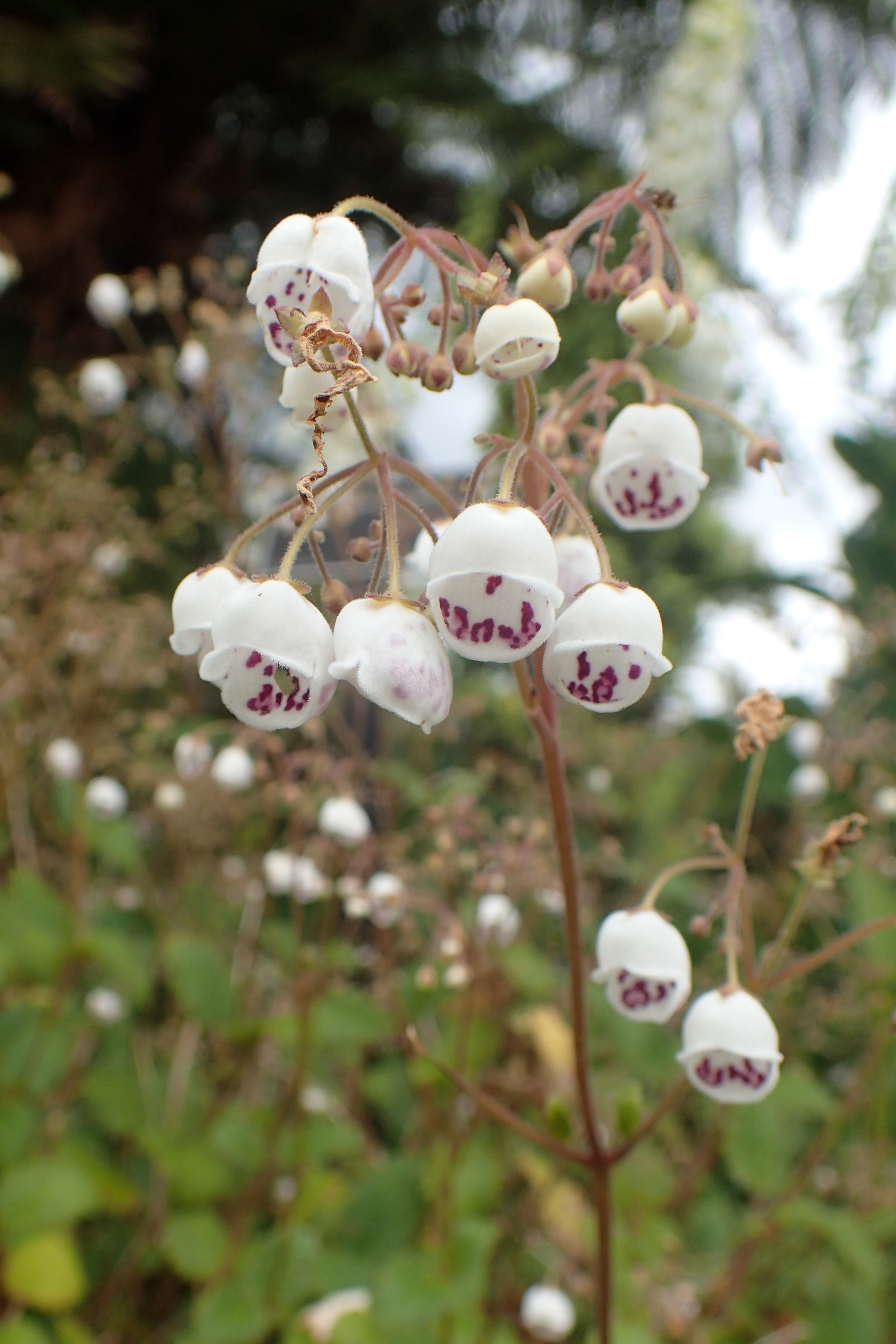
Jovellana is a small genus of flowering plants in the family Calceolariaceae, placed within the order Lamiales. It was long classified in the broader family Scrophulariaceae, but molecular research demonstrated that Scrophulariaceae was polyphyletic — containing unrelated lineages — prompting the reassignment of Jovellana and several allied genera to Calceolariaceae and other segregate families.
The genus currently comprises four accepted species of mainly herbaceous perennials. They are native to two widely separated regions: Chile in South America and New Zealand, a disjunct distribution that has attracted considerable botanical commentary. This pattern is not unique among flowering plants — the genus Fuchsia similarly spans Central and South America, New Zealand, and Tahiti. Molecular clock analyses suggest the South American and New Zealand lineages of Jovellana diverged approximately 4.1 million years ago, likely via long-distance dispersal facilitated by the climatic similarity between central Chile and temperate New Zealand as it cooled through the Late Miocene and Pliocene.
Plants in the genus bear simple leaves and produce, in summer, nodding sprays of single, two-lipped, bell-shaped flowers in shades of white, lilac, and purple, marked inside with heavy spotting in a contrasting colour. At least three species are cultivated as ornamental garden plants valued for these distinctive flowers. The best-known in horticulture is Jovellana violacea, a semi-evergreen subshrub reaching 2.5 m tall, which has received the Royal Horticultural Society's Award of Garden Merit.
Etymology
The genus name Jovellana honours Gaspar Melchor de Jovellanos (1744–1811), a Spanish statesman, writer, and botanist. The genus was described by Hipólito Ruiz López and José Antonio Pavón, who named it in his honour.
Distribution
Jovellana has a markedly disjunct distribution, with species occurring in Chile (South America) and New Zealand. Molecular evidence indicates the two population groups diverged approximately 4.1 million years ago, likely through long-distance dispersal rather than vicariance. The South American and New Zealand species within each clade subsequently diverged from one another around 1.0 million years ago.
History
The genus was described by Hipólito Ruiz López and José Antonio Pavón in the late 18th century during their botanical exploration of South America. The presence of Jovellana in New Zealand is thought to reflect long-distance dispersal during the Late Miocene and Pliocene, when New Zealand's North Island climate cooled from subtropical to a temperate regime resembling that of central Chile, potentially enabling colonisation by South American lineages.
Cultivation
At least three species of Jovellana are grown as ornamental garden plants. They tolerate frost to approximately −5 °C (23 °F) but perform best in a sheltered position in full sun. Jovellana violacea is the most widely cultivated, forming a semi-evergreen subshrub to 2.5 m tall and 1 m wide, bearing lilac flowers spotted purple on a yellow background; it holds the Royal Horticultural Society's Award of Garden Merit.
Taxonomy Notes
Jovellana was historically placed in Scrophulariaceae, a large and heterogeneous family. Molecular phylogenetic studies revealed Scrophulariaceae to be polyphyletic, and several of its genera — including Jovellana — were transferred to Calceolariaceae. The genus is now accepted within Calceolariaceae in the order Lamiales, with authorship attributed to Ruiz & Pav.










