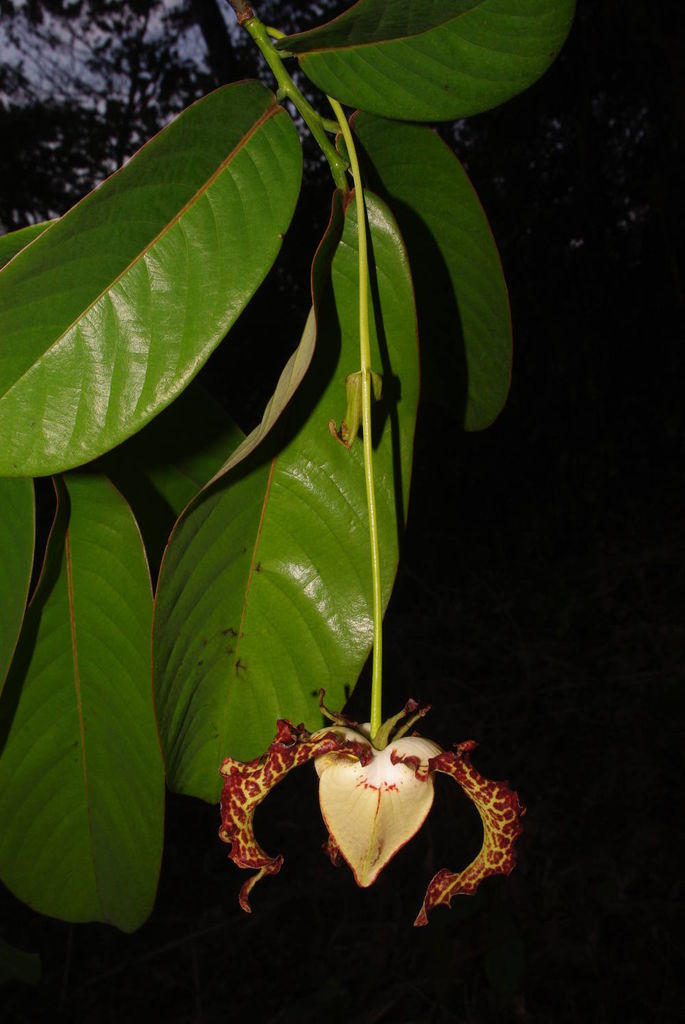
Monodora is a genus of approximately 15 species of flowering trees and shrubs in the family Annonaceae (the custard apple family), order Magnoliales. All known species are native to tropical Africa, ranging from West Africa across Central Africa to East Africa.
Members of the genus are typically medium to large trees. The genus is characterised by its striking flowers, which are large, pendant, and fragrant — with six petals arranged in two whorls and often marked with vivid spots of red, green, and yellow. The flowers are protogynous (the stigma becomes receptive before the stamens shed pollen) and are pollinated by insects. Fruits are large, smooth, spherical woody berries containing numerous seeds embedded in a fragrant pulp.
The most economically and culturally significant species is Monodora myristica (Gaertn.) Dunal, known as calabash nutmeg or African nutmeg. Its seeds have a flavour reminiscent of true nutmeg and have long been used as a spice in West African cooking, ground or sold whole for use in soups, stews, and baked foods. During the 18th century, the species was carried to the Caribbean via the slave trade, where it became established on several islands under the name Jamaican nutmeg. The timber of M. myristica is also valued for carpentry and joinery, and various parts of the tree are used in traditional medicine across its range.
Because of its spectacular orchid-like flowers, M. myristica is also cultivated as an ornamental; it was introduced to the Bogor Botanical Gardens in Indonesia in 1897. Other notable members of the genus include Monodora tenuifolia, M. zenkeri, M. stenopetala, and several species formally described in recent decades by botanist Thomas Couvreur.
Distribution
Monodora is restricted to tropical Africa, with the approximately 15 species collectively ranging from West Africa (Sierra Leone, Liberia, Ghana, Nigeria) through Central Africa (Cameroon, Democratic Republic of Congo, Angola) to East Africa (Uganda, Tanzania). Most species occupy lowland tropical evergreen forest habitats.
Ecology
Species of Monodora grow in tropical evergreen and semi-deciduous forests. Their large, pendant, fragrant flowers are insect-pollinated; the flowers are protogynous, with the stigma receptive before the stamens release pollen, which promotes cross-pollination. The large woody fruits contain seeds surrounded by fragrant pulp, suggesting dispersal by animals.
Cultural Uses
Monodora myristica, the calabash nutmeg, has been used for centuries as a spice across West and Central Africa. Its dried seeds — sold whole or ground under names including ehuru, ariwo, awerewa, and ehiri — flavour soups, stews, cakes, and desserts and serve as a substitute for true nutmeg. The seeds are also used medicinally as stimulants and stomachics, and in treatments for headaches, sores, and as an insect repellent; they are occasionally made into necklaces. The hard timber is used for carpentry and joinery, while the bark features in traditional remedies for stomach complaints, fever, and eye diseases.
History
The calabash nutmeg (M. myristica) was once widely traded as an inexpensive substitute for true nutmeg. During the 18th-century Atlantic slave trade, the species was introduced to Caribbean islands where it naturalised and became known as Jamaican nutmeg. In 1897 it was introduced to the Bogor Botanical Gardens in Indonesia, where trees flower regularly. Its common cultivation as an ornamental reflects the beauty of its large, orchid-like flowers.










