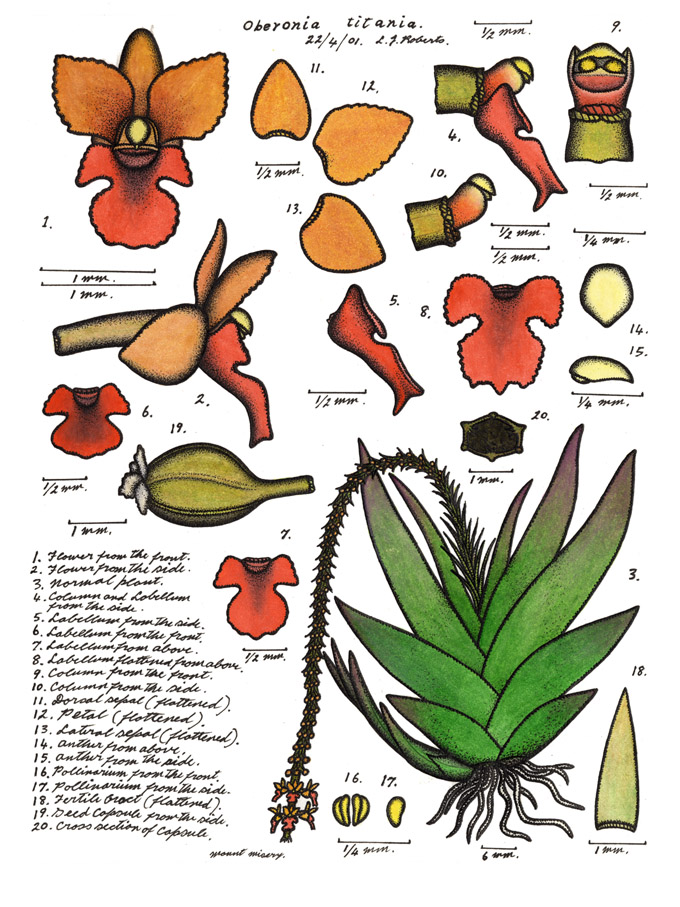
Oberonia, commonly known as fairy orchids, is a large genus of flowering plants in the family Orchidaceae (order Asparagales), comprising around 270 species of epiphytic or lithophytic orchids. The genus was first formally described in 1830 by the British botanist John Lindley in The Genera and Species of Orchidaceous Plants.
Plants in the genus are sympodial herbs with an unusual fan-like leaf arrangement: the leaves overlap in two rows near the base and spread outward toward the tips. The flowers are among the most distinctive features of the genus — tiny, short-lived, non-resupinate, and cup-shaped, produced in large numbers arranged in whorls or spirals along an arching stem that emerges from the base of the uppermost leaf. The sepals and petals are broadly similar in appearance and free from one another, though the petals are narrower than the sepals. The labellum is rigidly attached to the base of the column and is typically three-lobed.
Oberonia ranges across a vast tropical and subtropical belt, from tropical Africa through southern Asia — including India, China, Japan, Indochina, Indonesia, and the Philippines — to Australia and the islands of the Pacific and Indian Oceans.
Etymology
The name Oberonia was coined by John Lindley in 1830 as a reference to Oberon, the king of the fairies in English folklore, evoking the genus's extraordinarily tiny flowers and their intricate, whirling arrangement along the flowering stems. The common name "fairy orchids" derives from the same allusion.
Distribution
Oberonia orchids are native to a wide pan-tropical range extending from tropical and southern Africa eastward through southern Asia — including India, China, Japan, Indochina, Indonesia, and the Philippines — to Australia and numerous islands of the Pacific and Indian Oceans.
Taxonomy Notes
The genus was established in 1830 by John Lindley in The Genera and Species of Orchidaceous Plants and is placed in the family Orchidaceae, order Asparagales. It currently encompasses approximately 270 accepted species, though circumscription has varied and some authorities recognize additional or fewer species depending on treatment.










