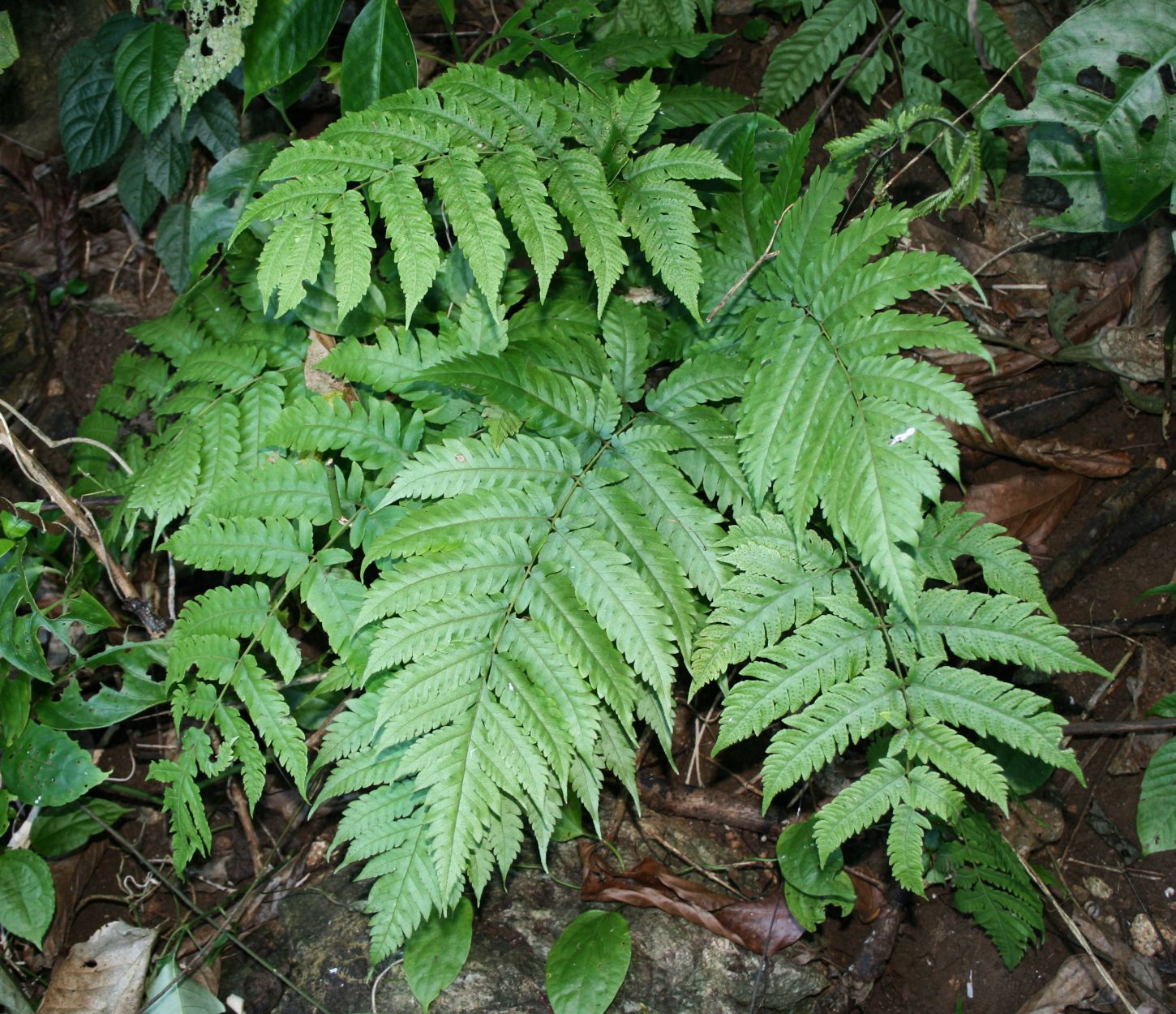
Tectaria is a large genus of tropical and subtropical ferns belonging to the family Tectariaceae, within the order Polypodiales. The genus was established by the Spanish botanist Antonio José Cavanilles in 1799, published in his Analectos de Historia Natural, and encompasses approximately 200–430 accepted species distributed across the world's tropical regions.
Members of Tectaria are terrestrial or occasionally epilithic ferns, typically growing from short, erect or creeping rhizomes. The fronds are usually pinnate to bipinnate, sometimes simple or trifoliate, and tend to be broad and herbaceous in texture. Sori are round and borne on the underside of the fronds, protected by kidney-shaped or round indusia. The genus is commonly known as halberd ferns, a name that refers to the characteristic lobed or angled shape of the frond segments seen in many species.
Tectaria is placed in its own family, Tectariaceae, which was recognised by the Pteridophyte Phylogeny Group (PPG I) in 2016 following molecular phylogenetic work that separated it from the broader Dryopteridaceae concept previously used. The family has undergone considerable taxonomic revision: many species were historically treated under Aspidium, a now-illegitimate name, before being reassigned to Tectaria or related genera.
The genus has its greatest diversity in Southeast Asia and the Pacific islands, with significant representation also in tropical Africa, the Americas (from Florida and the Caribbean through Central and South America), and the Indian Subcontinent. Taiwan, the Philippines, Indonesia, China, and Malaysia are among the most occurrence-rich regions. A handful of species reach subtropical Japan and the southern United States.
Etymology
The genus name Tectaria was coined by the Spanish botanist Antonio José Cavanilles in 1799, published in Analectos de Historia Natural (1: 115). The name is derived from the Latin tectum ("roof" or "covering"), likely alluding to the indusium that covers the sori on the underside of the fronds.
Distribution
Tectaria has a pantropical distribution spanning Asia, the Americas, Africa, and the Pacific. The genus is most diverse in Southeast Asia — particularly Taiwan, the Philippines, Indonesia, Malaysia, Vietnam, and southern China — with additional centres of diversity in Central and South America (Mexico, Costa Rica, Colombia, Ecuador, Brazil), the Caribbean, tropical Africa, and the Indian Subcontinent. A few species extend into subtropical regions such as southern Japan and Florida, USA.
Taxonomy Notes
The genus was established by Cavanilles in 1799 with Tectaria trifoliata as the type species. The name Aspidium Sw. (1801), long used for many of these ferns, is an illegitimate synonym. Modern molecular phylogenetics led the Pteridophyte Phylogeny Group (PPG I, 2016) to formally recognise the family Tectariaceae, separating Tectaria and its relatives from the previously broader Dryopteridaceae. The genus currently encompasses approximately 434 species in the GBIF backbone, though circumscriptions vary among authorities.










