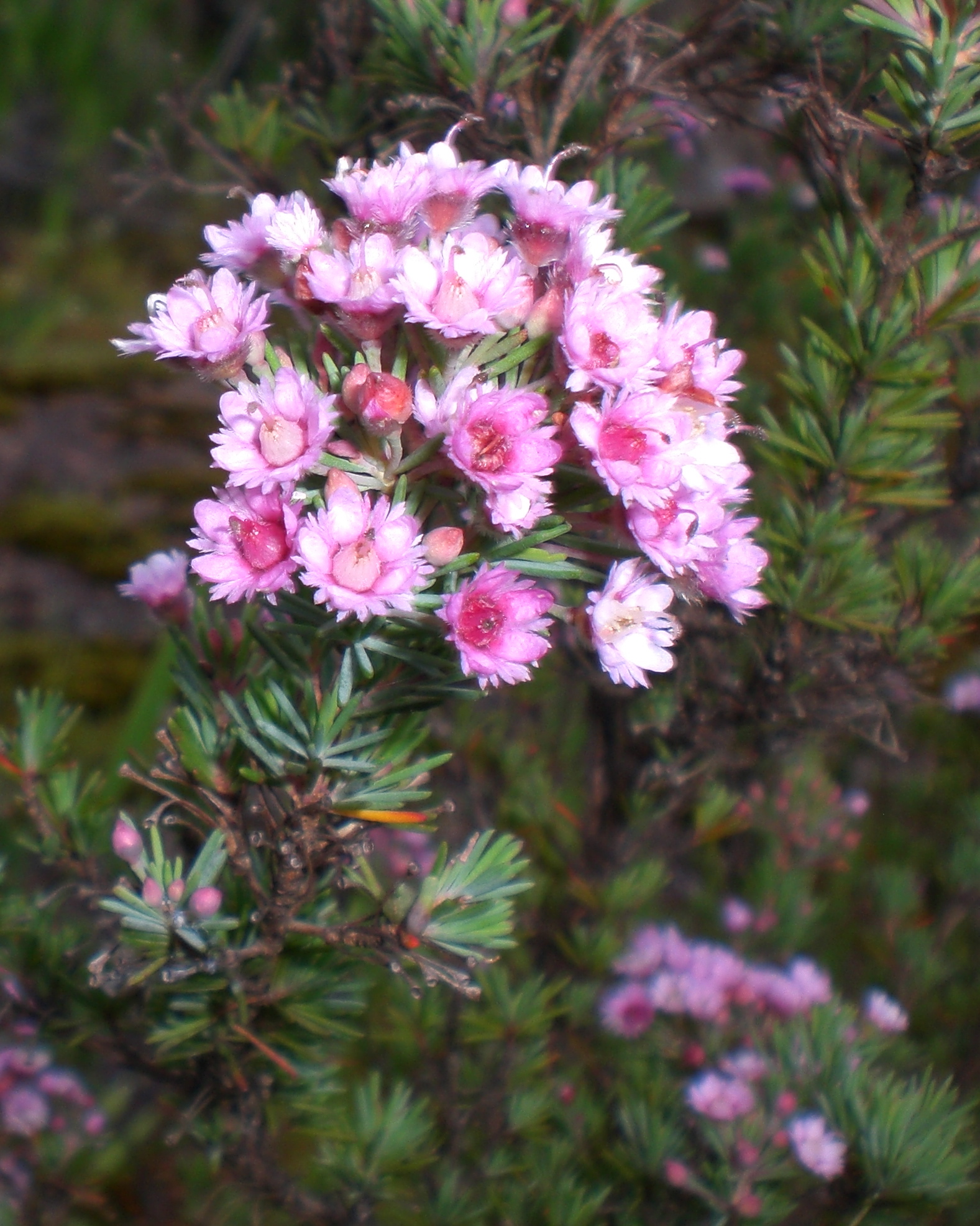
Verticordia, commonly known as featherflowers, is a genus of more than 100 flowering shrubs in the myrtle family (Myrtaceae), native almost entirely to Australia. Plants range from compact ground-hugging shrubs to specimens reaching 7 metres in height, and the genus is among the most ornamentally striking of all Australian wildflowers. The name Verticordia translates literally as "turner of hearts," a reference to the Roman goddess Venus — fitting, since myrtle was sacred to Venus and Verticordia belongs to the same family.
The flowers are the genus's defining feature. Sepals and petals are finely divided into feathery or hair-like segments, giving each bloom a soft, plume-like appearance. Flower colour spans the full spectrum — white, cream, yellow, orange, pink, red, and purple — with the notable exception of blue. Individual flowers are borne on separate stalks but arranged so densely that they appear clustered.
The overwhelming majority of species occur in Southwest Australia, concentrated in the Mediterranean-climate region of Western Australia, where they inhabit woodlands, sandy heaths, and granite outcrops. Only a small number of species reach the Northern Territory or Queensland. The Western Australian Herbarium lists 181 Verticordia taxa, and GBIF records 180 descendant taxa globally. The genus is also popular in the cut flower trade.
Within the genus, Alex George's 1991 revision recognised three subgenera — Chrysoma (21 species), Verticordia (36 species), and Eperephes (44 species) — arranged across 24 sections. Numerous species and varieties carry formal conservation codes in Western Australia; Verticordia albida and V. apecta are listed as Threatened.
Etymology
The genus name Verticordia is Latin for "turner of hearts" (vertere, to turn; cor/cordis, heart). It alludes to the Roman goddess Venus, an epithet applied to Venus in her role as changer of hearts. The connection is botanical as well as mythological: myrtle was the plant sacred to Venus in classical tradition, and Verticordia belongs to the myrtle family (Myrtaceae). The genus was formally described by the Swiss-French botanist Augustin Pyramus de Candolle in 1828, published in his Prodromus Systematis Naturalis Regni Vegetabilis.
Distribution
Verticordia is endemic to Australia. Nearly all species are native to the Southwest Australian Floristic Region — one of the world's biodiversity hotspots — where they are concentrated in areas with a Mediterranean-type climate. Only a small number of species extend into the Northern Territory, and Queensland is also recorded as part of the range (WCVP via GBIF). Within Western Australia the genus occupies woodlands, sandy heaths, and granite outcrops across the southwest. All 181 taxa in the Western Australian Herbarium database (FloraBase) are recorded from Western Australia. The Atlas of Living Australia holds over 23,000 occurrence records for the genus.
Ecology
Verticordia species are adapted to nutrient-poor, freely draining substrates — sandy soils, gravelly soils, and granite outcrops — in the Mediterranean-climate zones of southwestern Australia. The greatest species richness occurs in the Southwest Australian Floristic Region, which experiences hot dry summers and cool wet winters. Outside this zone, elevated humidity readily causes fungal problems, which accounts for the genus's difficulty in cultivation east of the Great Dividing Range. Many species are fire-adapted, regenerating in open heath and woodland communities after periodic disturbance.
Cultivation
Verticordias are renowned as ornamental plants but are considered demanding to grow outside their native Southwest Australian climate. The principal challenge in humid regions (such as eastern Australia) is susceptibility to fungal diseases, which can rapidly kill plants established in heavy or poorly drained soils. Key requirements are excellent drainage, full sun, and a dry summer climate. Verticordia plumosa is consistently cited as the most adaptable and reliable species for garden use. In Sydney and other humid-temperate regions, success has been reported in raised beds with very sharp drainage in open, well-ventilated positions. Grafting onto related genera — particularly Darwinia citriodora and Chamelaucium uncinatum (geraldton wax) — has shown promise as a way to extend cultivability onto rootstocks more tolerant of heavier soils and higher moisture.
Conservation
Several Verticordia species carry formal conservation listings in Western Australia. Under the Western Australian Wildlife Conservation Act, V. albida and V. apecta are listed as Threatened (Conservation Code T). Additional species are classified under the Priority Flora system: V. aereiflora, V. argentea, and V. brevifolia subsp. stirlingensis are Priority 2 (Rare or Poorly Known — taxa from few locations); V. amphigia, V. attenuata, and V. brevifolia subsp. brevifolia are Priority 3 (Poorly Known). The conservation challenges reflect the genus's narrow endemism in the Southwest Australian Floristic Region, where habitat modification (land clearing for agriculture, altered fire regimes, invasive weeds) threatens localised species.
History
The first European collections of Verticordia were made in 1791 by Archibald Menzies during a voyage along the Western Australian coast. René Desfontaines provided the first formal description in 1826, and in 1828 Augustin de Candolle placed the genus in its current form in his Prodromus, citing its original publication in the Dictionnaire classique d'histoire naturelle (Dict. Class. 11: 400). The genus has carried several historical synonyms — Diplachna, Chrysorrhoea, and Chrysorhoe — before the name Verticordia was conserved by the Australian Plant Census. The most significant modern treatment is Alex George's 1991 comprehensive revision, which formalised three subgenera, 24 sections, and 102 species.
Taxonomy notes
Verticordia DC. (1828) belongs to the family Myrtaceae, order Myrtales, class Magnoliopsida, phylum Tracheophyta, kingdom Plantae. The genus is currently structured into three subgenera: Chrysoma (21 species), Verticordia (36 species), and Eperephes (44 species), with approximately 101 accepted species across 24 sections. GBIF records 180 descendant taxa; the Western Australian Herbarium (FloraBase) lists 181. Historical synonyms include Diplachna, Chrysorrhoea, and Chrysorhoe. The name Verticordia is treated as a conserved name under the Australian Plant Census.
Propagation
Three propagation methods are used for Verticordia:
Seed: Germination is erratic and slow, sometimes taking more than a year. Seeds have no standard pre-treatment that reliably accelerates the process, and seed viability can be variable.
Cuttings: Semi-hardwood cuttings of the current season's growth are used, with variable success rates. Application of a root-promoting hormone (IBA) improves strike rates.
Grafting: Research has demonstrated that Verticordia can be successfully grafted onto Darwinia citriodora or Chamelaucium uncinatum rootstocks. Grafting is particularly valuable for species and cultivars that resist other propagation methods, and for extending cultivation into soils and climates unsuited to the genus on its own roots.










