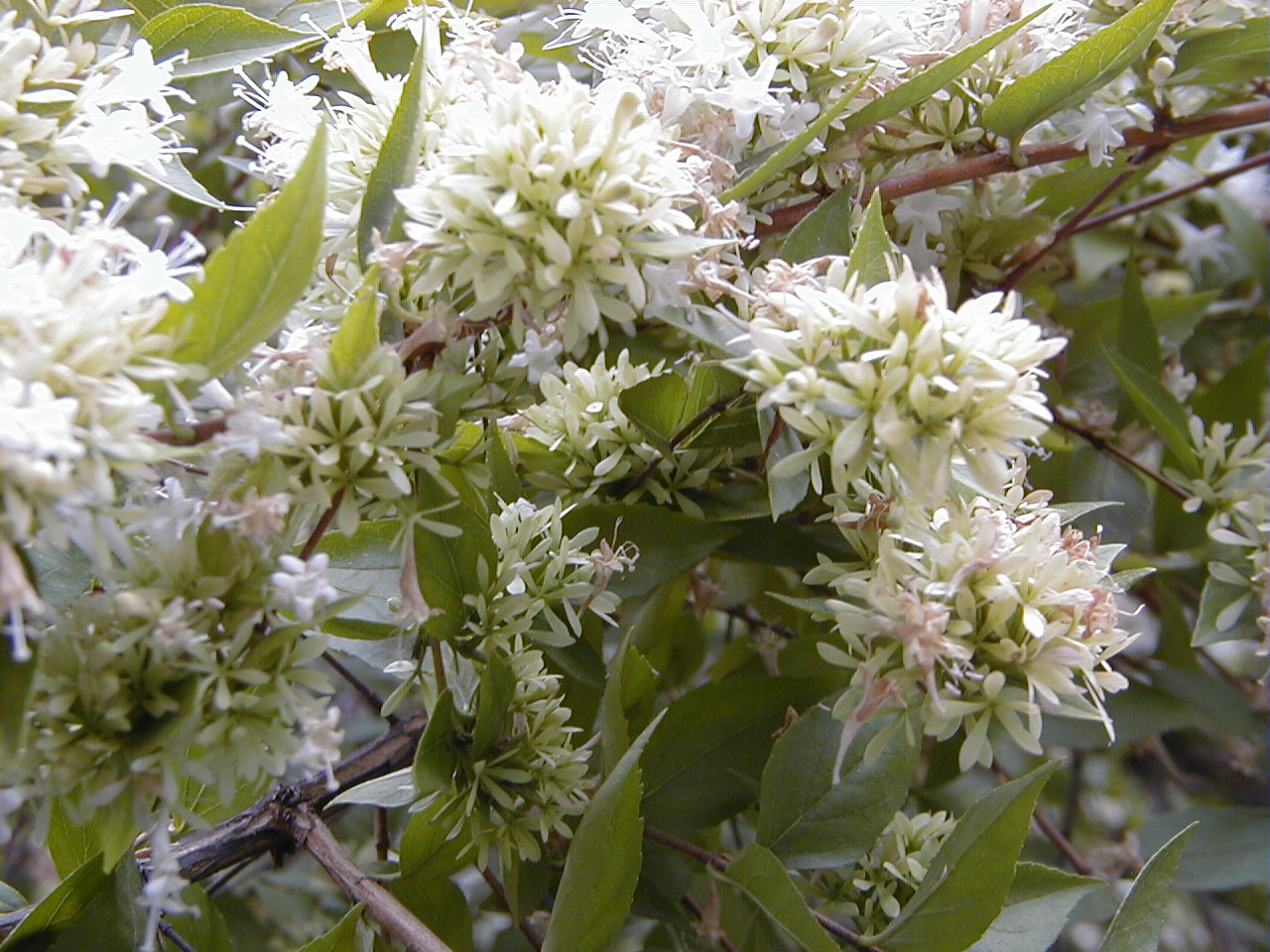
Abelia is a genus of flowering shrubs in the family Caprifoliaceae (subfamily Linnaeoideae), placed by some taxonomic authorities in the segregate family Linnaeaceae, within the order Dipsacales. The genus currently comprises six accepted species native to eastern Asia — primarily China, with species also in Taiwan and Vietnam.
Plants in the genus are shrubs ranging from 1 to 6 metres in height. Depending on the climate of their origin, species may be evergreen or deciduous; warm-climate species retain their leaves year-round, while those from cooler regions drop them in autumn, often with attractive foliage colour changes to purplish-bronze or red. Leaves are opposite or occasionally in whorls of three, ovate, and glossy dark green, typically 1.5–8 cm long. The flowers are borne in the upper leaf axils and at stem tips, pendulous, white to pink, and bell-shaped with a five-lobed corolla measuring 1–5 cm in length; they are usually scented and produced continuously over a long season from late spring through autumn.
The genus formerly contained around 30 species and numerous hybrids, but molecular phylogenetic studies demonstrated that it was not monophyletic. Following revisions published in 2015 by Wang, Landrein, and colleagues, the subfamily Linnaeoideae was reorganised into six monophyletic genera: Dipelta, Kolkwitzia, Linnaea, Vesalea (for former Mexican Abelia species), the newly created Diabelia, and the residual Abelia retaining six Asian species. Zabelia had previously been split off as a separate genus. Plants of the World Online accepts this narrower circumscription.
Despite these taxonomic changes, Abelia retains horticultural prominence, and several former members continue to be sold and catalogued under the name. The most widely grown ornamental is the artificial hybrid Abelia × grandiflora (a cross of A. chinensis × A. uniflora), prized for its long flowering season and semi-evergreen foliage.
Etymology
The genus name Abelia commemorates Clarke Abel (1780–1826), a British surgeon and naturalist who accompanied Lord Amherst's diplomatic embassy to China in 1816. Though Abel collected seeds and plants during the mission, all specimens were lost in a shipwreck on the return voyage. Living plants of Abelia chinensis were first successfully introduced to England in 1844 by the plant hunter Robert Fortune.
Distribution
The six currently accepted species of Abelia are native to eastern Asia, with their range centred on China and extending to Taiwan and Vietnam. The genus was once considered to have a much broader distribution, but taxonomic revisions transferred the majority of former species — including those from Mexico and Japan — to other genera such as Vesalea, Diabelia, and Zabelia.
Cultivation
Several species and hybrids of Abelia are grown as ornamental garden plants. Though not fully hardy in colder climates, they are generally easy to cultivate in a sheltered, sunny position. The cultivar Abelia 'Edward Goucher' has received the Royal Horticultural Society's Award of Garden Merit. Many plants sold commercially under the name Abelia may in fact belong to the segregate genus Diabelia following recent taxonomic revisions, but remain described as Abelia in horticultural listings.
Taxonomy Notes
The circumscription of Abelia has undergone significant revision. The genus was long thought to contain around 30 species, but molecular phylogenetic studies revealed it was polyphyletic. In 2013, Maarten Christenhusz proposed merging Abelia and related genera into Linnaea. The 2015 revision by Wang, Landrein, et al. instead reorganised subfamily Linnaeoideae into six separate monophyletic genera, leaving only six Asian species in a narrowly defined Abelia. GBIF places the genus in Linnaeaceae while other authorities place it in Caprifoliaceae — reflecting ongoing disagreement over whether Linnaeaceae should be recognised as distinct from Caprifoliaceae.










