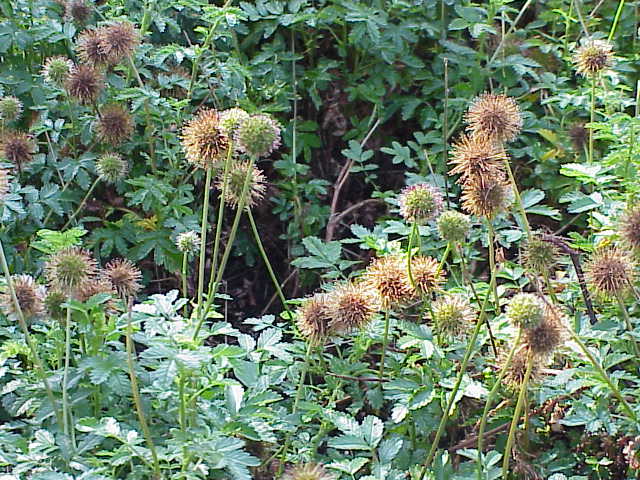
Acaena is a genus of roughly 60 species of mainly evergreen, creeping herbaceous perennials and subshrubs in the family Rosaceae (subfamily Rosoideae, tribe Sanguisorbeae). Plants are typically low-growing, forming dense mats, with alternate pinnate leaves measuring 4–15 centimetres bearing 7–21 leaflets. The flowers are small and petalless, held in compact, globose inflorescences 1–2 centimetres across. After flowering, the fruits develop into distinctive spiny burr-balls — the barbed, arrowhead-tipped spines catching on animal fur, feathers, and clothing to aid long-distance seed dispersal.
The genus is native mainly to the Southern Hemisphere, with its greatest diversity in New Zealand, Australia, and South America. A few species reach the Northern Hemisphere, including Acaena exigua in Hawaii and Acaena pinnatifida in California. Several species have been introduced far beyond their native ranges, sometimes becoming invasive: in the United Kingdom, Acaena novae-zelandiae is now common on coastal sand dunes, where its dense mats crowd out native vegetation.
The name Acaena comes from the Greek word akaina, meaning "thorn," a reference to the spiny hypanthium that gives the fruits their characteristic burr character. In New Zealand, native species are collectively known as piripiri in Māori, rendered in English as "bidibid" (also biddy-biddy or bidi-bidi). The English common name "bidgee widgee" is also applied, particularly in Australia.
Etymology
The generic name Acaena is derived from the Greek word akaina, meaning "thorn." This refers to the spiny hypanthium that surrounds and arms the fruit, forming the characteristic burr. The genus was formally published by Mutis ex Linnaeus in Mantissa Plantarum (Mant. 2: 145) in 1771.
Distribution
Acaena is distributed predominantly across the Southern Hemisphere. Its centres of diversity are New Zealand, Australia, and South America, but the genus extends to sub-Antarctic islands and other southern landmasses. A small number of species reach the Northern Hemisphere: Acaena exigua is native to Hawaii, and Acaena pinnatifida occurs in California. Beyond their native ranges, several species have been introduced to Europe and elsewhere, often inadvertently via wool or animal movement, and some have naturalised widely.
Ecology
Many Acaena species are adapted to open, disturbed, or coastal habitats where their creeping habit enables rapid mat formation. The barbed burrs are highly effective at epizoochorous (external animal-mediated) dispersal — the arrowhead-tipped spines lodge readily in wool, fur, and feathers, enabling both short- and long-range spread. This dispersal mechanism is also responsible for several species becoming invasive outside their native range. In the United Kingdom, Acaena novae-zelandiae is often abundant on coastal sand dunes, where dense growth crowds out native vegetation. In California, three Acaena species are recognised as serious agricultural weeds. Initial spread in many regions is attributed to introduction via sheep's wool.
Taxonomy
Acaena belongs to the family Rosaceae, subfamily Rosoideae, tribe Sanguisorbeae. The genus was established by Mutis ex Linnaeus and published in Mantissa Plantarum (1771). GBIF records 199 species and infrageneric taxa under the genus, while approximately 60 are commonly recognised as accepted species — a gap reflecting the instability of species delimitation in the group. Plants are classified in phylum Tracheophyta, class Magnoliopsida, order Rosales.
Cultural uses
New Zealand species of Acaena are collectively known by the Māori name piripiri, rendered in English as "bidibid," "biddy-biddy," or "bidi-bidi." The common English name "bidgee widgee" is also in use, particularly in Australia. These names reflect the long familiarity of indigenous and settler communities with the plants, primarily in the context of the persistent burrs attaching to clothing, wool, and animals.










