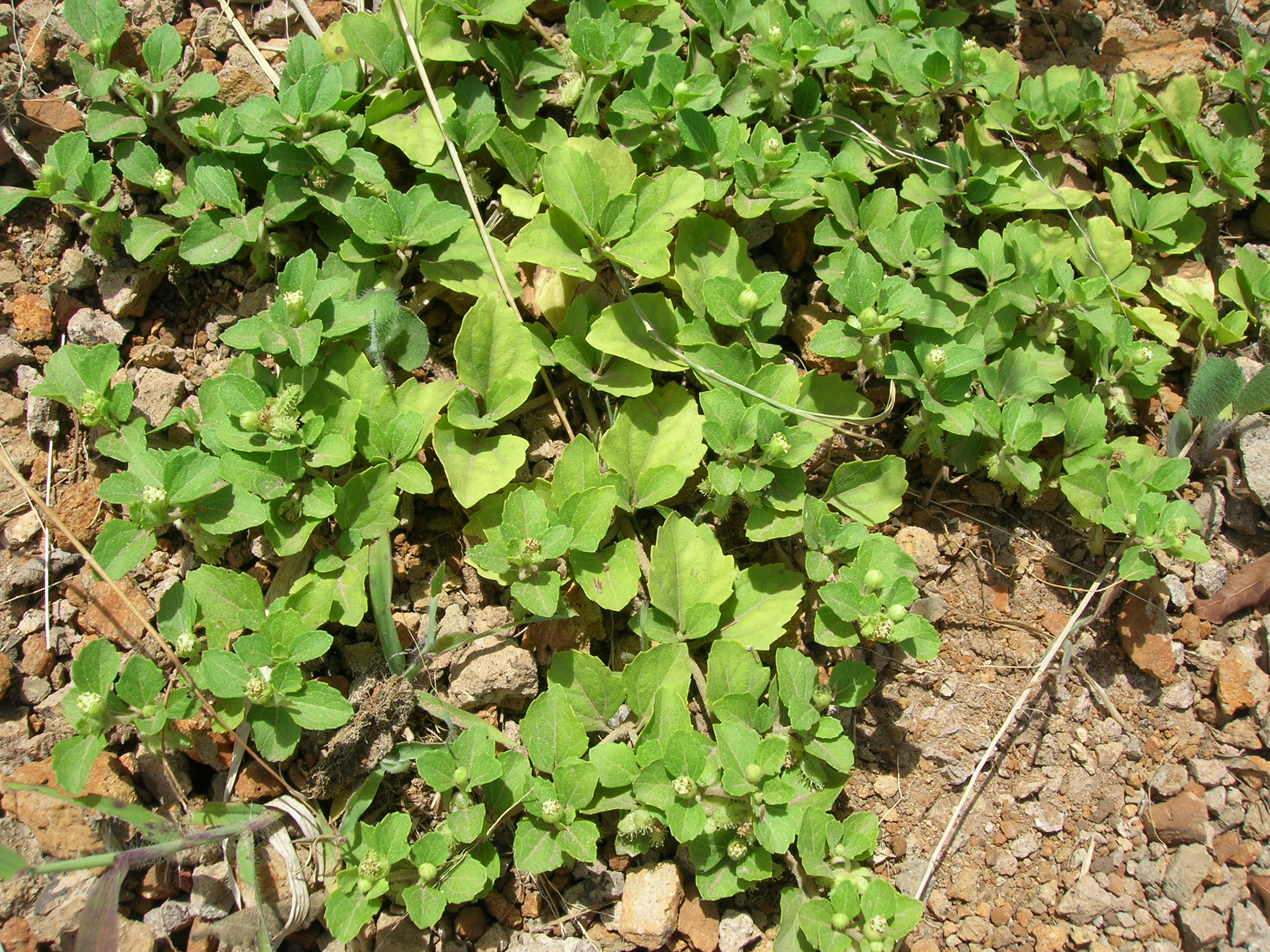
Acanthospermum is a genus of annual herbaceous plants in the daisy family Asteraceae, order Asterales. Commonly known as starburrs or starburs, the genus was first formally described by the German botanist Franz von Paula von Schrank in 1819, with publication in his work Plantae Rariores Horti Academici Monacensis. The name reflects the characteristic spiny, star-shaped burs that encase the genus's achene fruits — rigid, hooked spines that readily attach to animal fur and clothing, facilitating widespread seed dispersal.
The genus comprises around six accepted species (per Plants of the World Online, 2023): Acanthospermum australe, A. hispidum, A. humile, A. consobrinum, A. glabratum, and A. microcarpum. Native to tropical and subtropical South America and the Caribbean, several species — most notably A. hispidum — have become widespread weedy introductions across sub-Saharan Africa, South and Southeast Asia, parts of China, the Arabian Peninsula, Macaronesia, and the southern United States. GBIF records the genus as introduced across more than 30 regions outside its native range.
Within Asteraceae, Acanthospermum belongs to tribe Heliantheae. The genus is distinguished by its opposite leaves, small yellow or whitish flower heads, and the hardened, spiny bur-like involucral bracts surrounding each fertile floret. The burs are a reliable diagnostic feature at the genus level.
Etymology
The genus name Acanthospermum derives from the Greek akantha (thorn or spine) and sperma (seed), referring to the spiny bur-like structures encasing the seeds that are the genus's most distinctive feature.
Distribution
The genus is native to tropical South America and the Caribbean, with species ranging from the West Indies and Ecuador (including the Galápagos) through Brazil, Paraguay, Bolivia, Colombia, and Argentina. Several species, particularly A. hispidum and A. australe, have been widely introduced as agricultural weeds across sub-Saharan Africa, South and Southeast Asia, China, the Arabian Peninsula, Macaronesia, and the southeastern United States.
Taxonomy Notes
Acanthospermum was described by Schrank in 1819 and published in Pl. Rar. Hort. Monac. T. 53 (1819–1820). Synonyms include Centrospermum Kunth, Echinodium Poit. ex Cass., and Orcya Vell. The genus is placed in tribe Heliantheae within Asteraceae. Plants of the World Online currently accepts 6 species.










