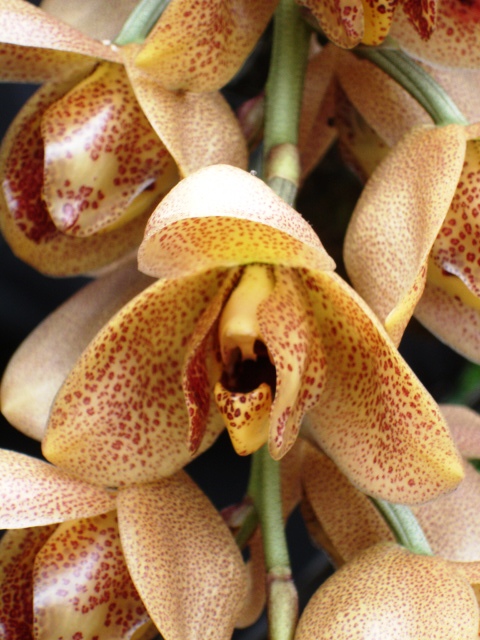
Acineta is a small genus of epiphytic orchids in the family Orchidaceae (order Asparagales), native to the tropical mountainous forests of Central and South America, from Mexico to western South America. These orchids grow at altitudes up to 2,000 metres, typically as epiphytes on trees but occasionally as lithophytes on steep embankments.
The genus is characterised by large, plicate, parallel-nerved leaves that resemble those of Peristeria and Lycaste, while the structure of the flowers bears a closer resemblance to Stanhopea — all related genera within the subtribe Stanhopeinae. Plants produce a pendent inflorescence bearing racemes of many fragrant, cup-shaped flowers in shades ranging from pale yellow to reddish brown. The labellum (lip) has side lobes that converge in a central callus, with the basal hypochile being at least as long as the side lobes. The column is pubescent and typically bears two pollinia, though the species Acineta dalessandroi unusually has four, casting some doubt on its generic placement. Pollination is carried out by male euglossine bees of the genera Eulaema or Eufriesia.
The horticultural abbreviation for the genus is "Acn," and several intergeneric hybrids have been registered, including ×Aciopea (Acineta × Stanhopea) and ×Acinbreea (Acineta × Embreea).
Etymology
The genus name Acineta is derived from the Greek word akinetos, meaning “immobile” or “unmoving,” in reference to the rigid, fixed labellum (lip) characteristic of the flowers.
Distribution
Acineta species are found in tropical mountainous forests from Mexico to western South America, occurring at elevations up to 2,000 metres. They are primarily epiphytic orchids, though they may also grow as lithophytes on steep embankments.
Ecology
Acineta orchids are pollinated by male bees of the genera Eulaema or Eufriesia (euglossine bees), attracted to the fragrant flowers. The plants are epiphytic in humid tropical montane forests, occasionally adopting a lithophytic habit on steep, exposed slopes where their epiphytic niche is unavailable.
Taxonomy Notes
The genus belongs to the subtribe Stanhopeinae (family Orchidaceae), with flowers structurally most similar to Stanhopea but foliage resembling Peristeria and Lycaste. Most Acineta species have two pollinia, but Acineta dalessandroi possesses four — an anomaly that makes its generic placement doubtful. Intergeneric hybrids include ×Aciopea (Acineta × Stanhopea) and ×Acinbreea (Acineta × Embreea).

