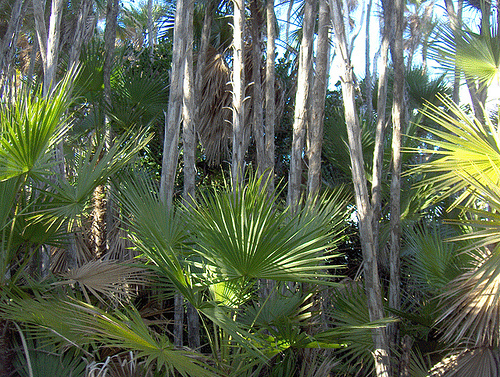
Acoelorrhaphe (also spelled Acoelorraphe) is a monotypic genus of clustering palms in the family Arecaceae (order Arecales), containing the single species Acoelorrhaphe wrightii — commonly known as the Paurotis palm, Everglades palm, or Madeira palm. It is a small to moderately tall palm that forms dense clumps of slender stems, typically reaching 5–7 metres in height (rarely to 9 m), with individual stems under 15 cm in diameter covered in fibrous matting. The leaves are palmate (fan-shaped), 1–2 metres wide, light-green on the upper surface with a distinctive silvery underside, and the leaf segments remain joined for about half their length. The petioles are 1–1.2 metres long and armed with curved, sharp orange teeth along the margins — a key identification feature. The flowers are minute, inconspicuous, greenish, and bear six stamens. The fruit is a small, pea-sized drupe that ripens from orange to black at maturity. The genus was formerly abundant in the Florida Everglades but was heavily collected for the nursery trade; it is now protected under Florida law and recovering in the wild. It is cultivated as an ornamental landscape palm in warm-temperate to subtropical regions.
Etymology
The genus name is derived from Greek: a- ('without'), koilos ('hollow'), and rhaphis ('needle'), alluding to the form of the fruit. The species epithet wrightii honors the American botanist Charles Wright. Several orthographical variants of the genus name exist, including Acoelorraphe and Acoelorhaphe, which are treated as equivalent by the International Plant Names Index.
Distribution
Acoelorrhaphe wrightii is native to Central America, southeastern Mexico, the Caribbean islands, Colombia, the Bahamas, and extreme southern Florida (USA). In Florida it is restricted to the Everglades region, where it grows in coastal swamps and brackish wetlands near sea level in thin, rocky soils overlying limestone. Its range spans tropical and subtropical regions of the Neotropics, with the Florida population representing the northern limit of the genus.
Ecology
The Paurotis palm is a wetland specialist, growing in coastal swamps, brackish marshes, and seasonally flooded areas close to sea level. It tolerates thin, rocky soils over limestone and is adapted to the hydrologically dynamic conditions of the Everglades ecosystem, where it forms dense thickets in wet prairies and along the edges of sloughs.
Cultivation
Acoelorrhaphe wrightii is propagated from seed or by sawing apart the basal clump. It is hardy to USDA zones 10–11 (central and southern Florida) and is cultivated as an ornamental landscape palm in warm-temperate to tropical regions. Its tolerance of wet soils and coastal conditions makes it suitable for rain gardens, pond margins, and seaside plantings.
Conservation
The Paurotis palm was once plentiful across the Florida Everglades, but extensive collection of wild specimens for the nursery trade led to significant population decline. It is now legally protected in Florida, with wild collection prohibited, and its numbers are reportedly recovering. No formal IUCN assessment is cited in available sources.
Taxonomy Notes
The accepted genus name is Acoelorrhaphe, though the orthographical variants Acoelorraphe (used by Wikipedia) and Acoelorhaphe are recognized by the International Plant Names Index. GBIF lists the genus under Acoelorrhaphe with authorship unrecorded. The genus is placed in the palm family Arecaceae, order Arecales, and contains a single accepted species.










