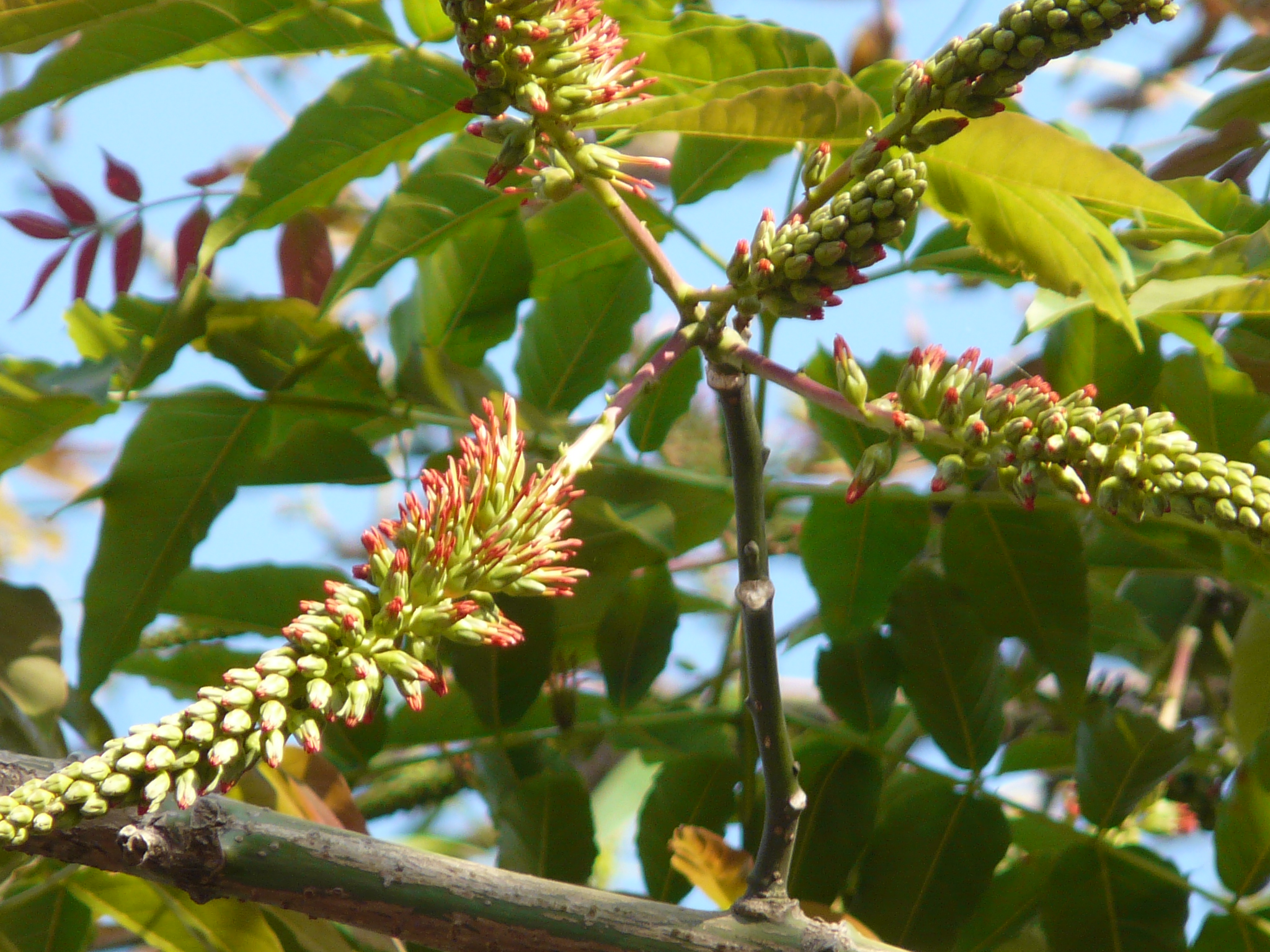
Acrocarpus is a monotypic genus of deciduous trees in the legume family Fabaceae (order Fabales). Its sole species, Acrocarpus fraxinifolius (author Arn.), is commonly known as the pink cedar or shingle tree. It is a fast-growing, stately emergent tree reaching 30 to 60 metres in height, with a prominently buttressed bole. The wood is prized for its decorative quality: the sapwood is whitish, while the heartwood is bright red to brownish-red with darker veins, with a straight to slightly interlocked grain and a coarse, even, lustrous texture. Heavy and moderately hard, it is easy to work and well suited for turnery, carving, cabinetry, and furniture.
Native to tropical and subtropical Asia, the species occurs from the Indian subcontinent (India, Bangladesh, Bhutan, Nepal) through southern China, Myanmar, Thailand, Laos, and into Malaysia and Indonesia. It inhabits evergreen gallery forest, montane rain forest, and deciduous monsoon forest at elevations from sea level to about 2,000 metres. A pioneer species with nitrogen-fixing root nodules, it colonises burnt areas, exposed soils, and road cuts. The tree produces spectacular flowering displays when leafless, followed by a flush of coral-red new foliage. It is widely cultivated in tropical plantations as a shade tree for coffee and tea, for reforestation of degraded land, and for soil stabilisation along riverbanks. The species also serves as a food plant for the endangered lion-tailed macaque.
Distribution
Acrocarpus is native to tropical and subtropical Asia, ranging from the Indian subcontinent (India, Bangladesh, Bhutan, Nepal) through southern China, Myanmar, Thailand, and Laos, into Malaysia and Indonesia. It has been widely introduced and cultivated throughout the tropics as a plantation and shade tree.
Ecology
Acrocarpus fraxinifolius is a pioneer species of evergreen gallery forest, montane rain forest, and deciduous monsoon forest. It regenerates in small burnt areas, on open patches with exposed soil, and along newly constructed roads. The tree forms a symbiotic relationship with nitrogen-fixing soil bacteria and has an extensive root system penetrating up to 4.5 metres, making it valuable for reinforcing riverbanks and stabilising terraces. Its leaf fall contributes nutrients and humus to the soil. It is a food plant for the endangered lion-tailed macaque and a good source of nectar for bees.
Cultivation
The shingle tree is widely cultivated throughout the tropics, particularly as a shade tree on coffee and tea plantations and as a windbreak. It grows best in submontane areas of the humid and subhumid tropics with a short dry spell, at elevations from sea level to about 2,000 metres, with annual precipitation of 500–3,000 mm and temperatures of 15–26°C. It is very sensitive to frost. The tree prefers fertile soil and full sun but tolerates some shade when young, succeeding in both acid and alkaline soils. It is extremely fast-growing: seedlings can reach 3 metres within 12 months, and growth rates of 120 cm per year in height and 19 mm in diameter have been recorded. It coppices vigorously, with rotation periods of 8–10 years for fuel and 30–40 years for timber.
Taxonomy
Acrocarpus is a monotypic genus in the family Fabaceae (order Fabales), containing the single species Acrocarpus fraxinifolius. The genus was authored by G.A. Walker Arnott (Arn.). Synonyms include Acrocarpus combretiflorus Teijsm. & Binn., Acrocarpus grandis (Miq.) Miq., and Mezoneurum grande Miq.
Propagation
Propagation is primarily by seed. Seeds should be pre-soaked for 5 minutes in hot water and left for 24 hours in warm water, or pre-treated with sulphuric acid for 10 minutes. After pre-treatment, germination rates of 80–95% are achieved within 2–7 days. Under natural conditions, some seeds germinate within a week while others remain dormant for a year. Seedlings are ready for planting out at 3 months when 30–45 cm tall, and should be placed in full sunlight. Seeds exhibit orthodox storage behaviour and should be kept at low temperatures, though some have survived 7 years at room temperature. Patch budding has been used successfully in seed orchards with an 80% success rate.










