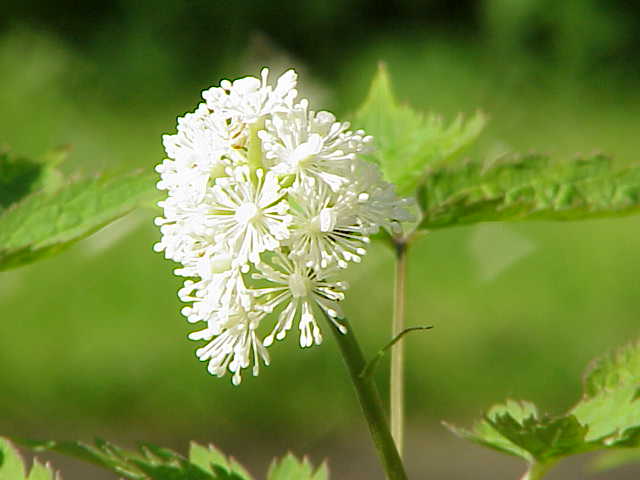
Actaea L. — commonly known as baneberry or bugbane — is a genus of approximately 25 to 33 species of herbaceous perennial flowering plants in the buttercup family (Ranunculaceae). The genus was established by Carl Linnaeus in 1753, with Actaea spicata as the type species, and is distributed across temperate, subtropical, and subarctic regions of Europe, Asia, and North America.
Plants are clump-forming, typically growing 60 cm to 1.8 m (2–6 feet) tall. They bear compound, toothed leaves that superficially resemble those of elder (Sambucus) — a resemblance that inspired the name Actaea, which Pliny borrowed from the Greek word for elder. Small white flowers are produced in dense, elongated spikes (racemes). After flowering, the plants develop showy fleshy berries — red, white, or black depending on the species — that are attractive to birds but highly toxic to mammals.
The genus was significantly expanded in the 1990s, when molecular and morphological studies led to the merger of the formerly separate genera Cimicifuga and Souliea into Actaea. This circumscription is accepted by Plants of the World Online (33 species as of 2023) and GBIF (~71 taxa). Some botanists maintain the narrower view, reserving Actaea for the berry-fruited species and keeping Cimicifuga separate for the dry-fruited bugbanes — a debate that persists in taxonomic literature.
All parts of Actaea plants are toxic to humans, dogs, cats, and horses, with berries and roots being the most hazardous. Toxic compounds include ranunculin and protoanemonin, which cause burning sensations, gastrointestinal distress, and in high doses can affect cardiac function. The extremely bitter taste typically deters adults from ingesting significant quantities, and confirmed fatalities in the United States are unknown. Birds, however, consume the berries without harm and serve as the primary seed dispersers.
Several species have significant ethnobotanical and medicinal histories. Actaea racemosa (black cohosh) is widely used in herbal medicine for menopausal symptoms. A. dahurica and A. heracleifolia are sources of Sheng ma, an important remedy in Traditional Chinese Medicine. Indigenous peoples of eastern North America used root preparations of A. rubra and related species for a range of ailments.
Etymology
The generic name Actaea is ancient, derived from the Greek word for elder (Sambucus). According to Pliny the Elder, the name was applied because the leaves of Actaea and Sambucus are similar in shape — both being large, pinnately compound, and sharply toothed. The name was formally adopted by Linnaeus in 1753 when he described the genus in his Species Plantarum.
The synonym Cimicifuga — applied to a portion of the genus before the 1990s merger — has a descriptive Latin origin: cimex (bed bug) + fugare (to repel), reflecting historical use of the plants as an insect repellent. This name survives in common usage as "bugbane" for several species, particularly those formerly classified in Cimicifuga (e.g., Actaea simplex, A. racemosa).
Distribution
Actaea has a broadly Northern Hemisphere distribution, occurring across temperate, subtropical, and subarctic zones of Europe, Asia, and North America. In Europe, A. spicata is the native representative, documented from Scandinavia south through Central Europe; A. spicata is the only species recorded in Switzerland by InfoFlora. In North America, the center of diversity includes eastern species such as A. pachypoda (white baneberry) and A. rubra (red baneberry), which range from southern Canada through the eastern United States to the southern Appalachians and westward to Oklahoma and Minnesota; A. arizonica extends into the southwestern United States. East Asia, particularly China, holds the highest species diversity, including A. dahurica, A. heracleifolia, A. yunnanensis, and several others.
In North America, the species favour deciduous and mixed forests. Actaea spicata in Europe similarly occupies woodland habitats.
Ecology
Actaea species are woodland plants, typically found in the understory of deciduous and mixed forests where shade, moisture, and humus-rich soils are available. They tolerate a wide soil pH range (4.0–8.0+) and can establish in both well-drained and consistently moist conditions.
The flowers — small, white, and borne in racemes — attract a range of pollinators including bees, butterflies, and hummingbirds. The fleshy, brightly coloured berries (red, white, or black) are the primary dispersal unit: birds consume them freely and are not harmed, providing effective seed dispersal. In contrast, the berries are highly toxic to mammals. The toxicity appears to function as a mammal deterrent while preserving avian dispersal.
Toxic compounds include ranunculin and protoanemonin. Ingestion by humans causes burning in the mouth and throat, excessive salivation, nausea, vomiting, abdominal cramps, and diarrhoea. High doses can produce a sedative effect on cardiac muscle. The extremely bitter taste typically limits consumption by adults; confirmed fatal cases in the United States have not been documented. Children are at higher risk because of the berries' waxy, attractive appearance. The plant is toxic to rabbits, cats, dogs, and horses.
Cultivation
Actaea species are grown as ornamental perennials in shade and woodland gardens. They are valued for their bold compound foliage, upright flower spikes, and decorative autumn berries. Plants grow 60 cm to 1.8 m tall in clumping forms and are reliably hardy across USDA zones 3–8b depending on species.
The genus performs best in partial to deep shade — typically dappled sunlight or fewer than 6 hours of direct sun per day. Well-drained to consistently moist, humus-rich soil in loam or clay is ideal, though plants tolerate a wide range of pH (4.0 to over 8.0). Spacing of 30 cm to 90 cm is appropriate depending on the species and planting goal.
Landscape applications include shade gardens, woodland borders, cottage gardens, naturalized areas, and meadow plantings. Several species and cultivars, particularly those formerly in Cimicifuga (e.g., A. simplex 'Brunette', A. racemosa), are popular in perennial garden design for their late-season dark foliage and white flower plumes. Plants also provide ecological value: flowers attract bees, butterflies, and hummingbirds, while the berries attract birds.
Propagation
Actaea is propagated by two main methods: division of the rhizome and seed propagation. Division is the more reliable method for maintaining cultivar characteristics; clumps are best divided in early spring before new growth emerges or in autumn after the growing season. Seeds require stratification (a period of cold, moist conditions) to break dormancy and should be sown fresh or after cold stratification.
Cultural Uses
Actaea species have a long history of use in traditional and herbal medicine across North America and East Asia.
In eastern North America, Indigenous peoples and early settlers used preparations of A. rubra and A. pachypoda roots as decoctions for coughs, colds, rheumatism, and syphilis. Small doses were administered to ease childbirth pain (oxytocic use), and the plant was employed as a stimulant in critical situations. External infusions treated itchy skin conditions; root preparations were used as a gargle for sore throats. Leaf infusions were taken by some Indigenous women to promote lactation. The root is documented as anticonvulsive, antirheumatic, emmenagogue, and mildly hypnotic.
Actaea racemosa (black cohosh, formerly Cimicifuga racemosa) has become one of the most commercially significant medicinal plants in North America, widely used in modern herbal medicine as a remedy for menopausal symptoms.
In Traditional Chinese Medicine, Cimicifugae rhizoma — known as Sheng ma — is an established herbal preparation extracted from the roots of A. dahurica and A. heracleifolia. It is used as an anti-inflammatory and detoxifying agent.
All uses require caution: the same compounds responsible for medicinal activity also cause severe toxicity in larger doses, including gastrointestinal inflammation and skin blistering.
Taxonomy Notes
Actaea was established by Linnaeus in 1753 (family Ranunculaceae, order Ranunculales) with A. spicata as the type species. For most of its taxonomic history it was a small genus of approximately eight fleshy-fruited baneberries, while the dry-fruited bugbanes were placed in Cimicifuga and the monotypic Souliea.
In the 1990s, phylogenetic studies combining DNA sequence data, biochemical profiles, and morphological characters demonstrated that Cimicifuga and Souliea were nested within Actaea, rendering the three-genus system paraphyletic. The merger into a single broadly circumscribed Actaea is now followed by major global checklists including Plants of the World Online (33 species, 2023) and GBIF (~71 accepted taxa in the backbone, including infraspecific names). Under this treatment, familiar cultivated bugbanes such as A. simplex 'Brunette' and A. racemosa are fully transferred into Actaea.
A minority of botanists continue to recognize the narrower genera, arguing that fruit type (fleshy vs. dry follicle) is a significant morphological character. This conflict in circumscription means that older horticultural literature and some regional floras still list plants under Cimicifuga.
The genus name is a homonym shared with a crab genus in family Xanthidae (Animalia) and a moth genus in Notodontidae (Insecta), requiring care when querying biodiversity databases.










