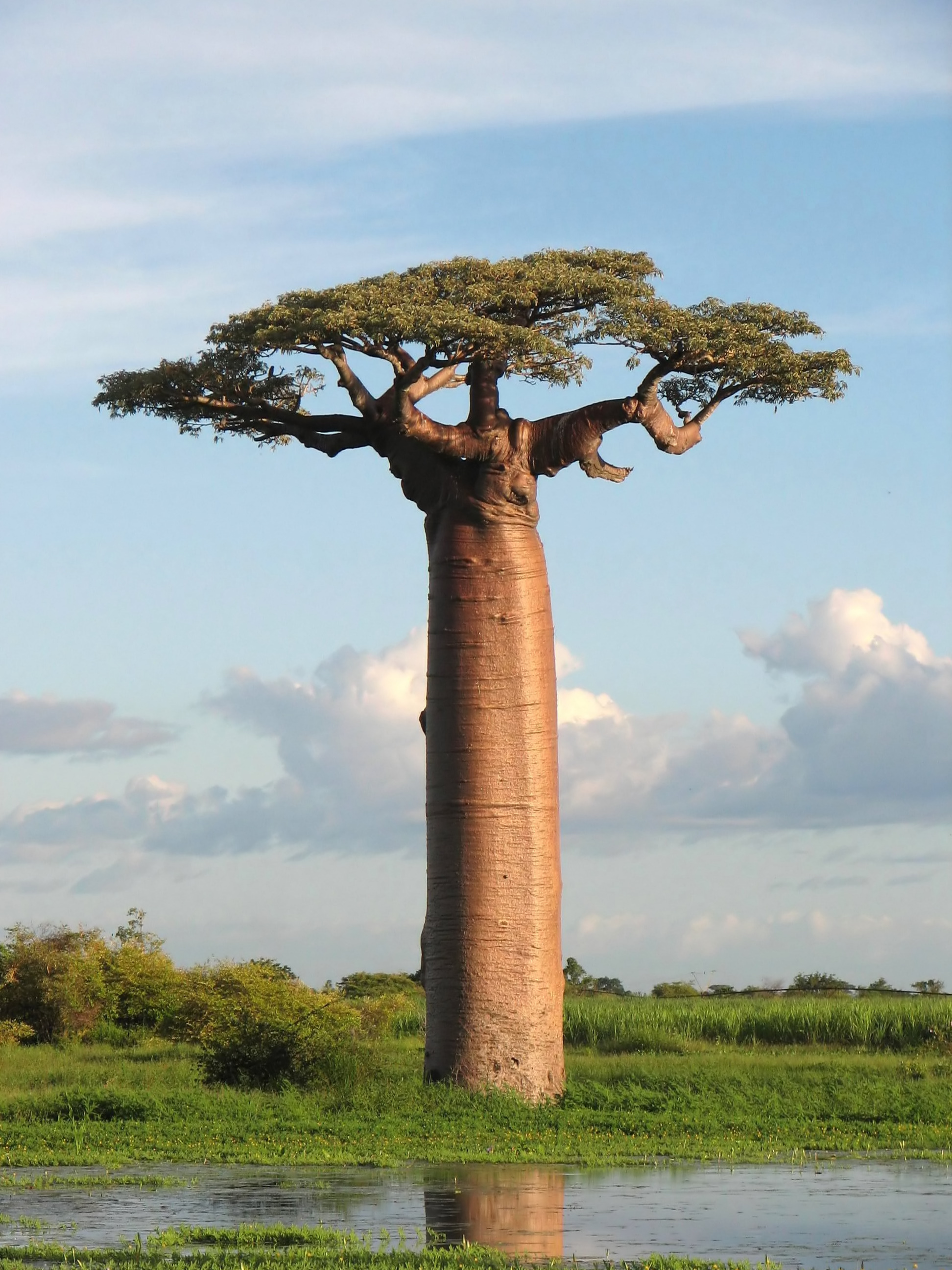
Adansonia is a genus of eight species of large deciduous trees commonly known as baobabs, belonging to the family Malvaceae (subfamily Bombacoideae). They are among the most iconic trees on Earth, instantly recognizable by their massively swollen, bottle-shaped or cylindrical trunks, which can reach 10–14 metres in diameter and store up to 120,000 litres of water as a drought-survival adaptation.
Baobabs stand 5–30 metres tall and are notable for spending most of the year leafless: they shed their palmately compound leaves (bearing 5–11 leaflets) for up to nine months annually, giving rise to the popular "upside-down tree" description. Their large, showy flowers open near dusk and remain receptive for only about 15 hours. The fruits are large, oval to round berry-like structures whose dry pulp surrounds kidney-shaped seeds rich in vitamin C and carbohydrates.
Six of the eight species are endemic to Madagascar, where they are keystones of dry deciduous forest ecosystems. A. digitata (the African baobab) is native to the African mainland and the Arabian Peninsula and is the most ecologically and culturally significant species; it is also the only tetraploid in the genus. A. gregorii, the smallest species, is native to northwestern Australia, where it is commonly called the boab.
The genus was established by Linnaeus in 1753 and named in honor of the French naturalist Michel Adanson, who produced the first detailed botanical description of A. digitata. Some of the oldest known individual baobabs were estimated to be over 2,000 years old. Since the early 21st century, a disproportionate number of large, ancient African baobabs have died, a trend researchers have linked to drought and climate warming.
Etymology
The genus name Adansonia commemorates Michel Adanson (1727–1806), a French naturalist and explorer who provided the first detailed and widely accepted botanical description of Adansonia digitata during his time in Senegal. The genus was formally described by Linnaeus in 1753.
The common name "baobab" is generally traced to Arabic, most likely abū ḥibāb meaning "father of many seeds" or "many-seeded fruit," reflecting the large seed-laden fruits. The informal nickname "upside-down tree," widespread across sub-Saharan Africa and the Arabian Peninsula, refers to the tree’s bare dry-season silhouette, in which the spreading branches resemble a root system held skyward. The Australian species A. gregorii is called "boab," a shortened form of the same Arabic root.
Distribution
The eight Adansonia species are distributed across three widely separated biogeographic regions. Six species — A. grandidieri, A. madagascariensis, A. perrieri, A. rubrostipa, A. suarezensis, and A. za — are endemic to Madagascar, concentrated in the island’s dry deciduous forests and spiny thickets. A. digitata is native to the African continent, ranging from Mauritania and Sudan in the north to Angola, Botswana, Namibia, South Africa, and Mozambique in the south, as well as parts of the Arabian Peninsula. A. gregorii is native to the Kimberley region and northwestern Australia.
Per the World Checklist of Vascular Plants (WCVP) via GBIF, A. digitata has been introduced to Bangladesh, India, Sri Lanka, Vietnam, the Comoros, and other tropical regions. The African species is characteristic of thorn woodland and savannah with 4–10 dry months per year and annual rainfall of 250–1,000 mm, though trees tolerate a wider range.
Taxonomy
Adansonia L. (1753) is placed in the family Malvaceae, subfamily Bombacoideae, order Malvales. The genus contains eight accepted species per GBIF: A. digitata, A. grandidieri, A. gregorii, A. madagascariensis, A. perrieri, A. rubrostipa, A. suarezensis, and A. za. Within the genus, three informal sections are recognized based on flower and fruit morphology.
A notable cytological distinction is that A. digitata is tetraploid, while all remaining species are diploid. A ninth name, A. kilima, was described in 2012 but is now treated as a synonym of A. digitata. The genus type is A. digitata L.
Ecology
Baobabs are keystone species in the ecosystems they inhabit. Their most distinctive ecological adaptation is water storage: the spongy wood of the trunk can hold up to 120,000 litres, allowing trees to remain physiologically active through extended dry seasons. They are deciduous and leafless for up to nine months of the year.
The hollow trunks of older specimens provide nest sites and shelter for numerous bird species and mammals, and baobabs are considered indicators of nearby subsurface water in arid landscapes. The large, white, night-opening flowers are pollinated by fruit bats and hawk moths, while the fruits feed primates, elephants, and other mammals that disperse the seeds.
Since the early 2000s, an unusual number of large, ancient African baobabs have collapsed or died — a trend researchers have linked to prolonged drought and rising temperatures associated with climate change.
Cultivation
Baobabs are grown as ornamental specimen trees in tropical and subtropical climates (USDA hardiness zones 10–12) and are increasingly cultivated for their fruit in agroforestry systems. They require full sun and well-drained sandy or loamy soils, and once established are highly drought tolerant.
Optimal growth occurs at mean temperatures of 20–30°C, and trees cannot tolerate more than one frost day annually. Preferred annual rainfall is 250–1,000 mm, though plants survive in the range of 100–1,500 mm. Young trees grow relatively quickly (approximately 2 m in two years) before growth slows markedly as the trunk begins to swell. Their dramatic trunk form also makes young baobabs popular bonsai subjects.
Propagation
Baobab seeds exhibit high germination rates (90–100%) under warm conditions (around 21°C). Without treatment, germination typically takes 15–40 days. Scarification — nicking or filing the hard seed coat — can accelerate germination to as few as 6 days, and soaking overnight in warm water is also practiced.
Direct sowing into a well-drained growing medium is preferred. Seedlings benefit from 3–4 months of establishment before transplanting, and because young taproots are sensitive, disturbance should be minimized at transplant time.
Uses & Culture
Adansonia digitata is one of the most culturally important trees in sub-Saharan Africa, and nearly every part of the tree is used. The fruit pulp is eaten fresh or dissolved in water to make a lemonade-like drink and is a significant source of vitamin C and dietary fiber; dried pulp powder gained EU novel food authorization and US GRAS status in 2008. The young leaves are eaten as a spinach-like vegetable, and seeds are consumed directly or pressed to yield vegetable oil used in food and cosmetics.
Non-food uses are equally extensive. Bark fibers are twisted into rope, cordage, and baskets. The soft, fibrous wood is used for canoes and light rafts; seed shells and wood provide fuel; roots yield a red dye; and ash is used to produce potash for soap-making.
In traditional medicine, leaves are used to treat kidney and bladder complaints, asthma, and diarrhea; pulp is used against fevers and dysentery. Culturally, baobabs are frequently the center of communal life in African villages — serving as meeting places, courts, and spiritual sites. In Antoine de Saint-Exupéry’s The Little Prince, baobabs appear as symbols of forces that must be vigilantly controlled.
Conservation
No formal IUCN Red List assessment exists at the genus level for Adansonia, and individual species assessments vary. Several Malagasy species are threatened by habitat loss from deforestation and agricultural expansion in Madagascar, with A. perrieri of particular conservation concern.
A. digitata, the most common and widespread species, is not formally threatened, but the unexplained mass die-off of large, ancient specimens across Africa since the early 21st century has raised concern, with drought and elevated temperatures linked to climate change as the leading hypotheses. A. gregorii in Australia is considered locally secure within its Kimberley range.

