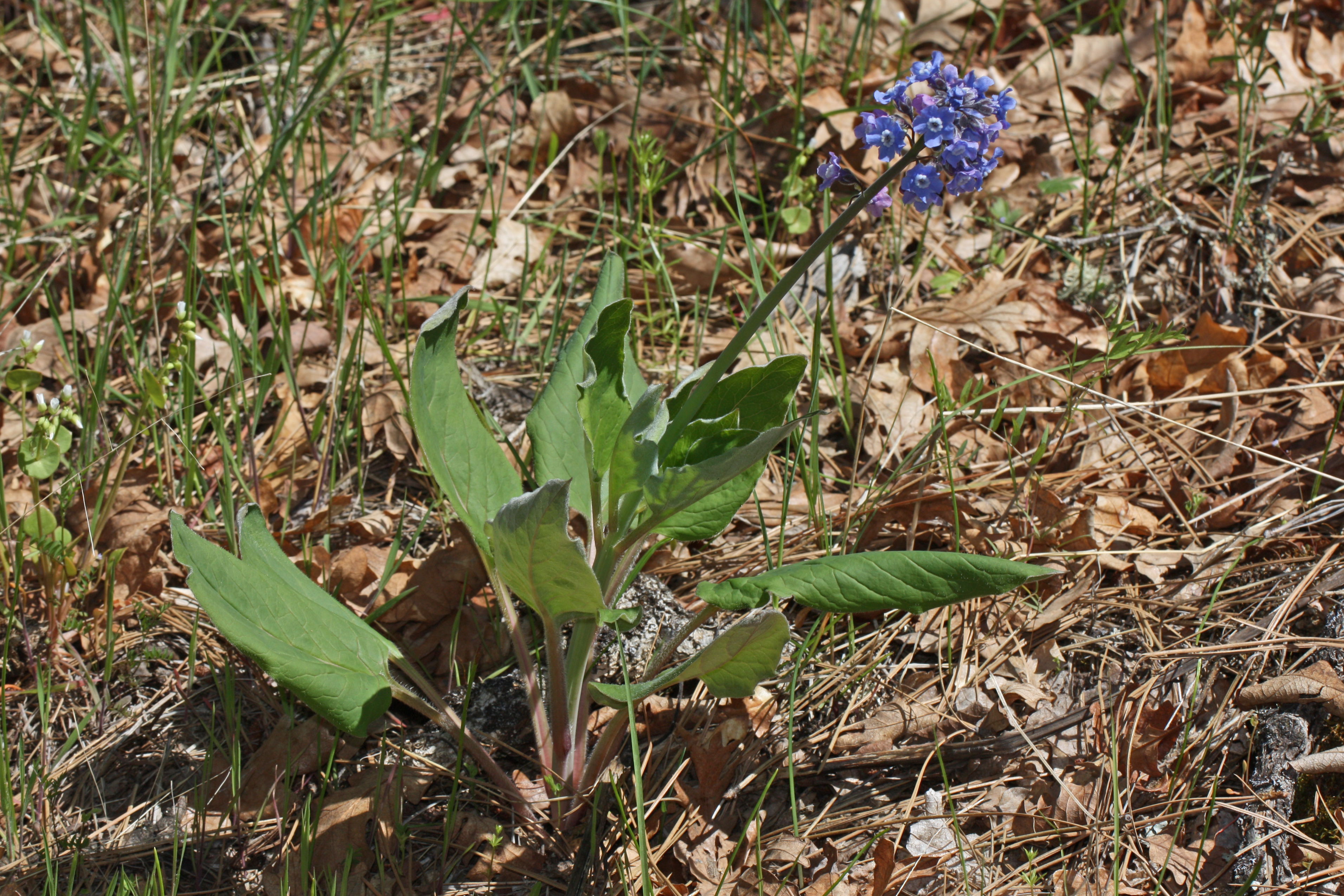
Adelinia is a monotypic genus of flowering plants in the borage family (Boraginaceae), order Boraginales. It contains a single species, Adelinia grandis, previously classified as Cynoglossum grande and commonly known as hound's tongue or grand hound's tongue.
The plant is a perennial herb that grows an erect stem up to 80 centimetres tall from a taproot. Leaves are concentrated at the base of the plant, each with an oval blade up to 15 cm long on a petiole of similar length. The inflorescence is a panicle of flowers borne on individual pedicels; each five-lobed flower is bright to deep blue with white appendages at the centre, measuring 1 to 1.5 cm across. The fruit consists of an array of four slightly bristly nutlets.
Adelinia grandis is native to western North America, ranging from British Columbia south through California, where it grows in shady woodland and chaparral habitats. On the forest floors of California oak woodlands, typical plant associates include Calochortus amabilis, C. luteus, and Delphinium variegatum.
The genus was described by American botanist James I. Cohen, who named it in honour of his daughter Adeline Etta Cohen (b. 2014). The genus was separated from Cynoglossum based on distinguishing morphological characters.
Etymology
The genus name Adelinia honours Adeline Etta Cohen (born 2014), daughter of American botanist James I. Cohen, who formally described the genus. The common name "hound's tongue" refers to the shape and texture of the leaves and is shared with the closely related genus Cynoglossum, from which Adelinia was separated.
Distribution
Adelinia grandis is native to western North America, occurring from British Columbia south through California. It grows in shady areas within woodland and chaparral, and on the floor of California oak woodlands, where it associates with species such as Calochortus amabilis, C. luteus, and Delphinium variegatum.
Cultural Uses
Native Americans prepared the roots of Adelinia grandis medicinally to treat burns and stomach aches.
Taxonomy Notes
Adelinia grandis was previously placed in the genus Cynoglossum (as C. grande) within the borage family Boraginaceae. The monotypic genus Adelinia was established by James I. Cohen to accommodate morphological characters that distinguish it from Cynoglossum. GBIF places the genus in order Boraginales, class Magnoliopsida.










