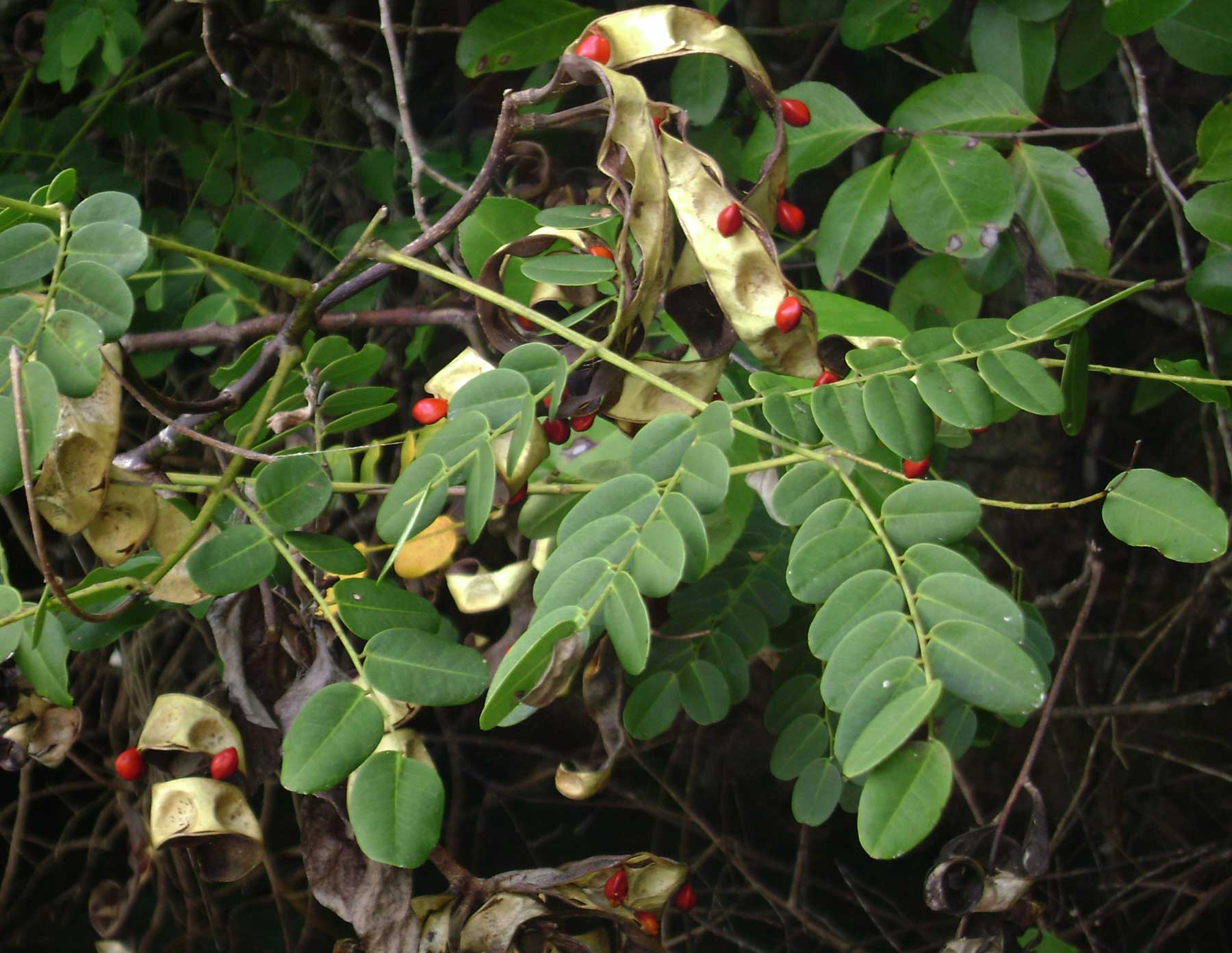
Adenanthera is a genus of flowering plants in the family Fabaceae (legumes), order Fabales. The genus comprises approximately 12 accepted species of trees native to tropical Asia and the Pacific Islands, with one species (A. microsperma) reaching mainland China. The best-known member is Adenanthera pavonina, commonly called red sandalwood or coralwood — though it is not a true sandalwood (Santalum).
Species in this genus are medium-sized trees, typically reaching 15–18 m in height. The leaves are bipinnate, an identifying feature of the group, with multiple pairs of pinnae each bearing numerous ovate-oblong leaflets. Flowers are small (about 1 cm wide), creamy white, and borne on slender racemes that can reach 30 cm in length. The most distinctive feature of the genus is its fruit: curved, flattened pods up to 22 cm long that split open when mature to reveal 8–12 hard, glossy, bright red seeds. These striking scarlet seeds have given the genus cultural significance across its range.
The wood is dense and extremely hard, suitable for boat-building, furniture-making, and producing a red dye. The trees are nitrogen-fixing legumes and are often fast-growing with a spreading canopy, making them valued as shade trees and ornamentals in tropical gardens.
Distribution
The genus Adenanthera is native to tropical Asia and the Pacific Islands, with its centre of diversity in Southeast Asia. The range of the most widespread species, A. pavonina, extends from India and Sri Lanka eastward through southern China (Hainan), Indonesia, New Guinea, and the Solomon Islands to northern Australia. One species, A. microsperma, reaches mainland China and Hong Kong. A. pavonina has been widely introduced across the tropics and is naturalised in parts of Africa, the Americas, the Philippines, and Pakistan.
Ecology
Adenanthera species are nitrogen-fixing legumes, contributing to soil fertility in their native and introduced ranges. A. pavonina has become naturalised and sometimes invasive in parts of the tropics outside its native range, including the Philippines, Pakistan, and tropical Africa and the Americas.
Cultivation
Adenanthera pavonina is cultivated as an ornamental tree for its attractive, spreading canopy and bright red seeds. It is fast-growing and used as a shade tree in large gardens and parks. The tree is also grown for forage. However, it produces considerable litter from leaves, twigs, and seed pods.
Cultural Uses
The bright red seeds of Adenanthera pavonina have a long history of cultural use. In India, their remarkably consistent weight led to their use as units of measurement for gold and other fine goods throughout recorded history — the Malay name saga traces to the Arabic word for goldsmith. In China, the seeds are called xiang si dou (相思豆), or "mutual love bean," and are a traditional symbol of love. The seeds are also used as beads for jewellery. The wood yields a red dye and is hard enough for boat-building and furniture. In traditional medicine, a decoction of young leaves and bark is used to treat diarrhoea, and ground seeds are applied for inflammation.
Taxonomy Notes
Adenanthera belongs to the family Fabaceae (Leguminosae) within the order Fabales. As of March 2026, 12 species are recognised in the genus. The taxonomic status of the genus is ACCEPTED in the GBIF backbone taxonomy.










