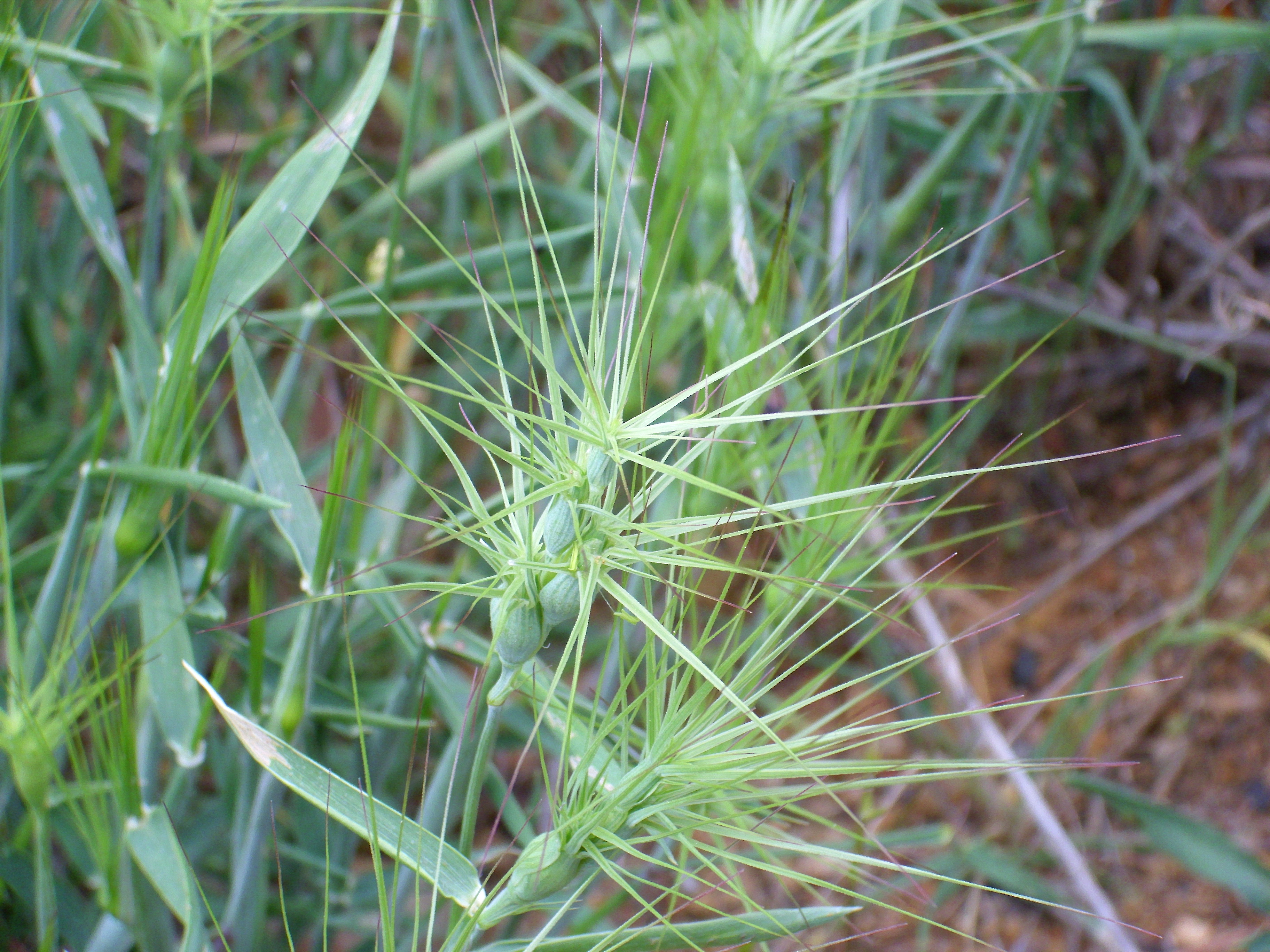
Aegilops, commonly known as goatgrass, is a genus of annual grasses in the family Poaceae (tribe Triticeae). The genus as currently circumscribed encompasses approximately 27 accepted species, all native to a broad arc stretching from the Mediterranean basin through the Middle East and into Central Asia. Plants are typically slender, erect annuals growing 14–80 centimetres tall, with narrow, linear leaves reaching up to 15 centimetres in length. The inflorescence is a terminal spike bearing 2–12 solitary spikelets, each around 1.2 centimetres long, often armed with awns of varying number and length depending on the species.
The genus has exceptional significance in the history of agriculture. Approximately 8,000 years ago, cultivated emmer wheat hybridized naturally with Aegilops tauschii to produce common bread wheat (Triticum aestivum), the world's most widely grown cereal crop. This hybridization event, in which Aegilops tauschii donated its D-genome, underpins the genetic composition of modern bread wheat. Though Aegilops and Triticum are closely related — sufficiently so to form natural hybrids — most botanical authorities maintain them as separate genera on the basis of their differing ecological attributes and non-monophyletic grouping.
Several species have established themselves as invasive weeds outside their native range. Aegilops cylindrica (jointed goatgrass), introduced to North America at the end of the 19th or early 20th century, is now the most problematic of these, competing directly with wheat crops, contaminating harvested grain, and serving as a host for pests including the Russian wheat aphid and various fungal pathogens.
Etymology
The name Aegilops derives from Ancient Greek aigílōps, a word of uncertain ultimate origin. The most widely cited theory combines aígilos (goat) and -ōps (eye or resembling), yielding an interpretation such as "goatlike herb" or "herb liked by goats." Alternative theories trace the root to Proto-Indo-European words related to oak. The name was in use in classical antiquity and was formally applied to this grass genus by Linnaeus in his Species Plantarum (1753). A linguistic curiosity attached to the word is that "aegilops" is considered the longest common English word in which all letters appear in strict alphabetical order with no letter repeated.
Distribution
Aegilops species are native to a broad region spanning from the Iberian Peninsula and the Mediterranean basin eastward through Turkey, the Levant, the Caucasus, and Central Asia as far as Pakistan. Within this range, individual species occupy varying sub-ranges: Aegilops geniculata extends from the western Mediterranean to Iran, while others are more narrowly restricted to the eastern Mediterranean or the Near East.
Outside their native range, several species have become established as introduced weeds. In North America, introductions occurred at the end of the 19th or beginning of the 20th century, likely through contaminated grain or wool importation; four species are now established north of Mexico, of which Aegilops cylindrica is by far the most widespread. In Central Europe, six species have been recorded in Switzerland, including A. cylindrica, A. geniculata, A. neglecta, A. triuncialis, and A. ventricosa.
Ecology
Aegilops species are annual grasses of open, disturbed, and semi-arid habitats, typically growing in dry grasslands, roadsides, field margins, and degraded scrubland. They are adapted to the seasonally dry conditions of the Mediterranean climate zone and produce seed that can remain viable in soil for several years.
Within their introduced North American range, several species function as agricultural weeds. Aegilops cylindrica (jointed goatgrass) is particularly damaging in winter wheat production areas, where it outcompetes the crop for water and nutrients, contaminates harvested grain, and acts as a reservoir for the Russian wheat aphid and pathogenic fungi. The genus's close genetic relationship with Triticum also raises concerns about gene flow between weedy goatgrasses and cultivated wheat varieties, potentially spreading herbicide-resistance traits.
History
Human interaction with goatgrasses predates agriculture. During the Mesolithic, nomadic peoples harvested wild Aegilops plants using bone sickles set with flint, dried the plants, threshed them with wooden flails, and singed the grains to remove inedible chaff and awns. Charred grains from this pre-agricultural processing are preserved in archaeological contexts across the Near East.
The genus's most consequential role in human history is its contribution to the origin of bread wheat. Approximately 8,000 years ago, cultivated emmer wheat (Triticum turgidum subsp. dicoccum) hybridized with the wild goatgrass Aegilops tauschii, producing the hexaploid genome of Triticum aestivum — modern common wheat. This single hybridization event, in which Aegilops tauschii donated its D-genome, gave bread wheat properties including improved dough-forming characteristics that enabled widespread adoption of leavened bread.
Taxonomy Notes
The genus Aegilops was formally described by Linnaeus in Species Plantarum (1753). It belongs to the family Poaceae, subfamily Pooideae, tribe Triticeae — the same tribe that contains Triticum (wheats), Hordeum (barleys), and Secale (rye). GBIF recognizes 73 descendant taxa under the genus, with approximately 27 currently accepted at species rank.
The generic boundaries of Aegilops have been debated for decades. Some authorities have proposed sinking Aegilops into Triticum on the grounds that the two genera are not mutually monophyletic and that they hybridize freely in nature; however, the prevailing treatment maintains them as separate based on differing ecological and morphological characteristics. Several former Aegilops species have been transferred to other genera through phylogenetic revisions.
Cultural Uses
The primary cultural and economic significance of Aegilops lies in its role as ancestral stock for modern bread wheat. Aegilops tauschii is the diploid donor of the D-genome in hexaploid Triticum aestivum, the world's most widely cultivated cereal. This genomic contribution, established roughly 8,000 years ago, underpins the gluten-forming proteins that make common wheat suitable for leavened bread.
Beyond their indirect contribution through wheat evolution, individual Aegilops species have been harvested as wild food grains since the Mesolithic. Archaeological evidence of charred goatgrass grains, associated with sickle blades and threshing tools, documents their use as a food source by pre-agricultural peoples in the Near East.










