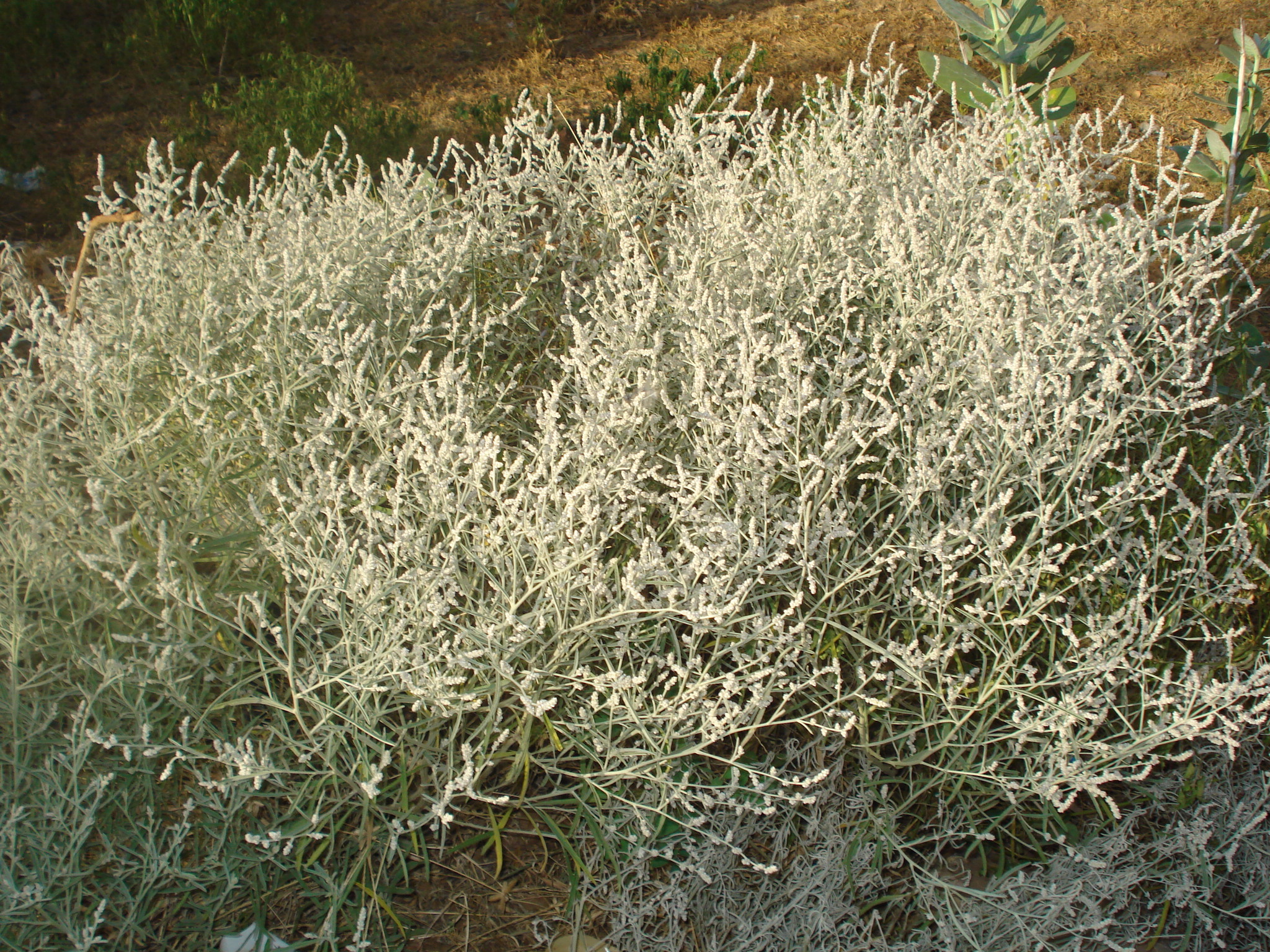
Aerva is a genus of flowering plants in the family Amaranthaceae, placed in the order Caryophyllales. The genus comprises approximately six accepted species distributed across the palaeotropics, with its range spanning continental Africa, Madagascar, and smaller Indian Ocean islands (Mauritius and Socotra), through parts of the Middle East, the Indian subcontinent, and southeast Asia as far as the Philippines and New Guinea. One species, Aerva javanica, has become naturalised in northern Australia.
Members of the genus are typically herbaceous plants or subshrubs. Aerva lanata, the best-known species, is a perennial herb that frequently becomes woody at the base, with stems growing erect, prostrate, or scrambling, reaching 30–200 cm in length. Species in this genus occupy a range of disturbed and open habitats, from coastal scrub and waste ground to open forest on mountain slopes, at elevations from sea level up to approximately 1,490 metres.
A notable physiological feature of the genus is that at least four of its species have independently acquired the C4 carbon fixation pathway, an adaptation associated with high photosynthetic efficiency in warm, sunny, and seasonally dry environments — consistent with the genus's predominantly arid and semi-arid tropical distribution.
Aerva lanata has been gathered from the wild for food and medicine across its range. Its leaves are eaten as a cooked vegetable in Sri Lanka and India, where young shoots are also added to curries; the leaves have historically served as a famine food. In traditional medicine, a decoction of the plant is used as a diuretic and for treatment of urinary conditions across tropical Africa and Asia.
Etymology
The name Aerva is derived from the Arabic word ʿarwa (عروة), a vernacular name used for plants in this genus across parts of the Middle East and North Africa.
Distribution
Aerva is native to the palaeotropics, ranging across continental Africa, Madagascar, Mauritius, and Socotra, through the Arabian Peninsula and Middle East, the Indian subcontinent, and southeast Asia to the Philippines and New Guinea. Aerva javanica has additionally become established as an alien species in northern Australia.
Ecology
Species of Aerva occupy open and disturbed habitats: waste ground, deserted cultivation, coastal scrub, and open forest on mountain slopes, from sea level to about 1,490 m elevation. The genus is associated with warm, sunny, seasonally dry tropical and subtropical environments, consistent with the presence of the C4 carbon fixation pathway in at least four of its species.
Cultural Uses
Aerva lanata has a long history of use across tropical Africa and Asia. Its leaves are consumed as a cooked vegetable in Sri Lanka and sold in local markets there; young shoots are incorporated into curries in India, and the leaves have been used as a famine food. In traditional medicine, a decoction of the plant is employed as a diuretic and to treat urinary ailments including catarrh of the bladder.










