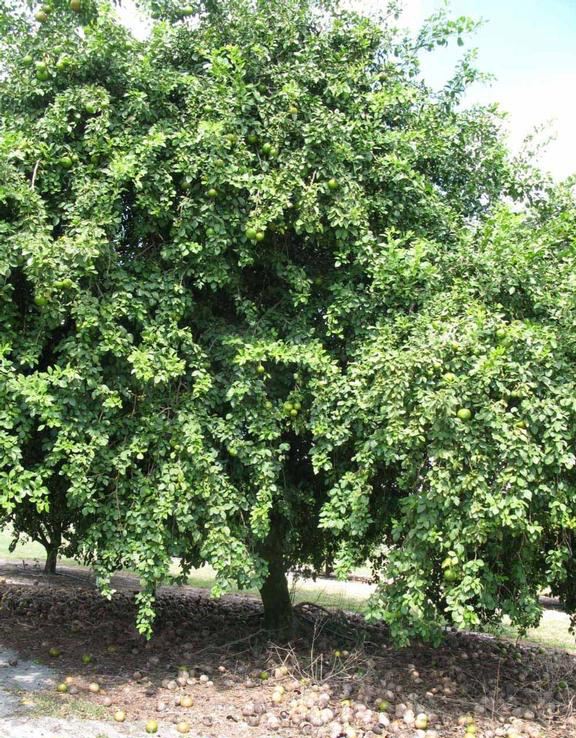
Afraegle is a small genus of evergreen trees in the family Rutaceae (the citrus family), order Sapindales. Native to Western and Western Central Tropical Africa, the genus is closely allied to other Aurantioideae genera such as Aegle (bael fruit) and Citrus, sharing the characteristic aromatic foliage and woody fruit typical of the subfamily.
The genus comprises around four accepted species. The best-known member, Afraegle paniculata — commonly called Nigerian Powder-Flask Fruit or African afraegle — is an evergreen tree reaching up to 12 metres in height with a spread of up to 10 metres, growing at a fast rate. It bears globose to obovoid fruits roughly the size of a large orange (6–8 cm in diameter when mature), with a wrinkled surface and no odorous glands. The trees favour well-drained sandy to loamy soils across a range of pH conditions, require full sun, and tolerate both dry and moist growing conditions.
Afraegle paniculata ranges across West tropical Africa from Senegal east to Nigeria, with records from Guinea, Liberia, Côte d'Ivoire, Ghana, Togo, and Benin. Afraegle gabonensis extends the genus's range into West Central Africa (Gabon and neighbouring countries). The genus has attracted limited horticultural attention outside its native region, though A. paniculata has been trialled as a rootstock for bael fruit (Aegle marmelos) in tropical regions where that species performs poorly on its own roots.
Distribution
Afraegle is native to Western and Western Central Tropical Africa. Afraegle paniculata, the most widespread species, ranges from Senegal east through Guinea, Liberia, Côte d'Ivoire, Ghana, Togo, Benin, and Nigeria. Afraegle gabonensis extends the genus into West Central Africa.
Ecology
Afraegle paniculata grows in light (sandy) to medium (loamy), well-drained soils across mildly acid to mildly alkaline pH ranges. It is a sun-demanding species unable to establish in shade, and tolerates both dry and moist soil conditions within its tropical African range.
Cultural Uses
Parts of Afraegle paniculata have several traditional uses in West Africa. The seeds yield an edible oil, and the leaves are occasionally cooked and eaten, though this is considered a minor or rare use. Leaves are also macerated and added to bathing water. The wood is used to make household, domestic, and personal items. The species has been evaluated as a rootstock for bael fruit (Aegle marmelos) in tropical horticulture, with reports of vigorous growth in suitable conditions.










