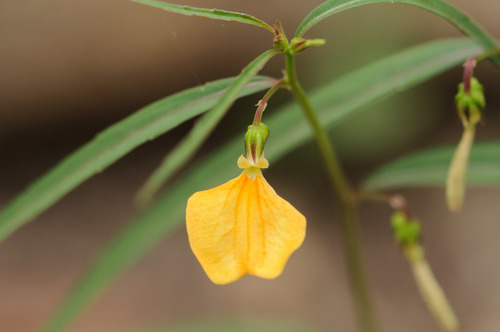
Afrohybanthus is a genus of flowering plants in the family Violaceae, placed in the order Malpighiales. It was established by Flicker and Ballard in 2015 (Phytotaxa 230: 50) to accommodate a distinctive and widely distributed Old World lineage of hybanthoid violets that had previously been treated within the broadly circumscribed and polyphyletic genus Hybanthus. Molecular and morphological evidence showed that Hybanthus as traditionally delimited comprised up to nine different natural groups; Afrohybanthus was erected to give one of these groups a monophyletic home.
The genus belongs to the violet family (Violaceae) alongside well-known genera such as Viola, and shares the family's characteristic zygomorphic (bilaterally symmetrical) flowers with five petals, five sepals, and five stamens surrounding a single pistil. Members of the hybanthoid lineage typically have small, often inconspicuous flowers and herbaceous to slightly woody habits.
As currently recognised in GBIF, Afrohybanthus contains a small number of accepted taxa, with Afrohybanthus stellarioides (Domin) Flicker being the principal species. This species had a long nomenclatural history before receiving its current name: originally described as a variety of Hybanthus enneaspermus by Domin, it was later treated as Hybanthus stellarioides by P.I. Forster (1993) on the basis of Australian herbarium work, and finally transferred to Afrohybanthus upon the genus's creation. The species is distributed across eastern Australia (Queensland, New South Wales, Northern Territory) and Papua New Guinea, with additional records from India.
Etymology
The name Afrohybanthus combines the prefix Afro- (from Latin Afer, African) with Hybanthus, the genus from which it was segregated. Hybanthus itself derives from the Greek hybos (humpback) and anthos (flower), referring to the drooping pedicels characteristic of plants in that group. The name thus signals both the African affinity of part of the lineage and its origin within the broader Hybanthus complex.
Distribution
Afrohybanthus stellarioides, the principal species of the genus, occurs in eastern Australia (Queensland, New South Wales, and Northern Territory), Papua New Guinea, and India. The genus's wider Old World hybanthoid lineage (including species now placed in the related genus Pigea) spans tropical and southern Africa, Madagascar, and tropical Asia to Australia.
Taxonomy Notes
Afrohybanthus was erected in 2015 by Flicker and Ballard (Phytotaxa 230: 50) when it became clear that Hybanthus as broadly circumscribed was grossly polyphyletic, potentially encompassing up to nine distinct natural genera. Several segregate genera had been recognised earlier — including Pombalia, Cubelium, and Pigea — and Afrohybanthus was added to accommodate another distinct lineage. The sole DB species, Afrohybanthus stellarioides, passed through at least four nomenclatural combinations since Domin's original description before arriving at its current name. On Wikipedia the name Afrohybanthus redirects to Pigea, suggesting the two are sometimes treated as synonymous depending on the authority followed.










