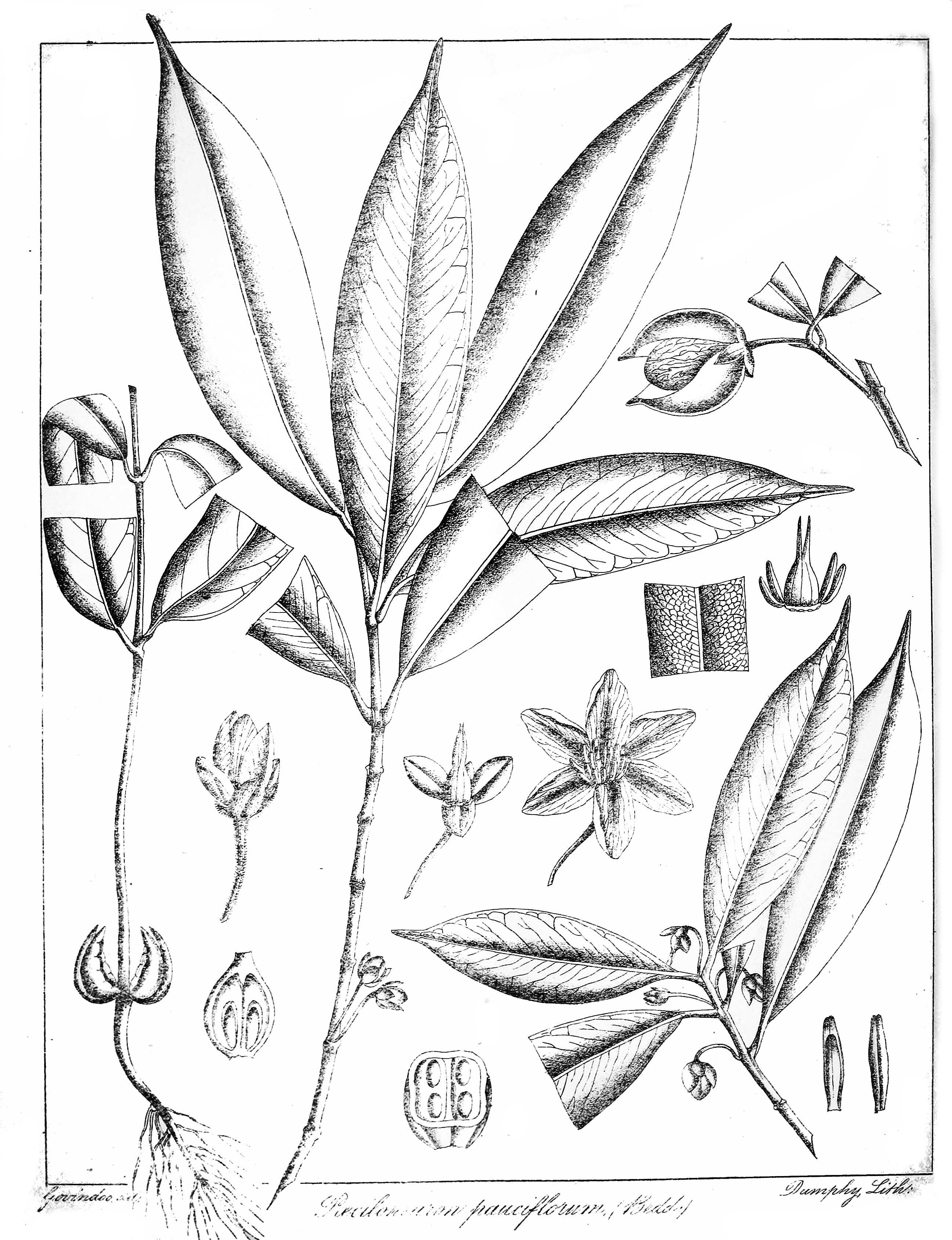
Agasthiyamalaia is a monotypic genus of flowering tree in the family Calophyllaceae (sometimes placed in Clusiaceae), erected in 2007 to accommodate a single species endemic to the southern Western Ghats of India. The genus belongs to the order Malpighiales and was established by S. Rajkumar and M.K. Janarthanam in the Journal of the Botanical Research Institute of Texas.
The sole species, Agasthiyamalaia pauciflora, was originally described as Poeciloneuron pauciflorum by the British botanist Richard Henry Beddome in the 19th century. It is a tree recorded historically from the Travancore and Tirunelveli regions, corresponding to present-day Kerala and Tamil Nadu states. The species epithet pauciflora is Latin for "few-flowered," describing its sparse inflorescences.
Very little is known about the living tree's morphology or ecology in detail. It was split from the related genus Poeciloneuron (which also includes Poeciloneuron indicum, another Western Ghats endemic) based on distinct morphological characters. However, the species has not been reliably recorded in the wild since the 19th century, making it one of India's rarest and most poorly known trees.
The genus is named after the Agasthyamalai Hills (also known as the Ashambu Hills), the part of the southern Western Ghats where the tree is endemic. Both the genus and its sole species are considered Critically Endangered under IUCN Red List criteria, and a tissue-culture-based species recovery program has been initiated in India.
Sources used: Wikipedia, GBIF, iNaturalist, Semantic Scholar
Etymology
The genus name Agasthiyamalaia refers to the Agasthyamalai Hills (Agasthiyamala Biosphere Reserve) in the southern Western Ghats of India, where this tree is endemic. The specific epithet pauciflora is Latin for "few-flowered," describing the plant's sparse flowering habit. The basionym author Beddome is Richard Henry Beddome (1830–1911), a British naturalist who served as the first conservator of forests in the Madras Presidency and described many plants of the Western Ghats.
Sources used: Wikipedia, Semantic Scholar
Distribution
Agasthiyamalaia pauciflora is endemic to a highly restricted range in the Agasthyamalai Hills of the southern Western Ghats, straddling the border of Kerala and Tamil Nadu states in southwestern India. Historical records from the 19th century place it in the Travancore and Tirunelveli districts. The species has not been reliably recorded in the wild since that time, and its current population status in the field is unknown — it may persist at very low numbers or be effectively extinct in the wild.
Sources used: Wikipedia, GBIF
Ecology
Almost nothing is documented about the ecology of this species. It is a tree associated with the evergreen and semi-evergreen forests of the southern Western Ghats, a global biodiversity hotspot. Like its former congener Poeciloneuron indicum, it is likely a canopy or sub-canopy tree of mid-elevation wet forests, but no modern field studies of its habitat preferences, phenology, pollination, or dispersal exist. The absence of any confirmed wild records since the 19th century means its ecological role in the forest community remains unknown.
Sources used: Wikipedia
Conservation
Agasthiyamalaia pauciflora is listed as Critically Endangered (CR) on the IUCN Red List. It has not been recorded in the wild since the 19th century, and its known range is extremely restricted. A species recovery program involving mass multiplication through tissue culture has been initiated by the Department of Biotechnology at Gauhati University, New Delhi, with the aim of producing plants for reintroduction. The species epitomises the conservation crisis facing many narrow endemics of the Western Ghats, where habitat loss and the extremely small population sizes of range-restricted species place them at severe risk of extinction.
Sources used: Wikipedia, iNaturalist
Taxonomy Notes
Agasthiyamalaia was established as a new monotypic genus by S. Rajkumar and M.K. Janarthanam in 2007 (published in the Journal of the Botanical Research Institute of Texas, volume 1, issue 1, page 131). It was erected to accommodate Poeciloneuron pauciflorum Bedd., which the authors determined was morphologically distinct enough from Poeciloneuron indicum — the type species of Poeciloneuron — to warrant its own genus.
The family placement is unsettled: GBIF places the genus in Clusiaceae at the genus level but the species in Calophyllaceae at the species level. This reflects a broader taxonomic debate — the Angiosperm Phylogeny Group (APG) systems have variously treated Calophyllaceae as a distinct family or as part of a broadly circumscribed Clusiaceae (alternatively known as Guttiferae). Both treatments are encountered in the literature. The genus is unambiguously placed within the order Malpighiales under either classification.
Sources used: GBIF, Semantic Scholar

