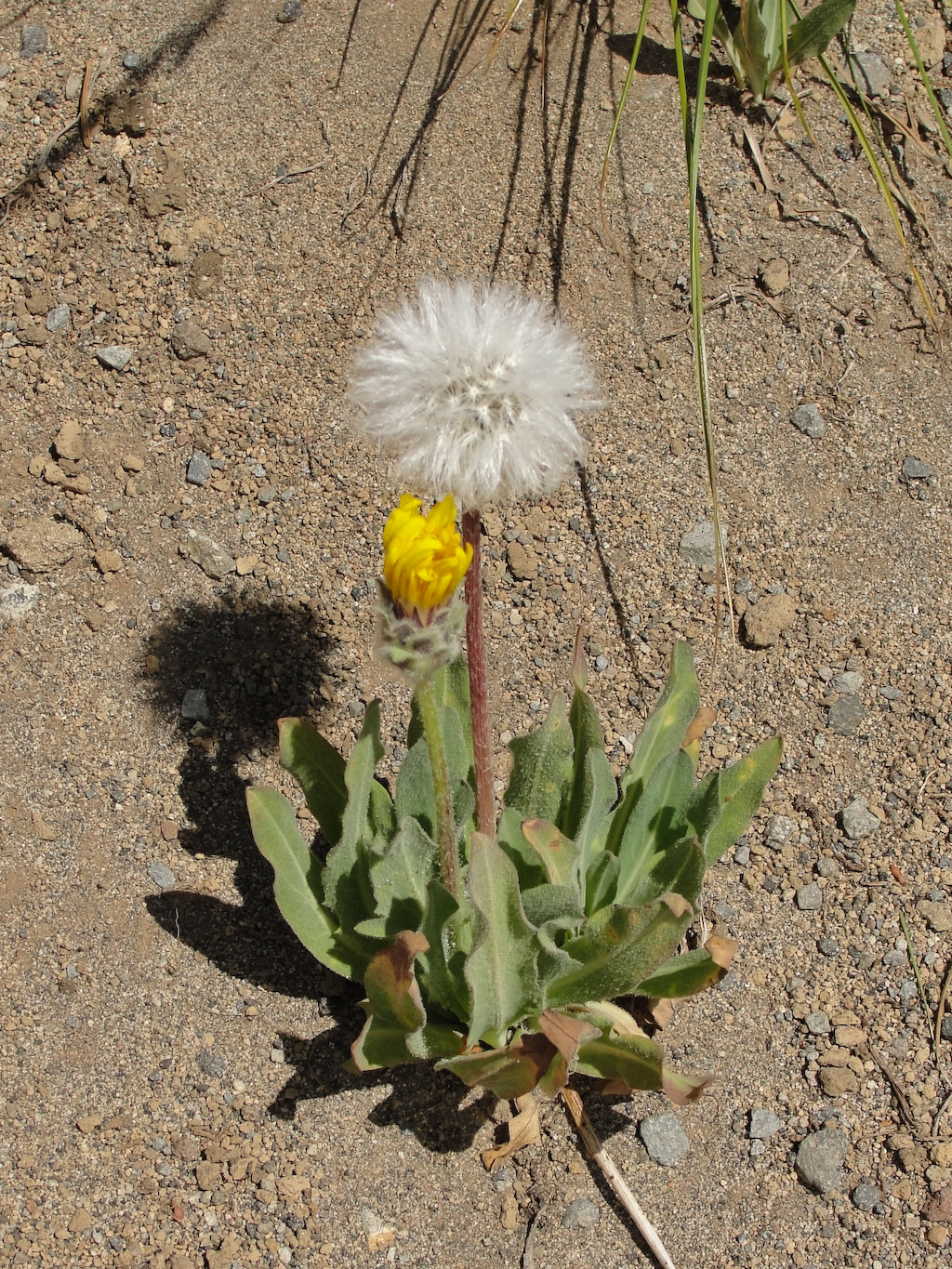
Agoseris is a small genus of annual or perennial herbs in the daisy family (Asteraceae), placed in the order Asterales. It was formally described as a genus by the American botanist Constantine Samuel Rafinesque in 1817. The genus comprises roughly a dozen accepted species, with centers of diversity in western North America and a disjunct occurrence in southern South America.
In general appearance, Agoseris closely resembles dandelions (Taraxacum) and is commonly known by the names mountain dandelion or false dandelion. Like dandelions, the plants are largely or entirely stemless, with leaves arranged in a basal rosette. They produce milky sap and send up several unbranched, stem-like flowering stalks (peduncles), each bearing a single erect flower head composed entirely of strap-shaped (ligulate) florets. The flower heads mature into a globe-shaped seed head of beaked achenes, each tipped with a pappus of numerous white bristles that aids in wind dispersal.
The genus occupies a wide range of open habitats across the Americas — from coastal bluffs and grasslands to alpine meadows and steppe. The distribution is notable for its New World amphitropical pattern: most species are found in the cordilleran mountain systems of western North America, but one species (Agoseris coronopifolia) extends through the southern Andes to Patagonia, Tierra del Fuego, and the Falkland Islands.
Notable members in the genus include Agoseris grandiflora (grassland agoseris) of the Pacific Coast ranges, Agoseris heterophylla (annual agoseris) widespread across western North America, and Agoseris glauca (prairie agoseris) distributed from Alaska to New Mexico. Several hybrid taxa are also recognized within the genus.
Etymology
The genus name Agoseris was coined by Constantine Samuel Rafinesque in his 1817 work Florula Ludoviciana (Fl. Ludov. 58). The common names mountain dandelion and false dandelion reflect the genus's close superficial resemblance to true dandelions (Taraxacum), though Agoseris is a distinct lineage within the tribe Cichorieae of Asteraceae.
Distribution
Agoseris has a New World amphitropical distribution, occurring in temperate regions of both North and South America with a large gap in between. Most species are found in cordilleran regions of western North America, ranging from the southern Yukon Territory and the Alaska Panhandle south to northern Baja California, Arizona, and New Mexico, and from the Pacific coast east to the northern Great Plains. Isolated populations also occur on the Gaspé Peninsula and Otish Mountains of Quebec, near Hudson Bay in Ontario, and on hills near the Arctic Ocean in the Northwest Territories. One species (Agoseris coronopifolia) is native to the southern Andes of Argentina and Chile, extending south through Patagonia and Tierra del Fuego to the Falkland Islands.
Ecology
Agoseris species occupy a broad range of open, often dry or montane habitats including coastal scrub, prairie grasslands, sagebrush steppe, and alpine meadows. The wind-dispersed beaked achenes with white pappus bristles are well adapted for colonizing disturbed and open terrain. The genus frequently grows alongside other members of Asteraceae in meadow and grassland communities throughout the American West.










