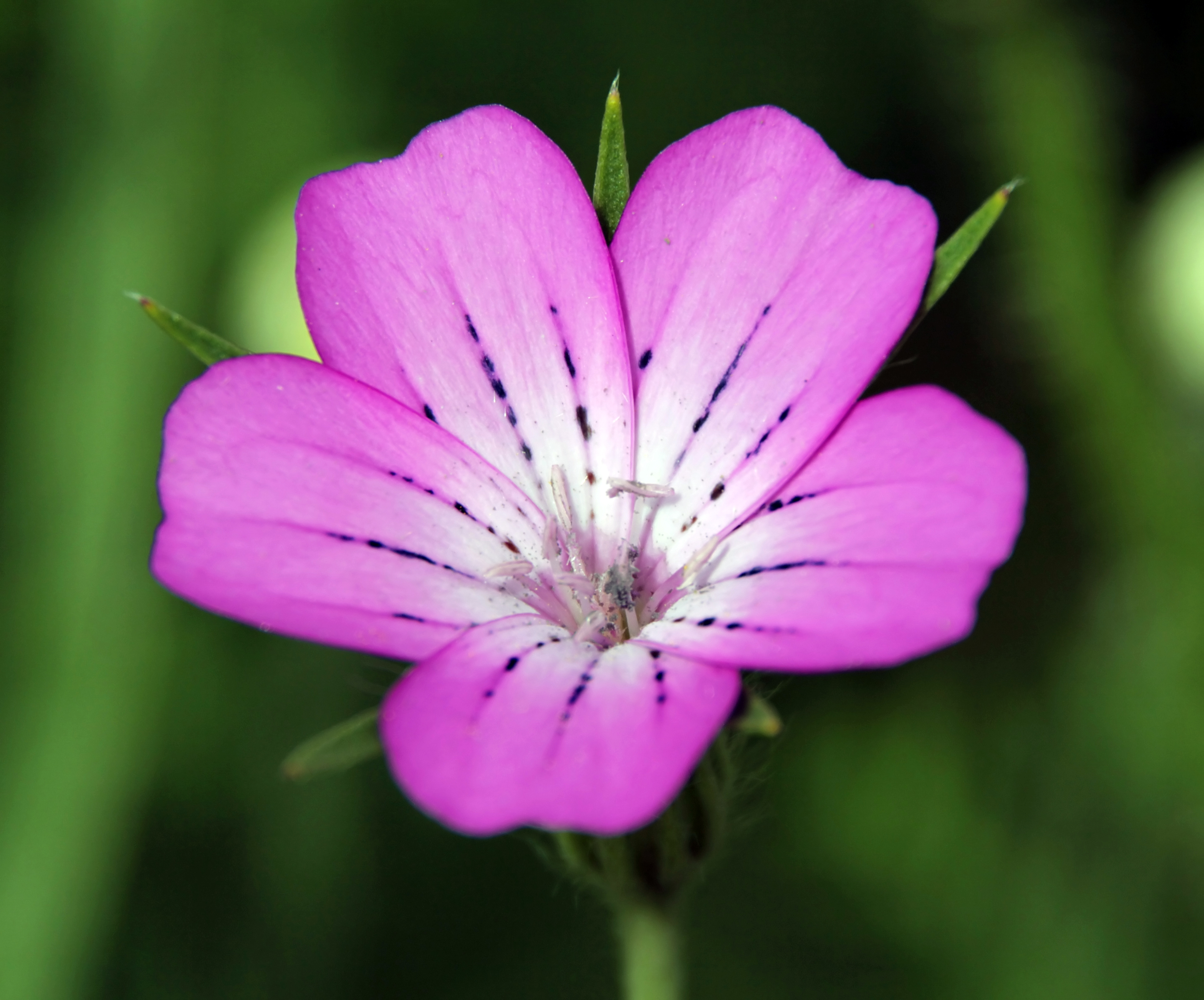
Agrostemma is a genus of annual herbs in the pink family (Caryophyllaceae), order Caryophyllales, containing the species known as corncockles. The genus comprises two species: Agrostemma githago (common corncockle) and Agrostemma brachyloba (narrow corncockle). Published by Linnaeus in 1753, the name derives from Greek agros (field) and stemma (garland or crown), alluding to the flowers' historical use in garlands.
Plants have stout taproots and simple or branched, terete stems. Leaves are connate proximally into a sheath, sessile, linear to narrowly lanceolate with acute apices, with one or obscurely three veins. The inflorescences are terminal, in lax cymes or solitary axillary flowers. The flowers are bisexual (rarely unisexual and pistillate), with sepals connate into a tube 25–62 mm long, 10-veined, cylindric to ovoid, and five long, narrow sepal lobes often exceeding the petals. Petals are five, purplish-red to white, clawed, and in A. githago each bears two or three discontinuous black lines. Stamens are ten; styles number four or five, clavate, 10–12 mm, with dense ascending hairs. The fruit is an ovoid capsule opening by four or five ascending teeth, containing approximately 30–60 black, reniform, laterally compressed, tuberculate seeds. The chromosome base number is x = 12.
The best-known species, A. githago, grows with erect, finely hairy stems to 100 cm, bearing opposite, pale green, narrowly lanceolate leaves 45–145 mm long held nearly erect against the stem. Its scentless, deep pink to purple flowers are 25–50 mm across, produced in summer. All parts of the plant are poisonous, containing githagin (ribosome-inactivating proteins) and saponins.
Historically a very common weed of European cereal fields, corncockle seeds were inadvertently harvested and resown with wheat for centuries. Improved seed-cleaning techniques and the shift to winter wheat have caused dramatic declines in its native European range, though it persists as an introduced species across temperate regions worldwide including North America, Australia, and New Zealand.
Etymology
The genus name Agrostemma derives from Greek agros (ἀγρός) meaning "field" and stemma (στέμμα) meaning "garland" or "crown," alluding to the use of the flowers in garlands. The common name "corncockle" reflects the plant's historical association as a weed of corn (cereal) fields.
Distribution
Agrostemma is native to Eurasia, with a probable centre of origin in the eastern Mediterranean. It has been introduced worldwide as a contaminant of cereal seed and now occurs as an alien species throughout much of temperate North America (United States and parts of Canada), Australia, and New Zealand. In its native European range, the genus has declined sharply due to intensive mechanized farming, winter wheat sowing, and improved seed cleaning; it is now uncommon or locally distributed and was believed extirpated in the United Kingdom until a single specimen was rediscovered in 2014.
Ecology
Agrostemma species are weeds of cereals and other crops, historically abundant in European wheat fields where their seeds were harvested and resown with the grain. The plants favour disturbed ground including fields, roadsides, railway lines, and waste places. Agrostemma githago is susceptible to downy mildew caused by the oomycete Peronospora agrostematis. The decline in native European populations is attributed to the shift to autumn-sown winter wheat (harvested before corncockle flowers or sets seed) and modern seed-cleaning practices.
Cultivation
Corncockle seeds remain commercially available to gardeners, valued for the plant's attractive deep pink to purple flowers. It is an annual easily grown from seed. Historically, corncockle persisted for at least four years as a garden waif in Boulder, Colorado, where Agrostemma brachyloba was reported escaping cultivation.
Taxonomy
The genus Agrostemma was published by Linnaeus in Species Plantarum 1: 435 (1753) and Genera Plantarum ed. 5, 198 (1754). It contains two species: Agrostemma githago L. (common corncockle) and Agrostemma brachyloba Hammer (narrow corncockle). Agrostemma gracile is a synonym of A. brachyloba. The genus belongs to the family Caryophyllaceae and is distinguished by its connate calyx tube with ten veins, five long sepal lobes often exceeding the petals, and capsules dehiscing by ascending teeth. The two species are separated by calyx lobe length relative to the tube (longer in A. githago, shorter in A. brachyloba) and petal spotting (spotted in A. brachyloba).
History
In the 19th century, Agrostemma githago was reported as a very common weed of European wheat fields, and its seeds were inadvertently included in harvested wheat and resown the following season. It is likely that until the 20th century, most wheat contained some corncockle seed. The plant's decline across Europe in the 20th century marks a significant shift in agricultural ecology driven by mechanization and improved seed-cleaning technology.
Cultural Uses
Despite its toxicity, Agrostemma githago has been used in folk medicine. Recent scientific research has investigated its biological activities, including cytotoxic effects on cancer cells, protective properties against oxidative stress, inhibition of Leishmania major culture growth, suppression of protein synthesis, and antiviral, anti-angiogenic, and cholesterol-lowering activities. All parts of the plant are poisonous, containing githagin (ribosome-inactivating proteins) and saponins.










