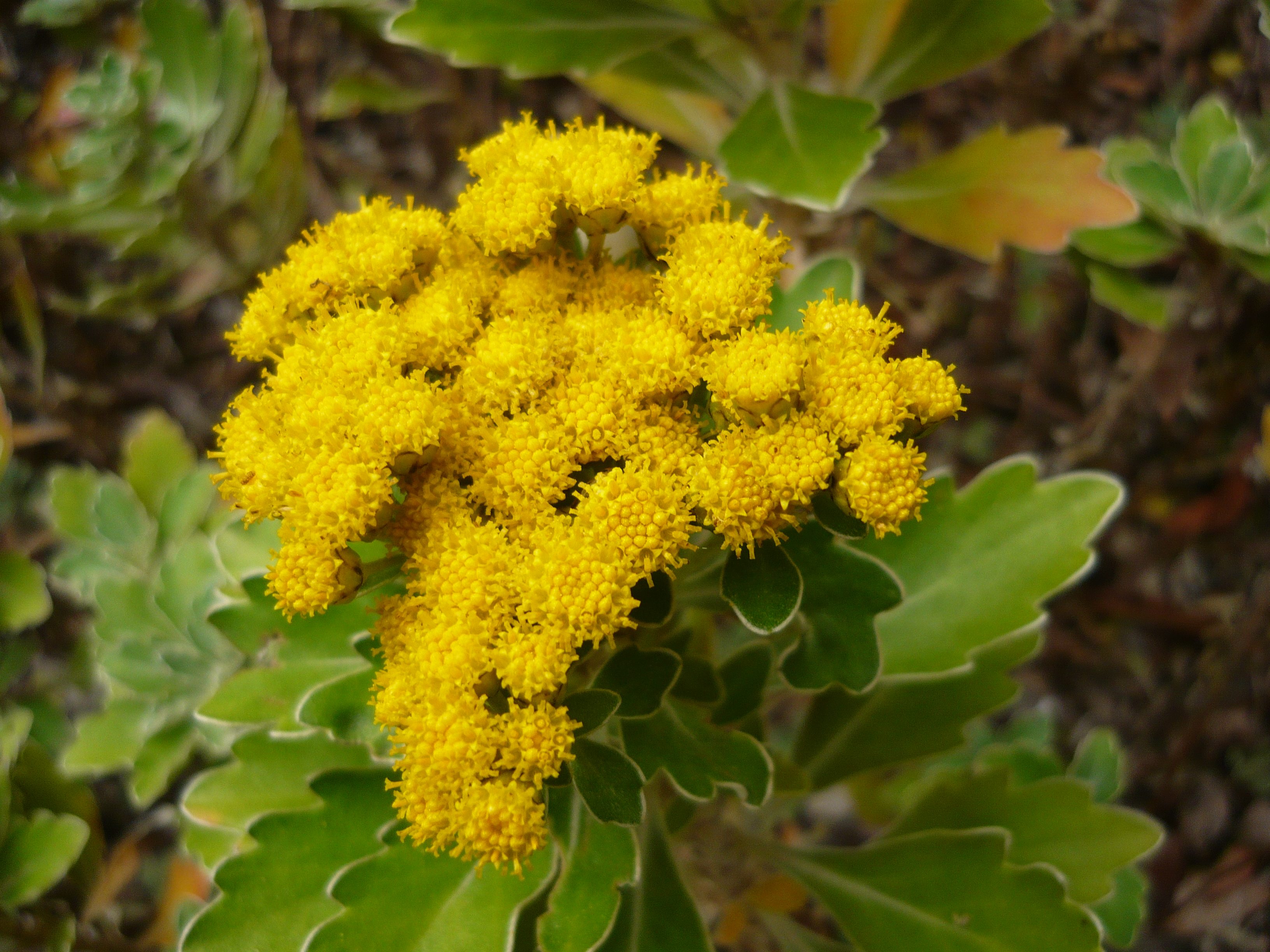
Ajania is a genus of perennial herbs and small subshrubs in the daisy family (Asteraceae), described by Poljakov in 1955. It is native to temperate Asia, with its centre of diversity in China, where 35 of the roughly 34–43 species are found, 23 of them endemic. The leaves are alternate, pinnately or palmate-pinnately divided, and serrate (rarely entire). The inflorescences are cymose and typically flat-topped, bearing heterogamous disciform capitula with campanulate or cylindric involucres of phyllaries in 4–5 rows. The florets are predominantly yellow (rarely purple): marginal florets are female with a narrowly tubular, 2–5-denticulate corolla, while the central disk florets are bisexual and 5-lobed. The achenes are obovoid with 4–6 ribs or striae and lack a corona (pappus). A well-known ornamental species is Ajania pacifica (Pacific chrysanthemum, formerly Chrysanthemum pacificum), a low-growing subshrub with silver-edged foliage and bright yellow button-like flower heads, valued as a drought-tolerant groundcover.
Etymology
The genus Ajania is named after Ayan, a Russian port city on the Sea of Okhotsk coast in the Khabarovsk Krai region of the Russian Far East.
Distribution
Ajania is native to temperate Asia, primarily Russia and China. The Flora of China records 35 species in China, of which 23 are endemic, with the remainder extending into Mongolia, Central Asia, and the Russian Far East.
Taxonomy Notes
The genus was described by Poljakov in 1955 (Bot. Mater. Gerb. Bot. Inst. Komarova Akad. Nauk S.S.S.R. 17: 419). Its synonym is Phaeostigma Muldashev. Members of Ajania were formerly placed in Chrysanthemum and Tanacetum; the genus is distinguished by its disciform capitula, epaleate receptacle, and achenes lacking a corona. As of August 2020, Kew's Plants of the World Online accepts 43 species.










