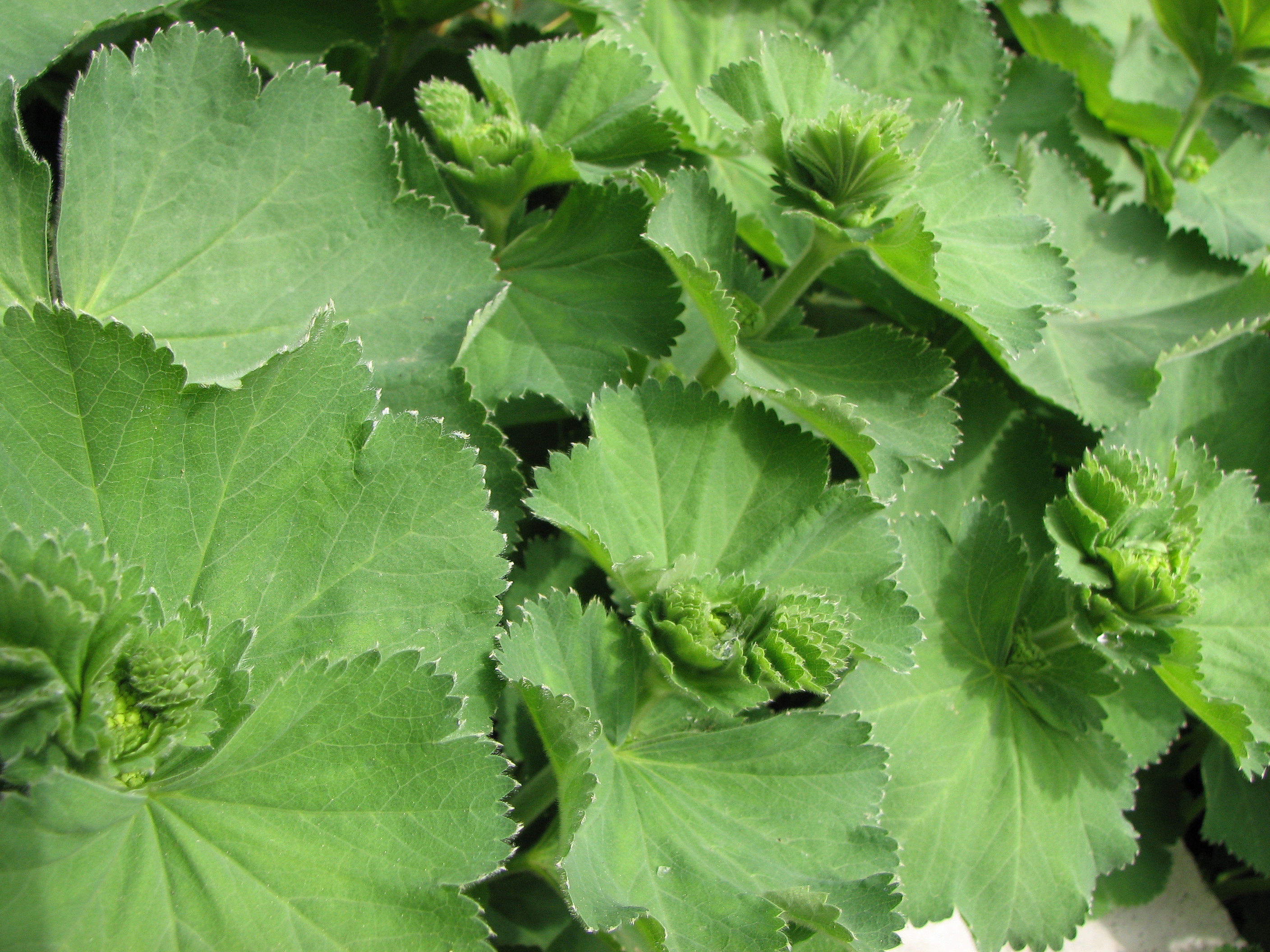
Alchemilla is a large genus of herbaceous perennial plants in the rose family (Rosaceae), encompassing approximately 700 species. The genus was formally described by Linnaeus in 1753, published in Species Plantarum (2: 123). Plants are characteristically clump-forming or mounded in habit, typically growing around 20 cm tall. The leaves are fan-shaped with small teeth at the tips and display a striking water-resistance — droplets bead up and roll across the leaf surface, a phenomenon long observed by herbalists and alchemists. Flowers are small, lacking petals entirely, and range from green to bright chartreuse; they are borne in loose, openly branched cymose clusters above the foliage in late spring and summer. The fruit is a small achene enclosed within a persistent hypanthium.
The majority of species are native to cool temperate and subarctic regions of Europe and Asia, with additional species occurring in the mountains of Africa and the Americas, including a presence in South America. In Europe the genus is especially diverse, with over 150 species and aggregate groups documented in the Swiss flora alone. The hypanthium is ellipsoid to turbinate or campanulate and permanently encloses the ovary; sepals typically number four and spread or ascend; petals are absent.
Common names include "lady's mantle," applied broadly to the genus and specifically to Alchemilla mollis in horticultural contexts. The genus has long been associated with traditional medicine and folk herbalism across Europe, particularly for gynaecological and wound-healing applications.
Etymology
The genus name Alchemilla derives from the Arabic word alkemelyeh, referring to the alchemical properties attributed to the water droplets that collect and bead on the leaves. Medieval alchemists collected this dew and believed it to have purifying or transformative properties. The English common name "lady's mantle" alludes to the shape of the lobed, pleated leaves, which were compared to the scalloped edge of a lady's cloak or mantle in medieval Europe.
Distribution
Alchemilla is distributed primarily across cool temperate and subarctic regions of Europe and Asia, where the greatest species diversity is found. The genus also extends into mountainous regions of Africa and the Americas. In Europe it is particularly well represented: Switzerland alone records more than 150 species and aggregate groups, including complex species aggregates such as Alchemilla alpina aggr. and Alchemilla vulgaris aggr. African species (e.g., A. abyssinica, A. elgonensis) occur in Afroalpine zones, while North American and South American populations are documented in montane habitats. GBIF records confirm presence in the flora of Brazil, extending the genus's range into South America.
Ecology
Alchemilla species inhabit meadows, pastureland, and woodland clearings, typically on acidic soils. The genus is strongly associated with cool, moist conditions and is common in subalpine and alpine grasslands throughout Europe. Plants are rhizomatous perennial herbs and are well adapted to disturbed and grazed habitats; they are notably resistant to rabbit grazing. The water-resistant leaf surface causes rain and dew to form spherical droplets that roll off the foliage — an adaptation sometimes interpreted as reducing leaf-surface pathogens. Species occur across a wide elevational range, from lowland meadows to high mountain zones in both the Old and New Worlds.
Cultivation
Alchemilla thrives in ordinary, well-drained, slightly acidic soil in full sun to partial shade. It tolerates heavy clay soils and performs well even in dry shade, making it a versatile ground-cover and border plant. Plants grow to approximately 20 cm tall and wide at a moderate pace. The genus is widely used in temperate gardens, particularly Alchemilla mollis, valued for its soft chartreuse flower sprays and water-beading leaves as ornamental features. Suitable applications include alpine gardens, perennial borders, containers, rock gardens, and ground cover. Plants are hardy to USDA zones 3–7 (UK hardiness zone 5) and require little maintenance once established.
Propagation
Seeds can be sown indoors in spring and germinate within 3–4 weeks at 16°C. Seedlings should be potted individually and overwintered in a cold frame before transplanting outdoors in late spring. Division of established clumps is the more common method and can be carried out in spring or autumn. Many species also self-seed freely in garden conditions.
Uses
Alchemilla has a long history of use in European herbal medicine. Alchemilla xanthochlora and Alchemilla vulgaris are both used medicinally and as herbal teas. Therapeutically, the genus is regarded as alterative, antirheumatic, astringent, diuretic, emmenagogue, febrifuge, sedative, styptic, tonic, and vulnerary. Primary applications include wound healing (both internal and external), treatment of diarrhea, and management of menstrual irregularities and menopausal symptoms. The high tannin content makes it an effective astringent and styptic. Fresh juice has been applied to treat acne and other skin conditions; diluted decoctions are used for eye inflammation.
Young leaves are edible raw or cooked, though with a dry, somewhat astringent flavour. Historically, leaves were mixed with bistort (Persicaria bistorta) and smartweed species to make "Easter ledger," a bitter herb pudding consumed during Lent in northern England. Roots are also edible when cooked. Commercially, dried foliage is blended into herbal tea products.
Taxonomy
The genus Alchemilla was formally established by Linnaeus in 1753 (Sp. Pl. 2: 123). It belongs to family Rosaceae (order Rosales, class Magnoliopsida). The type species is Alchemilla vulgaris L. GBIF recognises 946 descendant taxa under this genus (as of August 2023). The genus is notoriously complex taxonomically: many species reproduce apomictically (without fertilisation), which has led to the recognition of hundreds of microspecies and numerous aggregate species groups. Synonymous generic names include Alchimilla, Aphanes, Lachemilla, Percepier, and Zygalchemilla. Not all authorities treat the genus at the same circumscription; some segregate Aphanes as a distinct genus.










