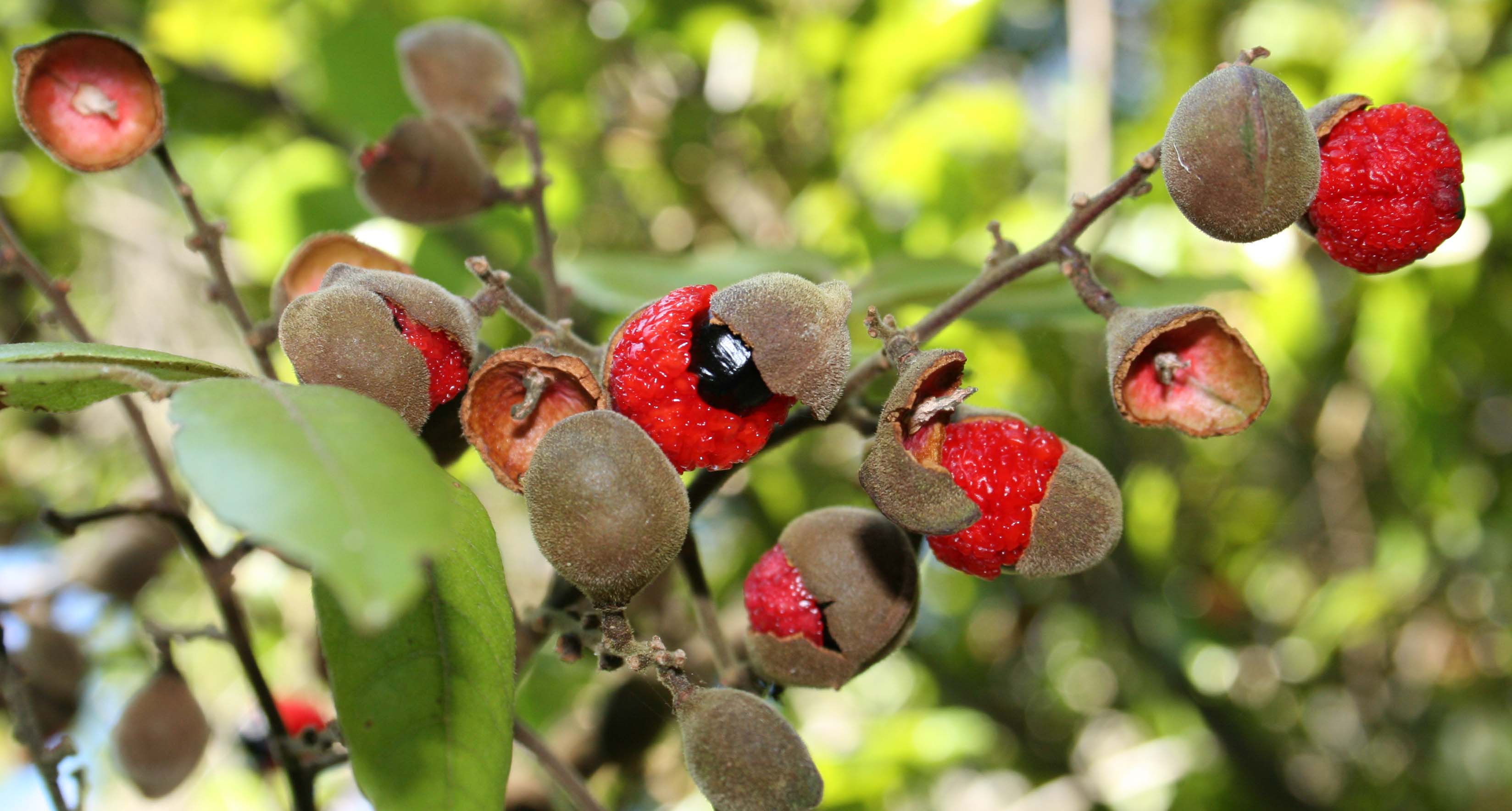
Alectryon is a genus of roughly 30 species of trees and shrubs belonging to the soapberry family Sapindaceae, order Sapindales. Plants range from low shrubs to trees reaching 30 metres in height. Their leathery leaves may be simple or pinnate, and small flowers are borne typically at the ends of stems. The most distinctive feature is the fruit: when ripe it splits open along a rough-edged seam to reveal a seed — often glossy black — nestled in a fleshy, brightly coloured (usually red) aril. These juicy arils are eagerly consumed by birds and other animals, making them the genus's primary seed-dispersal agents.
The genus is centred on mainland Australia, particularly the rainforests and monsoon tropics of eastern Queensland and New South Wales, which harbour 15 of the roughly 30 species, 12 of them found nowhere else. Broadening to the Sahul continent (Australia plus New Guinea and their continental islands), 21 species occur, 19 of them endemic. Beyond Australia the genus extends across Papuasia, Melanesia, western Polynesia, east Malesia and into Southeast Asia, with outlying species in New Zealand, Hawaii, Fiji, Samoa, Vanuatu, the Solomon Islands, New Caledonia, Indonesia and the Philippines. Members occupy a striking range of habitats — from lowland rainforests and gallery forests to coastal scrub, arid savannas and heaths.
Several species have conservation significance: Alectryon macrococcus of the Hawaiian Islands is IUCN Critically Endangered, while the southeastern Queensland endemic A. ramiflorus is listed as Endangered both globally and under Australian legislation. The New Zealand species A. excelsus (tītoki) is among the most widely recognised members of the genus.
Etymology
The name Alectryon derives from the Ancient Greek word for "rooster" (ἀλεκτρύων, alektryṓn), an allusion to the colourful fleshy aril surrounding the seed, which recalls the bright red wattle of a cockerel. The name was applied by the botanist Joseph Gaertner when he described the genus in 1788.
Distribution
Alectryon ranges across Australasia, Papuasia, Melanesia, western Polynesia, east Malesia and Southeast Asia. Mainland Australia — especially the rainforests of eastern Queensland and New South Wales and the monsoon tropics — is the global centre of diversity, with 15 species (12 endemic). The genus also occurs in New Guinea, the Solomon Islands, New Caledonia, New Zealand, Vanuatu, Fiji, Samoa, Hawaii, Indonesia and the Philippines.
Ecology
Species occupy a wide range of habitats, from lowland rainforests, gallery forests and coastal scrub to arid savannas and heaths. The fleshy red aril surrounding the seed attracts birds and other animals, which disperse seeds away from parent plants. This bird-mediated dispersal has likely facilitated the genus's spread across island chains of the Pacific and Southeast Asia.
Conservation
Alectryon macrococcus (ʻalaʻalahua) of the Hawaiian Islands is classified as Critically Endangered by the IUCN in both its varieties. In Australia, A. ramiflorus (Isis Tamarind), restricted to a very small area of southeastern Queensland, is listed as Endangered by the IUCN (1998) and under Australian and Queensland government legislation. A. repandodentatus, occurring in northeastern Queensland, the Torres Strait Islands and New Guinea, holds IUCN Vulnerable status and Queensland Endangered status. A. semicinereus of eastern Queensland is listed as Near Threatened by Queensland authorities.










