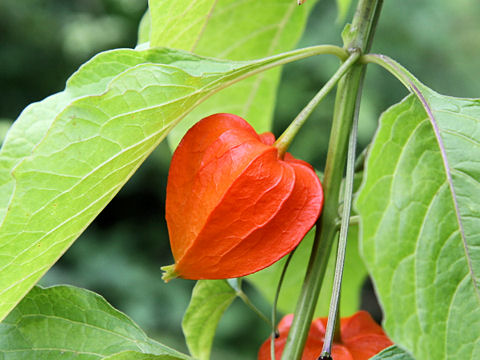
Alkekengi is a monotypic genus of flowering plants in the nightshade family Solanaceae, order Solanales. It contains a single species, Alkekengi officinarum, commonly known as the Chinese lantern, bladder cherry, or winter cherry. The genus was previously classified within Physalis until molecular and genetic evidence established it as a distinct lineage, with the North American Calliphysalis carpenteri as its closest relative.
The plant is a perennial herb reaching 40–80 cm tall, with slightly woody stems and spirally arranged ovate leaves 5–15 cm long. It is most readily identified by its distinctive fruiting structure: after flowering, the calyx inflates into a large, papery, bright orange to red lantern-shaped husk 2.5–5 cm long that encloses a shiny orange-red berry. The flowers are white with a greenish or yellowish center, rotate to bell-shaped, and 1–2 cm across. Two varieties are recognized: var. alkekengi with pubescent leaves and smaller fruiting calyces, and var. franchetii with smoother foliage and calyces exceeding 3 cm.
Native to Southern Europe through South Asia to Northeast Asia, the Chinese lantern has been widely cultivated as an ornamental in temperate regions and has naturalized beyond its range. It holds the Royal Horticultural Society's Award of Garden Merit and has a two-millennium history in traditional Chinese medicine, where it was used for fever, diuresis, and as a calming agent.
Etymology
The name Alkekengi derives from Arabic كَاكَنْج (kākanj), passed through Spanish alquequenje and French alkékenge. The plant was known in English as "alkakengie" as recorded by John Gerard in his 16th-century herbal.
Distribution
Alkekengi officinarum is native to a broad Eurasian range spanning Southern Europe, South Asia, and Northeast Asia. Widely cultivated as an ornamental in temperate regions worldwide, it has escaped cultivation and become naturalized in various parts of the world outside its native range.
Ecology
A hardy perennial tolerant of temperatures below −20 °C, the species can become invasive through its wide-spreading root system, which sends up new shoots at a distance from the parent plant. It has naturalized in many temperate regions where it is cultivated. The fruit is edible and provides forage for wildlife.
Cultivation
The Chinese lantern is widely grown as an ornamental for its decorative papery calyces, which are often used in dried flower arrangements. It is extremely hardy (to below −20 °C) and thrives in temperate climates. Care should be taken to contain its spreading root system, as it can become invasive in garden settings. The Royal Horticultural Society has conferred its Award of Garden Merit on this species.
History
Alkekengi officinarum (as Physalis alkekengi) has been used in traditional medicine for approximately two thousand years. Ancient Chinese texts including the Erya and Shen Nong Ben Cao Jing recorded its use for fever, mental tranquility, and childbirth. Li Shizhen's Ming dynasty Compendium of Materia Medica further documented its applications for reducing heat, boosting energy, and promoting diuresis; the juice was also considered a treatment for jaundice. In Europe, the English herbalist John Gerard described the plant as "red winter cherries" in his 1597 herbal, noting its garden cultivation and medicinal use.
Taxonomy
Alkekengi was formerly placed within the genus Physalis (as Physalis alkekengi Linnaeus, 1753). Molecular phylogenetic studies demonstrated that this lineage is sister to the North American Calliphysalis carpenteri and only distantly related to core Physalis, supporting its recognition as a distinct monotypic genus. This taxonomic revision is now accepted by major taxonomic authorities including GBIF.

